

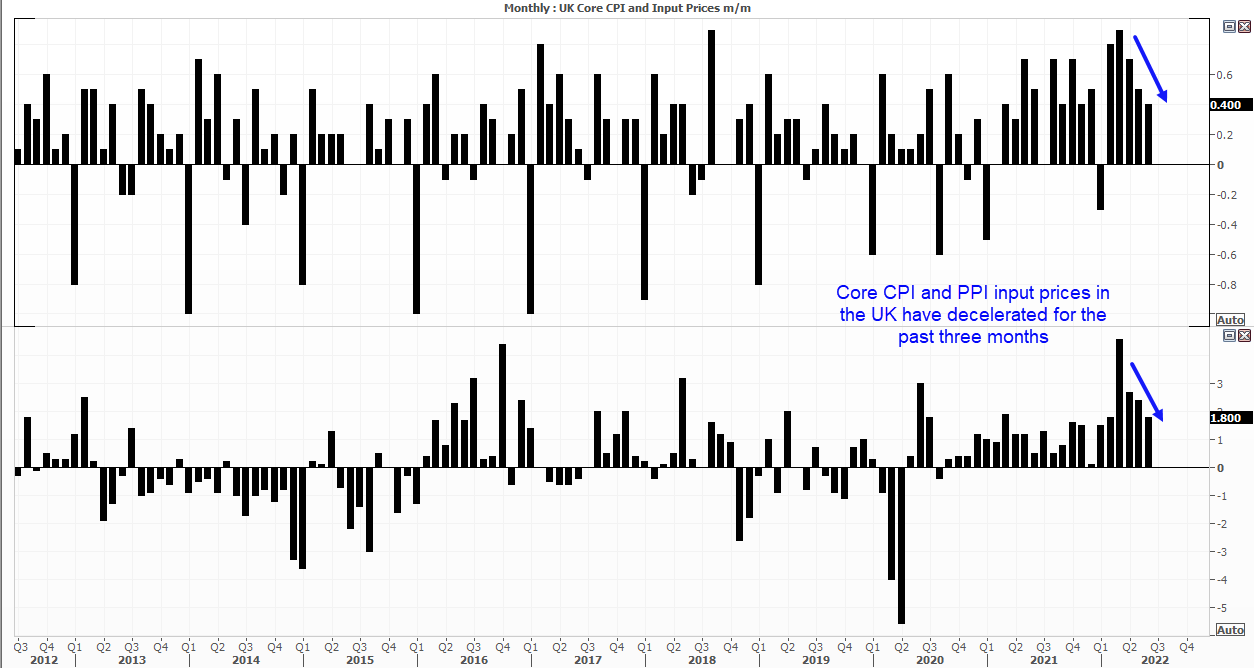


Early signs of (dis)inflation continue to appear
Whilst inflation has been hard to ignore, we are now seeing signs that the cooling of inflationary forces are finally showing up in some consumer prices.
Share this:

Whilst it is the annual rate of change (yy) that central targets monitor, any healthy change in the annual rate should first occur at the monthly rate (mm). It is therefore worth noting that some metrics of inflation have either seen the monthly reads rise at a slower rate or even contract (deflate). This also coincides with some measures of annualised inflation pulling back.
A host of inflation data was released for the UK and Canada today, and there are some promising signs. UK producer input prices slowed to 1.8% m/m, which is the third consecutive month of disinflation (slower rate of growth). Core CPI also slowed to 0.4% m/m which is also its third straight month of disinflation.
Canada’s producer prices contracted -1.1% in June - its first contraction since August 2021 and at its fastest pace May 2020. Whilst the annualised rate peaking in April at 18.1% could be attributed to basing effects, it is encouraging to see the m/m PPI prints trending their way into contraction – so we’d expect a lower headline PPI going forward. And as producer prices are an input for consumer prices, it comes as good news for consumers further down the track.
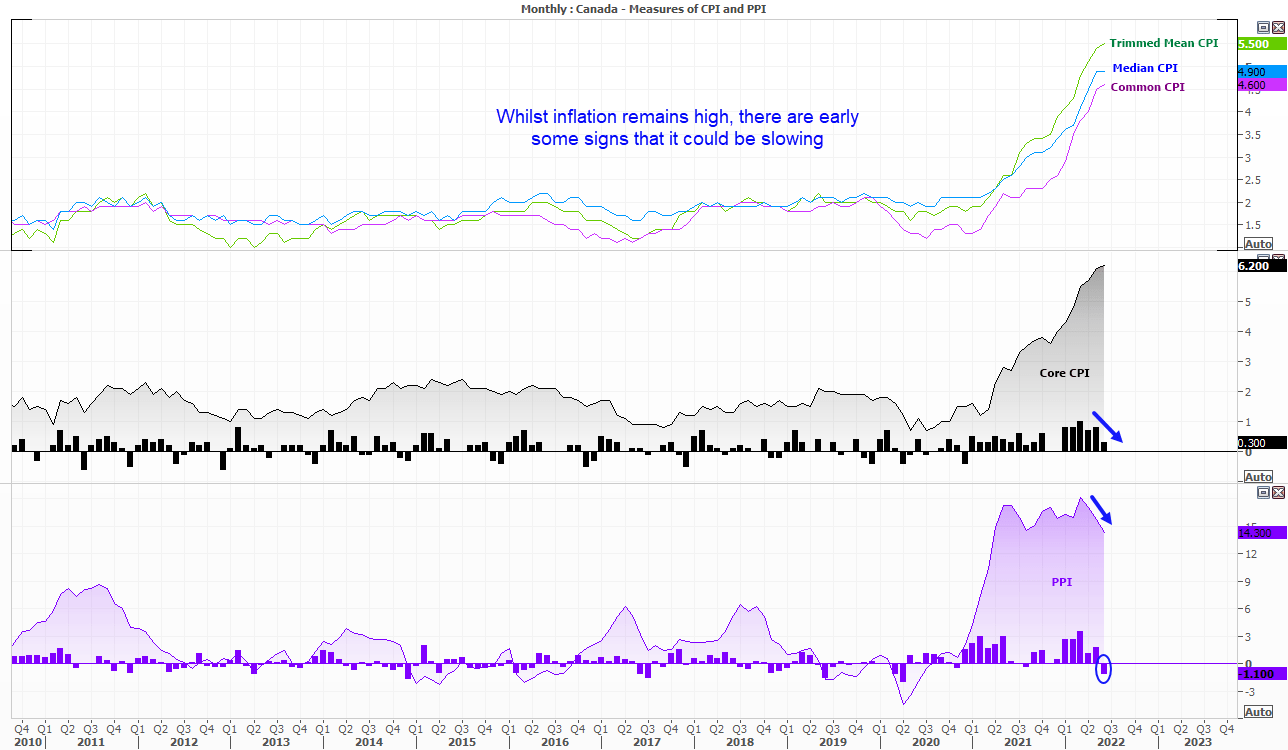
In fact Canada’s core CPI rose just 0.3% in June, its slowest rate of expansion this year. And like the PPI m/m read, it has been disinflating. We could therefore make the assumption that the core CPI y/y read is due to top out.
These subtle shifts help keep a lead on where central banks could be headed next
With that said, the BOC (Bank of Canada) pay closer attention to Trimmed mean, Median and Common CPI’s, which are less volatile prints of annualised inflation. And this gives us plenty of time to monitor the data accordingly and get ahead of the game.
Of course, today’s inflation sets are not likely to deter the BOE or BOC from hiking rates at their next meeting. And the BOC are likely to remain one of the more hawkish banks in town. But investors who prefer to see where the central banks are headed and not where they currently are, they’ll pay close attention to the subtle shifts on the m/m rates and (re)invest accordingly.
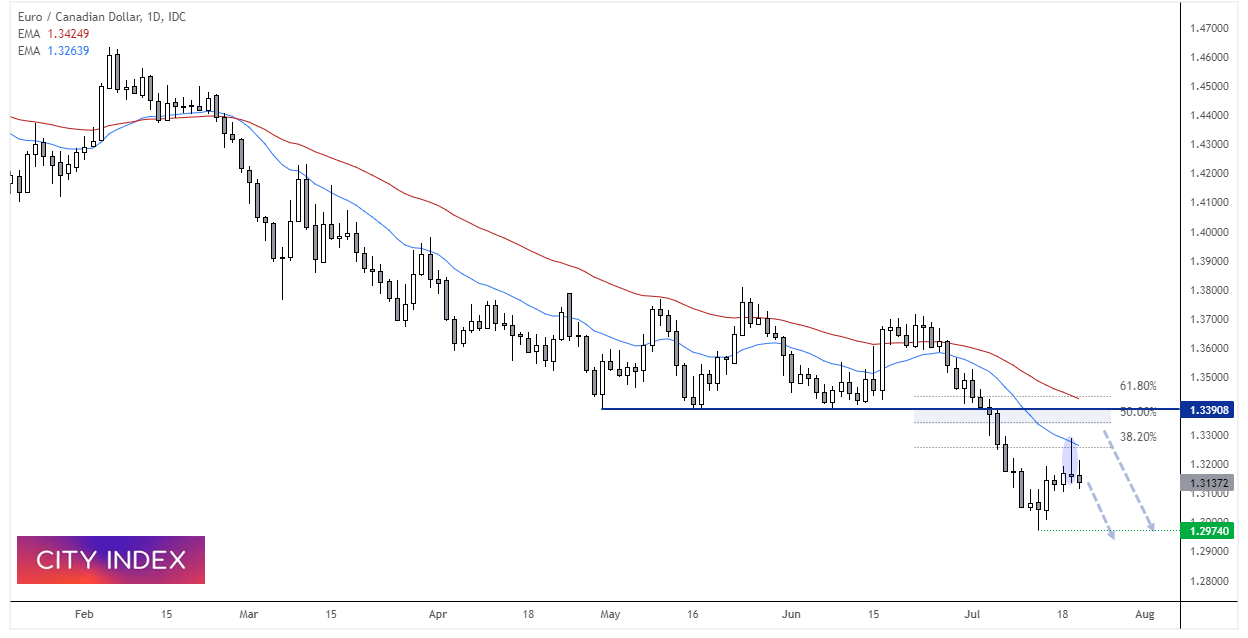
EUR/CAD daily chart:
The ECB meet tomorrow and there has been some excitement over a potential 50-bp hike. For them to really surprise markets we’d need to see a hawkish hike where they announce x 50 or even a 75-bp hike in the foreseeable future. For that reason I see the potential for some disappointment, and a weaker euro afterwards.
EUR/CAD remains in a strong downtrend on the daily chart and it has retraced against that trend. A bearish pinbar formed yesterday and respected the 20-day eMA, and 38.2% Fibonacci level. Perhaps the high is in and prices can now head back to the 1.3000 lows. Should prices instead recycle higher, the near-term bullish bias is towards the 1.3390 resistance zone, at which point we’d reconsider shorts if the technicals and fundamentals align.
How to trade with City Index
You can easily trade with City Index by using these four easy steps:
- Open an account, or log in if you’re already a customer
• Open an account in the UK
• Open an account in Australia
• Open an account in Singapore
- Search for the company you want to trade in our award-winning platform
- Choose your position and size, and your stop and limit levels
- Place the trade
How to trade with FOREX.com
Follow these easy steps to start trading with FOREX.com today:
- Open a Forex.com account, or log in if you’re already a customer.
- Search for the pair you want to trade in our award-winning platform.
- Choose your position and size, and your stop and limit levels.
- Place the trade.
Related tags:


Open an account in minutes
Experience award-winning platforms with fast and secure execution.
Economic calendar
Web Trader platform
Our sophisticated web-based platform is packed with features.
Related articles
China's steel slump leaves iron ore bulls under the pump
Iron ore has broken major support, threatening a return to the lows of 2022 as mounting evidence of weakness in China's steel sector reinforces the bearish outlook.

NZD/USD Forecast: Kiwi faces historic breakdown as RBNZ survey looms
NZD/USD is teetering above support that held through the pandemic and Liberation Day turmoil. With RBNZ hawks repeatedly disappointed, today's inflation expectations survey could open the door to a slide towards the GFC lows.

USD/JPY, AUD/JPY: Central Bank Divergence Creates Two-Way Risk
USD/JPY eyes a breakout above 160, while AUD/JPY faces further losses as Fed, RBA and BoJ interest rate expectations diverge.
StoneX Financial Ltd (trading as "FOREX.com") is an execution-only service provider. This material, whether or not it states any opinions, is for general information purposes only and it does not take into account your personal circumstances or objectives. This material has been prepared using the thoughts and opinions of the author and these may change. However, FOREX.com does not plan to provide further updates to any material once published and it is not under any obligation to keep this material up to date.
This material is short term in nature and may only relate to facts and circumstances existing at a specific time or day. Nothing in this material is (or should be considered to be) financial, investment, legal, tax or other advice and no reliance should be placed on it. No opinion given in this material constitutes a recommendation by FOREX.com or the author that any particular investment, security, transaction or investment strategy is suitable for any specific person.
The material has not been prepared in accordance with legal requirements designed to promote the independence of investment research. Although FOREX.com is not specifically prevented from dealing before providing this material, FOREX.com does not seek to take advantage of the material prior to its dissemination. This material is not intended for distribution to, or use by, any person in any country or jurisdiction where such distribution or use would be contrary to local law or regulation. For further details see our full non-independent research disclaimer and quarterly summary.