



Yields in renewed weakness amid plethora of central banks meetings
The message has been clear: global interest rates will remain at or near record lows for the foreseeable future.
Share this:

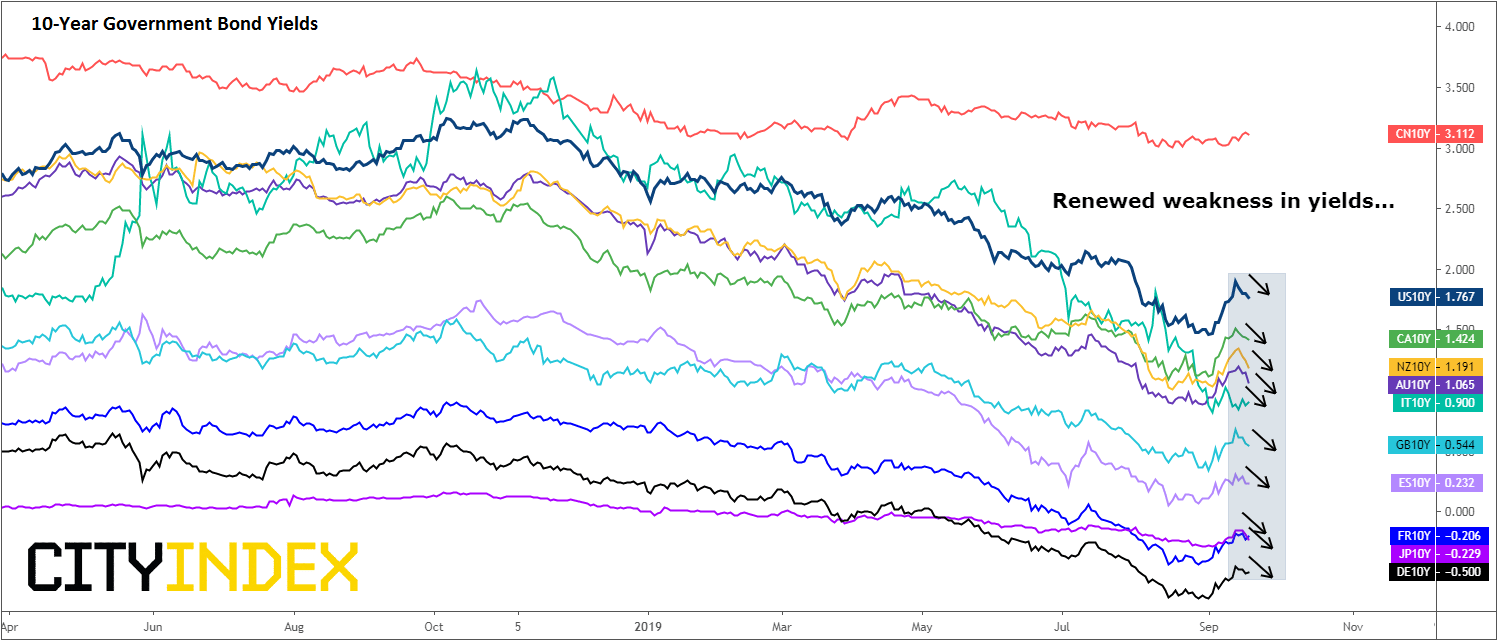
Over the past 24 hours or so, we have seen lots of central bank action (or inaction) and the message has been clear: global interest rates will remain at or near record lows for the foreseeable future. For that reason, yields have come under renewed pressure (see the chart below). This is helping to keep equity indices supported and near record levels in the case of the US, keeping the bears at bay despite raised geopolitical tensions and concerns over global demand hurting company earnings.
Source: Trading View and City Index.
This week’s main event was the Federal Reserve’s rate decision last night. As widely expected - and much to the displeasure of US President Donald Trump - the Fed did indeed cut interest rates by 25 basis points for the second consecutive meeting. There were three dissenters with Rosengren and George voting for no change again, while Bullard called for a larger 50 bps cut. But contrary to expectations, there was an element of a hawkish surprise as the so-called dot plots revealed a median view for a pause through to next year, rather than 2 more cuts expected. Still, it wasn’t hawkish enough to completely derail the rally on Wall Street.
The Bank of England was the latest major central to make a decision on interest rates today. “Shockingly,” it decided to leave its monetary policy unchanged. But it did strike a dovish tone, as it raised the prospects of a rate cut for the first time should Brexit uncertainty persists. The MPC said there was “entrenched uncertainty” over Brexit, which means “domestically generated inflationary pressure would be reduced”.
Elsewhere, the central bank of the world’s third largest economy disappointed some very hopeful expectations overnight despite exports falling there for the ninth consecutive month. The Bank of Japan decided to leave all policy settings unchanged, as widely expected. Its forward guidance was the same: extraordinary low policy to remain unchanged for an extended period at least through spring 2020.
In Hong Kong, the central bank decided to lower its base rate by 25 basis points to 2.25%, as expected and in tandem with the Fed.
Meanwhile there was some speculation that the Swiss National Bank would take some sort of policy action following the European Central Bank’s decision last week to re-introduce QE and cut rates further into negative. But the SNB decided against such a move this morning, even though it slashed its growth forecast for the year due to rising global headwinds.
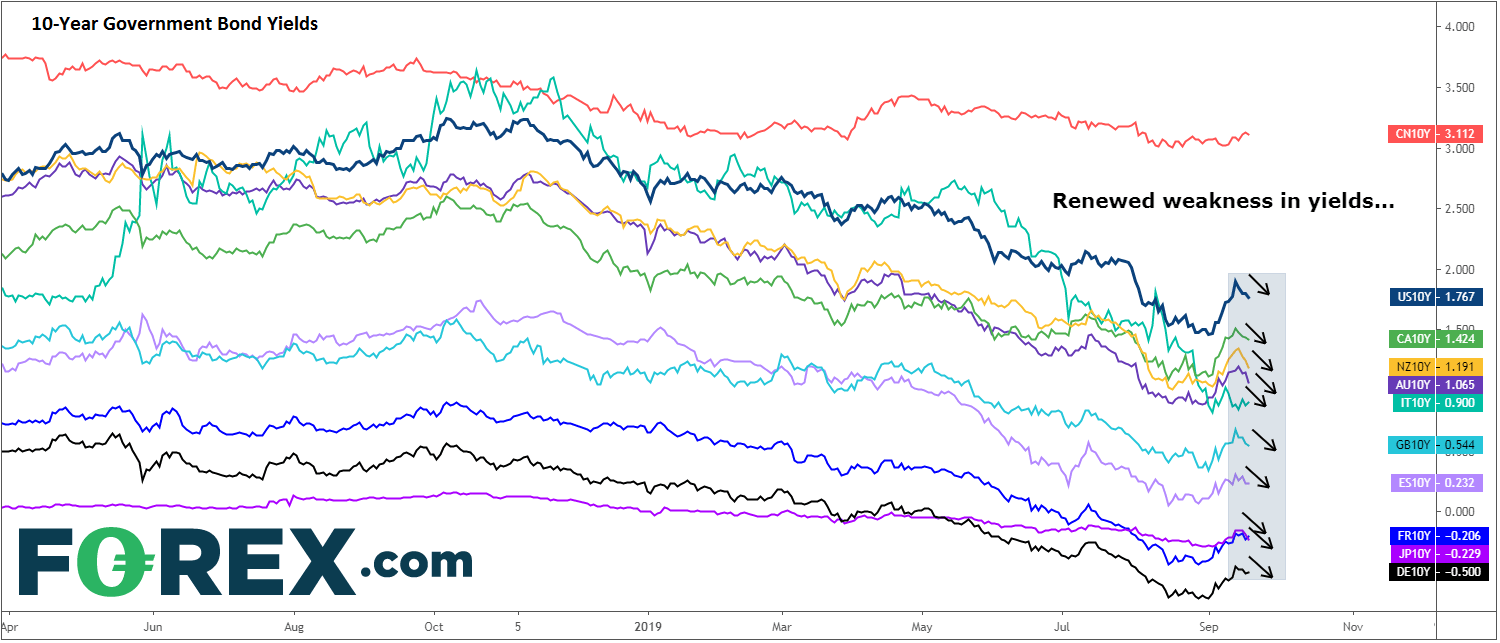
Now there was one central bank which bucked the trend again and lifted interest rates. Norway’s central bank decided to hike rates by 25 basis points to 1.5%. This was Norges Bank’s fourth hike in the past year but probably it’s last for a while as other banks ease policy.Over the past 24 hours or so, we have seen lots of central bank action (or inaction) and the message has been clear: global interest rates will remain at or near record lows for the foreseeable future. For that reason, yields have come under renewed pressure (see the chart below). This is helping to keep equity indices supported and near record levels in the case of the US, keeping the bears at bay despite raised geopolitical tensions and concerns over global demand hurting company earnings.
Source: Trading View and FOREX.com
This week’s main event was the Federal Reserve’s rate decision last night. As widely expected - and much to the displeasure of US President Donald Trump - the Fed did indeed cut interest rates by 25 basis points for the second consecutive meeting. There were three dissenters with Rosengren and George voting for no change again, while Bullard called for a larger 50 bps cut. But contrary to expectations, there was an element of a hawkish surprise as the so-called dot plots revealed a median view for a pause through to next year, rather than 2 more cuts expected. Still, it wasn’t hawkish enough to completely derail the rally on Wall Street.
The Bank of England was the latest major central to make a decision on interest rates today. “Shockingly,” it decided to leave its monetary policy unchanged. But it did strike a dovish tone, as it raised the prospects of a rate cut for the first time should Brexit uncertainty persists. The MPC said there was “entrenched uncertainty” over Brexit, which means “domestically generated inflationary pressure would be reduced”.
Elsewhere, the central bank of the world’s third largest economy disappointed some very hopeful expectations overnight despite exports falling there for the ninth consecutive month. The Bank of Japan decided to leave all policy settings unchanged, as widely expected. Its forward guidance was the same: extraordinary low policy to remain unchanged for an extended period at least through spring 2020.
In Hong Kong, the central bank decided to lower its base rate by 25 basis points to 2.25%, as expected and in tandem with the Fed.
Meanwhile there was some speculation that the Swiss National Bank would take some sort of policy action following the European Central Bank’s decision last week to re-introduce QE and cut rates further into negative. But the SNB decided against such a move this morning, even though it slashed its growth forecast for the year due to rising global headwinds.
Now there was one central bank which bucked the trend again and lifted interest rates. Norway’s central bank decided to hike rates by 25 basis points to 1.5%. This was Norges Bank’s fourth hike in the past year but probably it’s last for a while as other banks ease policy.Related tags:

Open an account in minutes
Experience award-winning platforms with fast and secure execution.
Economic calendar
Web Trader platform
Our sophisticated web-based platform is packed with features.
Related articles

NZD/USD Forecast: Kiwi faces historic breakdown as RBNZ survey looms
NZD/USD is teetering above support that held through the pandemic and Liberation Day turmoil. With RBNZ hawks repeatedly disappointed, today's inflation expectations survey could open the door to a slide towards the GFC lows.

USD/JPY, AUD/JPY: Central Bank Divergence Creates Two-Way Risk
USD/JPY eyes a breakout above 160, while AUD/JPY faces further losses as Fed, RBA and BoJ interest rate expectations diverge.


DXY, GBP/USD, AUD/USD, USD/CAD, USD/JPY, Gold Weekly Technical Outlook 11 16 2026
Sr. Technical Strategist Michael Boutros highlights the levels that matter on the USD Majors, commodities, and equity indices charts this week.

StoneX Financial Ltd (trading as "FOREX.com") is an execution-only service provider. This material, whether or not it states any opinions, is for general information purposes only and it does not take into account your personal circumstances or objectives. This material has been prepared using the thoughts and opinions of the author and these may change. However, FOREX.com does not plan to provide further updates to any material once published and it is not under any obligation to keep this material up to date.
This material is short term in nature and may only relate to facts and circumstances existing at a specific time or day. Nothing in this material is (or should be considered to be) financial, investment, legal, tax or other advice and no reliance should be placed on it. No opinion given in this material constitutes a recommendation by FOREX.com or the author that any particular investment, security, transaction or investment strategy is suitable for any specific person.
The material has not been prepared in accordance with legal requirements designed to promote the independence of investment research. Although FOREX.com is not specifically prevented from dealing before providing this material, FOREX.com does not seek to take advantage of the material prior to its dissemination. This material is not intended for distribution to, or use by, any person in any country or jurisdiction where such distribution or use would be contrary to local law or regulation. For further details see our full non-independent research disclaimer and quarterly summary.