



AUDJPY Is the sideways trend your friend
“The trend is your friend” is one of the first market witticisms most new traders learn, with good reason: After all, buying pullbacks or breakouts in established uptrends and downtrends is the essence of many of the world’s most successful trading strategies.
Share this:

“The trend is your friend” is one of the first market witticisms most new traders learn, with good reason: After all, buying pullbacks or breakouts in established uptrends and downtrends is the essence of many of the world’s most successful trading strategies. While those strategies can be successful in markets that are showing traditional uptrends or downtrends, the phrase provides little guidance for what traders should do in instances when there isn’t an obvious uptrend or downtrend, at least at first glance.
At a very high level, the essence of the saying “the trend is your friend” is that you should give the established trend the benefit of the doubt until you see convincing evidence that its changed. This principle can be applied to uptrends (higher highs and higher lows), downtrends (lower highs and lower lows), and even sideways trends (similar highs and similar lows).
AUD/JPY: A case study in rangebound trading
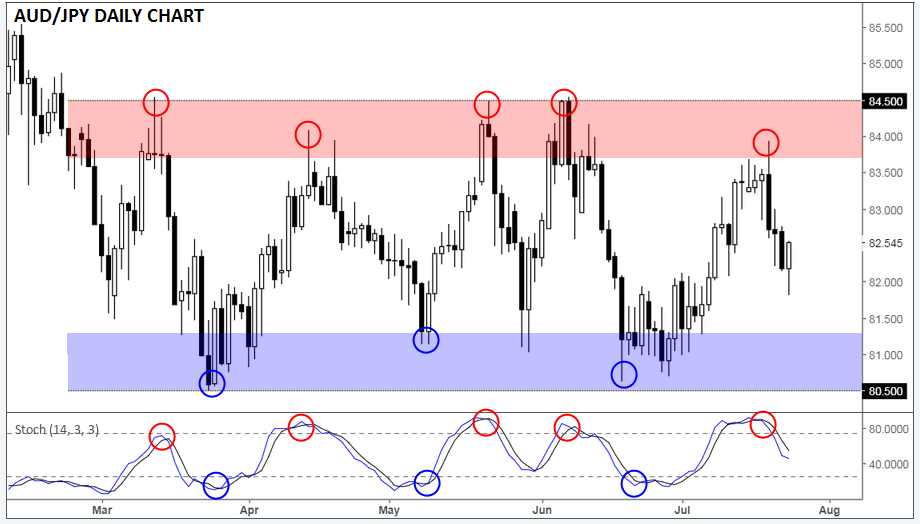
AUD/JPY’s price action over the last five months provides a picture-perfect case study of rangebound trading opportunities. Like many so-called “risk assets,” the pair peaked in January of this year before trending low through February and March. In March, the pair put in a high around 84.50 and 80.50, keeping the established downtrend intact. However, rates proceeded to put in similar highs and lows in mid-April and early May respectively, suggesting that the trend had shifted from a downtrend to a sideways trend.
At that point, astute traders could look to shift to more of a “sideways trend” trading mindset. In sideways trends, overbought/oversold oscillators are often used in concert with resistance/support levels to identify areas to sell/buy. As the chart below shows, a trader could have looked to sell when the stochastics oscillator reached overbought territory (above 75-80) while price was testing the top of its range (83.75-84.00) and looked to buy when the stochastics was oversold (below 25-30) and price was testing the bottom of its range (80.50-81.25):
Source: TradingView, FOREX.com
Of course, this is cherry-picked example of a pristine range that could easily break down in the days and weeks to come (in other words, “past performance is not indicative of future results”). Nonetheless, it serves as a good reminder that readers should keep their eyes out for opportunities to trade market’s true trend, whether it’s up, down, or even sideways.
As they say, the trend is your friend!




Open an account in minutes
Experience award-winning platforms with fast and secure execution.
Economic calendar
Web Trader platform
Our sophisticated web-based platform is packed with features.
Related articles
US dollar rally loses yield support as Nvidia looms
US yields are retreating, but the dollar isn't following. With risk aversion potentially keeping it supported, Nvidia's results could determine whether emerging reversal signals in AUD/USD and EUR/USD develop further.

Gold Price Short-term Outlook: XAU/USD Bears Face Critical Test at Yearly Lows 11 17 2026
Gold's decline is showing signs of exhaustion at major support, with a pivotal range break in focus ahead of the FOMC minutes.


British Pound Technical Outlook: GBP/USD Tests Pivotal Support—Breakdown Risk Rises 11 17 2026
Sterling bears are pressing critical support near the yearly lows, with the next reaction likely to determine whether the broader trading range survives.
StoneX Financial Ltd (trading as "FOREX.com") is an execution-only service provider. This material, whether or not it states any opinions, is for general information purposes only and it does not take into account your personal circumstances or objectives. This material has been prepared using the thoughts and opinions of the author and these may change. However, FOREX.com does not plan to provide further updates to any material once published and it is not under any obligation to keep this material up to date.
This material is short term in nature and may only relate to facts and circumstances existing at a specific time or day. Nothing in this material is (or should be considered to be) financial, investment, legal, tax or other advice and no reliance should be placed on it. No opinion given in this material constitutes a recommendation by FOREX.com or the author that any particular investment, security, transaction or investment strategy is suitable for any specific person.
The material has not been prepared in accordance with legal requirements designed to promote the independence of investment research. Although FOREX.com is not specifically prevented from dealing before providing this material, FOREX.com does not seek to take advantage of the material prior to its dissemination. This material is not intended for distribution to, or use by, any person in any country or jurisdiction where such distribution or use would be contrary to local law or regulation. For further details see our full non-independent research disclaimer and quarterly summary.