



AUDJPY The FX Stock Market Correlation Play
One of the first things that new traders to the FX markets learn is that many currencies are correlated with other markets. For instance, the close relationship between oil and the Canadian dollar or certain metals and the Australian dollar are intuitive given the importance of exporting those commodities for the Canadian and Australian economies.
Share this:

One of the first things that new traders to the FX markets learn is that many currencies are correlated with other markets. For instance, the close relationship between oil and the Canadian dollar or certain metals and the Australian dollar are intuitive given the importance of exporting those commodities for the Canadian and Australian economies.
One strong, but less obvious, correlation is the tight connection between AUD/JPY and global stock markets. In this case, the factor linking the two seemingly-disparate markets is investors’ risk appetite. When market participants are feeling optimistic about global economic growth, they tend to buy stocks at the expense of more conservative investments such as bonds.
A similar dynamic takes place in the FX market, where upbeat traders will buy higher-yielding currencies with underlying economies leveraged to global economic growth (e.g. the Australian and New Zealand dollars) and sell lower-yielding currencies with relatively stable economies (e.g. the Japanese yen and Swiss franc). Conversely, when traders are apprehensive about the potential for global economic growth, they tend to unwind those trades by selling the higher-yielding currencies and buying perceived safe havens. This is the essence of the so-called “carry trade,” a major short- and long-term driver of FX movements.
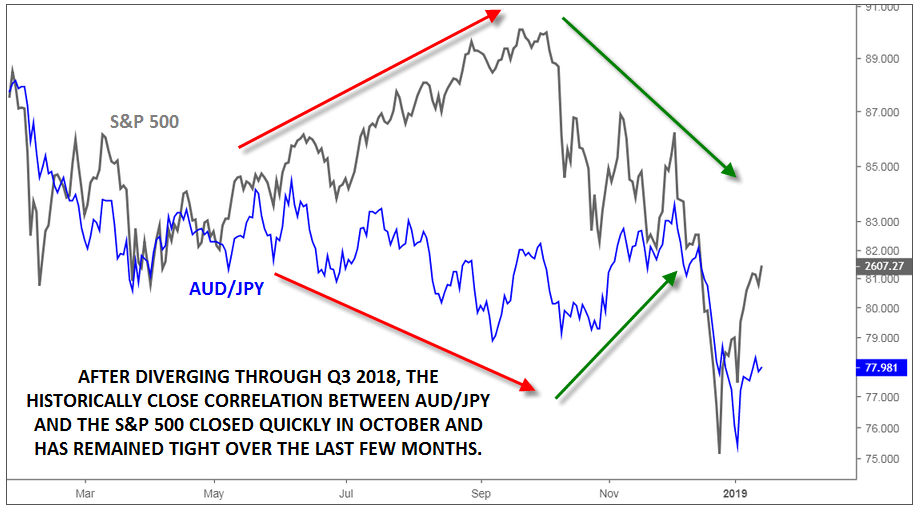
This strong correlation offers traders several actionable insights. Most straightforwardly, if a trader feels strongly that the broad stock market is due to fall or rise, he/she could use AUD/JPY to express that view in a highly liquid, 24-hour market that offers the potential for leverage. Alternatively, traders can watch for divergences between the S&P 500 and AUD/JPY as a sign that one (or both) of the markets is vulnerable to a reversal.
We saw that exact scenario in Q3 2018, when the S&P 500 rallied to new highs, while AUD/JPY continued to languish. The divergence indicated that stock traders should be more skeptical toward the rally in the S&P 500, and sure enough, the index came unwound months’ worth of a gains in a couple of weeks in October. Such divergences can emerge over longer time horizons given the upward tendency of stock investments, they can still provide valuable signals to short-term and swing traders.
Source: TradingView, FOREX.com




Open an account in minutes
Experience award-winning platforms with fast and secure execution.
Economic calendar
Web Trader platform
Our sophisticated web-based platform is packed with features.
Related articles

S&P 500 forecast: Why US stocks have largely defied gravity and what could trigger a correction
Though we have seen some weakness in US stock markets recently, this has been nothing compared to the percentage drops we have seen this year for Bitcoin, silver and several major Asia pacific equity markets. The divergence raises an important question: is S&P 500 genuinely insulated from the forces weighing on other assets, or is it simply taking longer for the weakness to spread?


USD/JPY, AUD/JPY: Central Bank Divergence Creates Two-Way Risk
USD/JPY eyes a breakout above 160, while AUD/JPY faces further losses as Fed, RBA and BoJ interest rate expectations diverge.


S&P, Nasdaq Slide as NVDA, AI Worries Continue to Build
It was a busy weekend in the headlines as a campaign to bring back Jensen Huang atop NVDA gained steam, even with accusations of possible treason and a circular funding model that has started to raise questions.

StoneX Financial Ltd (trading as "FOREX.com") is an execution-only service provider. This material, whether or not it states any opinions, is for general information purposes only and it does not take into account your personal circumstances or objectives. This material has been prepared using the thoughts and opinions of the author and these may change. However, FOREX.com does not plan to provide further updates to any material once published and it is not under any obligation to keep this material up to date.
This material is short term in nature and may only relate to facts and circumstances existing at a specific time or day. Nothing in this material is (or should be considered to be) financial, investment, legal, tax or other advice and no reliance should be placed on it. No opinion given in this material constitutes a recommendation by FOREX.com or the author that any particular investment, security, transaction or investment strategy is suitable for any specific person.
The material has not been prepared in accordance with legal requirements designed to promote the independence of investment research. Although FOREX.com is not specifically prevented from dealing before providing this material, FOREX.com does not seek to take advantage of the material prior to its dissemination. This material is not intended for distribution to, or use by, any person in any country or jurisdiction where such distribution or use would be contrary to local law or regulation. For further details see our full non-independent research disclaimer and quarterly summary.