



Bitcoin forecast: five weeks of selling put $65,000 back in focus
Bitcoin has fallen for five straight weeks, and a hotter October CPI report has added to the pressure. Record ETF outflows, forced liquidations and rising rate-hike bets leave $65,000 back in focus.
Share this:

Bitcoin has fallen for five consecutive weeks, and a hotter-than-expected US CPI report has added to the pressure, causing the crypto to fall for a sixth week (admittedly, the week is still young). The bearish price action is putting the $65,000 base of its late-August breakout firmly back in focus. Headline consumer prices rose 0.4% month on month in October against expectations of 0.3%, while core CPI climbed 0.3% versus a forecast of 0.2%, sending Bitcoin and gold lower as stock indices eased in immediate reaction. The near-term Bitcoin forecast is therefore tilted to the downside.
- Bitcoin has slid from above $86,000 at the start of October, briefly breaking below $75,000 for the first time since August.
- Hotter October inflation strengthens the case for further Federal Reserve rate hikes.
- Below $75,000, the $70,000, $67,000 and $65,000 levels are in focus.
Watch the Full Video
Technical Bitcoin forecast and key levels to watch
From a technical analysis point of view, the big move up from around $65,000 at the end of August has stalled, and momentum has been completely lost. The most important level is the $75,000 low formed on 15 September, which preceded the last rally that failed to hold above $85,000. Since then, Bitcoin has carved out a series of lower lows and lower highs, raising the risk of a sharp drop to fill the void left by that rally. That puts $70,000 in focus, ahead of the breakout's point of origin around $67,000 and its base at $65,000.
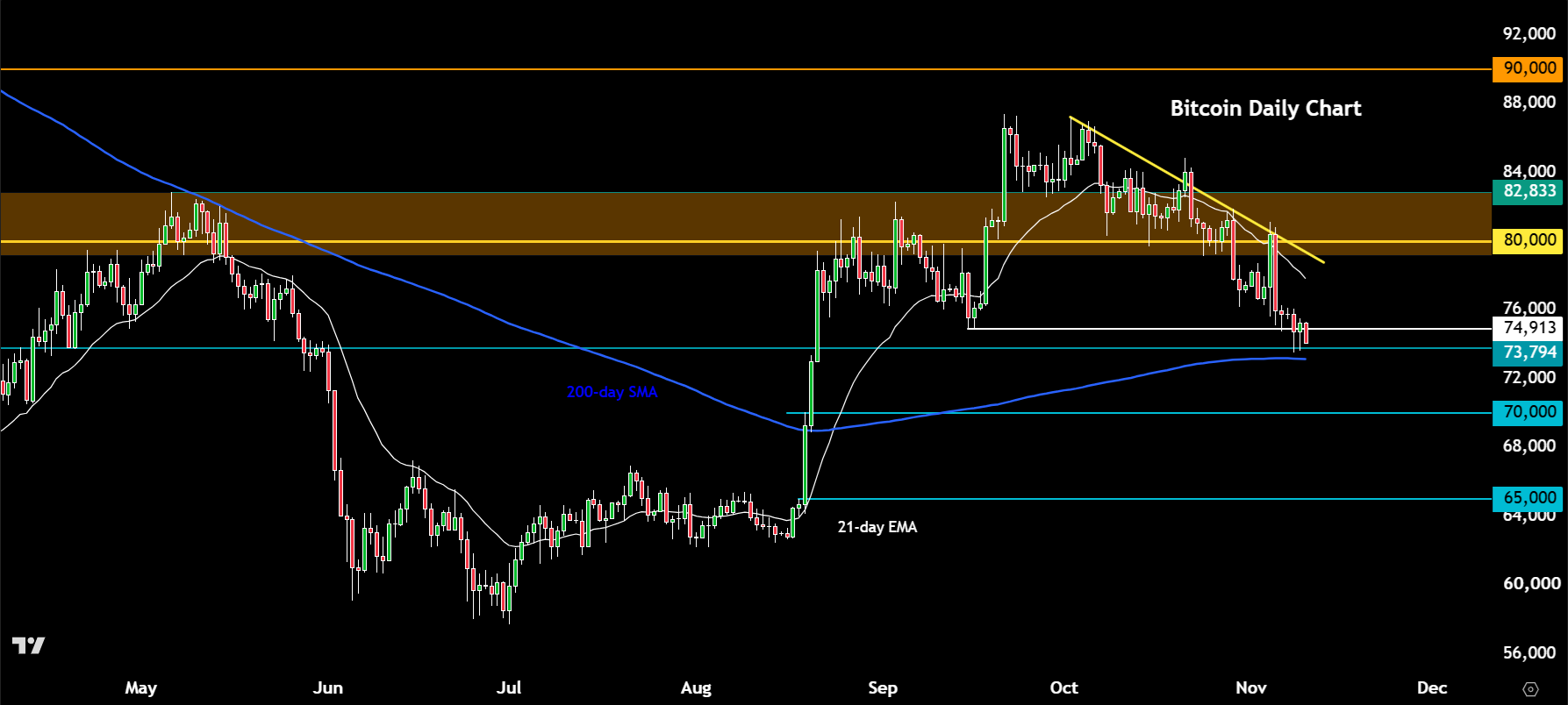
For the bulls, a quick recovery back above $75,000 is needed, along with a hold above the 200-day moving average and the March 2024 record high at $73,795. Until then, the risks remain tilted to the downside for the Bitcoin price.
Hot CPI strengthens the case for further rate hikes
The detail of the inflation report offered little comfort. Food prices jumped 0.5%, energy rose 0.7% and gasoline climbed 1.0%, while housing costs increased 0.3% and real earnings for private-sector workers were unchanged. Coming after a stronger-than-expected employment report, the data strengthens the case for further Federal Reserve rate hikes. For a non-yielding, speculative asset such as Bitcoin, that raises the opportunity cost of holding it.
ETF outflows and liquidations amplify the drop
The reversal in US spot Bitcoin ETF flows is arguably more significant. These products recorded a record weekly outflow of approximately $1.28 billion, with BlackRock's IBIT accounting for around $1.21 billion. A sustained reversal could leave prices more dependent on speculative and retail participation.
Leverage has meanwhile accelerated the decline, with more than $1 billion in leveraged crypto positions reportedly liquidated within 24 hours. Reports of a major security incident at Binance, with estimated losses of $6.3 billion, have also raised fresh questions about counterparty risk, despite the exchange reportedly covering user losses.
Bitcoin trades like a high-beta tech proxy
Bitcoin has also struggled to decouple from technology stocks, behaving less like an alternative asset and more like another high-beta expression of risk appetite. A relief rally is possible after such a sharp decline, but a durable recovery would probably require improving ETF demand, a friendlier macro backdrop and evidence that leveraged selling has run its course.
Frequently Asked Questions
Why did Bitcoin fall after the US CPI report?
Headline and core inflation both beat expectations, strengthening the case for further Federal Reserve rate hikes and raising the opportunity cost of holding a non-yielding asset.
Could Bitcoin fall back to $65,000?
It could. The $65,000 level marks the base of the late-August breakout, with $70,000 and $67,000 in focus along the way.
-- Written by Fawad Razaqzada, Market Analyst | Follow Fawad on Twitter @Trader_F_R
Related tags:



Open an account in minutes
Experience award-winning platforms with fast and secure execution.
Economic calendar
Web Trader platform
Our sophisticated web-based platform is packed with features.
Related articles
China's steel slump leaves iron ore bulls under the pump
Iron ore has broken major support, threatening a return to the lows of 2022 as mounting evidence of weakness in China's steel sector reinforces the bearish outlook.

USD/JPY, AUD/JPY: Central Bank Divergence Creates Two-Way Risk
USD/JPY eyes a breakout above 160, while AUD/JPY faces further losses as Fed, RBA and BoJ interest rate expectations diverge.


Gold and silver forecast: Precious metals extend drop but seasonality hopes keeps bullish case alive
It has been a risk off session so far today with stocks, gold and especially silver (-4%) all taking a drop. Gold has fallen to a fresh 2026 low and its now more than $100 below the psychologically important $4,000 mark. A firmer US dollar, rising US rate expectations and fading safe-haven demand have combined to undermine the metal, despite continued central bank buying. This year has so far been a bad one for gold.
StoneX Financial Ltd (trading as "FOREX.com") is an execution-only service provider. This material, whether or not it states any opinions, is for general information purposes only and it does not take into account your personal circumstances or objectives. This material has been prepared using the thoughts and opinions of the author and these may change. However, FOREX.com does not plan to provide further updates to any material once published and it is not under any obligation to keep this material up to date.
This material is short term in nature and may only relate to facts and circumstances existing at a specific time or day. Nothing in this material is (or should be considered to be) financial, investment, legal, tax or other advice and no reliance should be placed on it. No opinion given in this material constitutes a recommendation by FOREX.com or the author that any particular investment, security, transaction or investment strategy is suitable for any specific person.
The material has not been prepared in accordance with legal requirements designed to promote the independence of investment research. Although FOREX.com is not specifically prevented from dealing before providing this material, FOREX.com does not seek to take advantage of the material prior to its dissemination. This material is not intended for distribution to, or use by, any person in any country or jurisdiction where such distribution or use would be contrary to local law or regulation. For further details see our full non-independent research disclaimer and quarterly summary.