



CBRT cuts rates despite soaring inflation, weak Lira
After last weeks surprise rate cut by the CBRT, USD/TRY moved to its highest level since December 20th, 2021.
Share this:

Last week, the Central Bank of the Republic of Turkey (CBRT) surprised markets by cutting interest rates 100bps to 13% from 14%, despite an increase in inflation during July of 79.6% YoY, the highest level since 1998! Expectations were for the CBRT to leave rates unchanged. This was the first time the central bank cut rates since December 2021, when it ended its string of consecutive rate cuts and lowered rates by a total of 500bps! The central bank noted that it sees inflation decreasing after the Russia/Ukraine war. Recall that Turkey’s President Erdogan had been instructing central bank governors to cut the main interest rate since inflation began rising after the pandemic. If they did not do as instructed, they were fired.
Over the weekend, the CBRT took steps to decrease the gap between its policy rate and lending rates. The central bank replaced an existing 20% RRR for credits with a higher 30% treasury bond collateral requirement (Reuters).
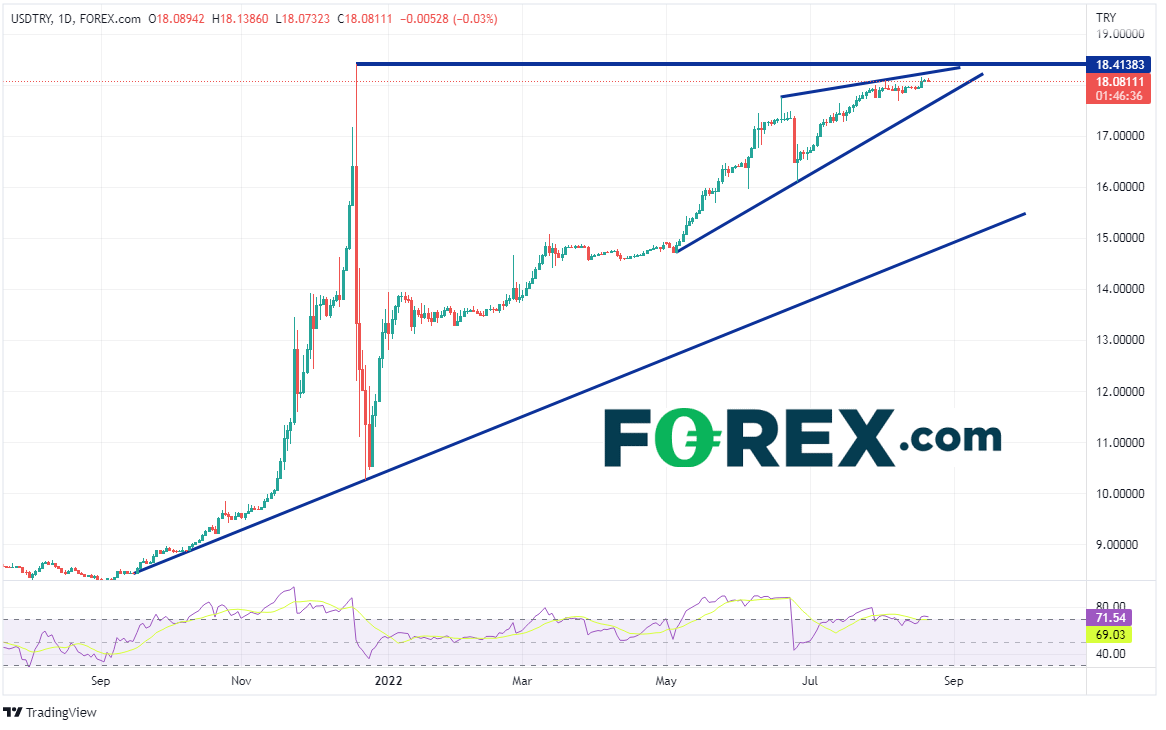
USD/TRY began trading aggressively higher in the fall of 2021 as inflation began moving rapidly back into the world economy. Price moved from a low 8.2640 on September 2nd, 2021 to a high of 18.4138 on December 20th, 2021. The pair then violently corrected over the next few days, retracing to 10.2491 by December 23rd. However, by mid-January of this year, USD/TRY leveled out near 13.15 before its slow price ascent during 2022. On Thursday, the date of the latest rate cut, the pair reached its highest level since December 20th at 18.1532.
Source: Tradingview, Stone X
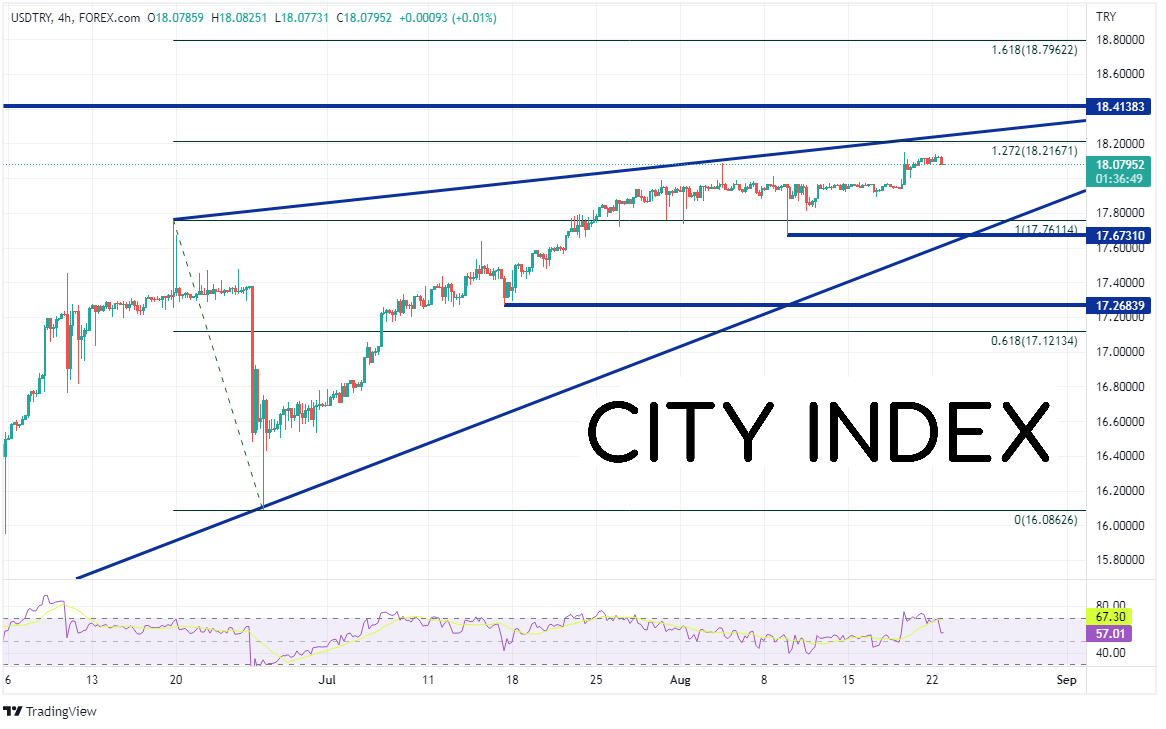
On a 240-minute timeframe, USD/TRY has been rising in an ascending wedge formation since late June. The expected breakout of an ascending wedge is lower. If price is to move lower, it must first break through the horizontal support at 17.6731. Below there, price can fall to the bottom, upward sloping trendline of the wedge bear 17.6000 and then additional horizontal support at 17.2684. However, if the pair continues higher, there is a confluence of resistance just above at the 127.2% Fibonacci extension level from the highs of June 19th to the lows of June 27th near 18.2167 and the top upward sloping trendline of the wedge near 18.2167. Above there, USD/TRY can move to the highs from December 2021 at 18.4138, then the 161.8% Fibonacci extension from the previously mentioned timeframe at 18.7962.

Source: Tradingview, Stone X
After last weeks surprise rate cut by the CBRT, USD/TRY moved to its highest level since December 20th, 2021. Could the pair take out the previous highs? With inflation continuing to increase and the central bank continuing to cut rates, it makes sense that the pair will continue higher. However, remember that the market doesn’t always act rational!
Last week, the Central Bank of the Republic of Turkey (CBRT) surprised markets by cutting interest rates 100bps to 13% from 14%, despite an increase in inflation during July of 79.6% YoY, the highest level since 1998! Expectations were for the CBRT to leave rates unchanged. This was the first time the central bank cut rates since December 2021, when it ended its string of consecutive rate cuts and lowered rates by a total of 500bps! The central bank noted that it sees inflation decreasing after the Russia/Ukraine war. Recall that Turkey’s President Erdogan had been instructing central bank governors to cut the main interest rate since inflation began rising after the pandemic. If they did not do as instructed, they were fired.
Over the weekend, the CBRT took steps to decrease the gap between its policy rate and lending rates. The central bank replaced an existing 20% RRR for credits with a higher 30% treasury bond collateral requirement (Reuters).
USD/TRY began trading aggressively higher in the fall of 2021 as inflation began moving rapidly back into the world economy. Price moved from a low 8.2640 on September 2nd, 2021 to a high of 18.4138 on December 20th, 2021. The pair then violently corrected over the next few days, retracing to 10.2491 by December 23rd. However, by mid-January of this year, USD/TRY leveled out near 13.15 before its slow price ascent during 2022. On Thursday, the date of the latest rate cut, the pair reached its highest level since December 20th at 18.1532.

Source: Tradingview, Stone X
Trade USD/TRY now: Login or Open a new account!
• Open an account in the UK
• Open an account in Australia
• Open an account in Singapore
On a 240-minute timeframe, USD/TRY has been rising in an ascending wedge formation since late June. The expected breakout of an ascending wedge is lower. If price is to move lower, it must first break through the horizontal support at 17.6731. Below there, price can fall to the bottom, upward sloping trendline of the wedge bear 17.6000 and then additional horizontal support at 17.2684. However, if the pair continues higher, there is a confluence of resistance just above at the 127.2% Fibonacci extension level from the highs of June 19th to the lows of June 27th near 18.2167 and the top upward sloping trendline of the wedge near 18.2167. Above there, USD/TRY can move to the highs from December 2021 at 18.4138, then the 161.8% Fibonacci extension from the previously mentioned timeframe at 18.7962.
Source: Tradingview, Stone X
After last weeks surprise rate cut by the CBRT, USD/TRY moved to its highest level since December 20th, 2021. Could the pair take out the previous highs? With inflation continuing to increase and the central bank continuing to cut rates, it makes sense that the pair will continue higher. However, remember that the market doesn’t always act rational!
Learn more about forex trading opportunities.
Related tags:
Latest market news




Open an account in minutes
Experience award-winning platforms with fast and secure execution.
Economic calendar
Web Trader platform
Our sophisticated web-based platform is packed with features.
Related articles
NZD/USD Forecast: Kiwi faces historic breakdown as RBNZ survey looms
NZD/USD is teetering above support that held through the pandemic and Liberation Day turmoil. With RBNZ hawks repeatedly disappointed, today's inflation expectations survey could open the door to a slide towards the GFC lows.
USD/JPY, AUD/JPY: Central Bank Divergence Creates Two-Way Risk
USD/JPY eyes a breakout above 160, while AUD/JPY faces further losses as Fed, RBA and BoJ interest rate expectations diverge.

DXY, GBP/USD, AUD/USD, USD/CAD, USD/JPY, Gold Weekly Technical Outlook 11 16 2026
Sr. Technical Strategist Michael Boutros highlights the levels that matter on the USD Majors, commodities, and equity indices charts this week.

StoneX Financial Ltd (trading as "FOREX.com") is an execution-only service provider. This material, whether or not it states any opinions, is for general information purposes only and it does not take into account your personal circumstances or objectives. This material has been prepared using the thoughts and opinions of the author and these may change. However, FOREX.com does not plan to provide further updates to any material once published and it is not under any obligation to keep this material up to date.
This material is short term in nature and may only relate to facts and circumstances existing at a specific time or day. Nothing in this material is (or should be considered to be) financial, investment, legal, tax or other advice and no reliance should be placed on it. No opinion given in this material constitutes a recommendation by FOREX.com or the author that any particular investment, security, transaction or investment strategy is suitable for any specific person.
The material has not been prepared in accordance with legal requirements designed to promote the independence of investment research. Although FOREX.com is not specifically prevented from dealing before providing this material, FOREX.com does not seek to take advantage of the material prior to its dissemination. This material is not intended for distribution to, or use by, any person in any country or jurisdiction where such distribution or use would be contrary to local law or regulation. For further details see our full non-independent research disclaimer and quarterly summary.