





Coronavirus Weaker PPI hitting AUDUSD
If China’s economy is slowing down, the Australian economy may slow down as well.
Share this:

Fears of an increase in the contagion of the coronavirus have been causing a selloff in the Australian Dollar across the board. As we have discussed during the US-China trade war, the Australian economy is directly tied to China’s economy. China is a large importer of Australian goods and services. Therefore, if China’s economy is to slow down because of the Coronavirus, the Australian economy may slow down as well. There have already been talks of the virus knocking off up to 2% off Q1 GDP for China. Businesses are temporarily shutting down. Airlines are halting flights to China for as long as 3 months (Delta Airlines just announced). All of this is causing a slowdown in China, and therefore, a potential slowdown in Australia.
In addition, the latest inflation data is not helping. Earlier, Australia released the PPI data for Q4. The actual print was 0.3% vs 0.5% expected and 0.4% previous. Add bad economic data into the mix, and it’s a recipe for AUD/USD to trade lower into the weekend.
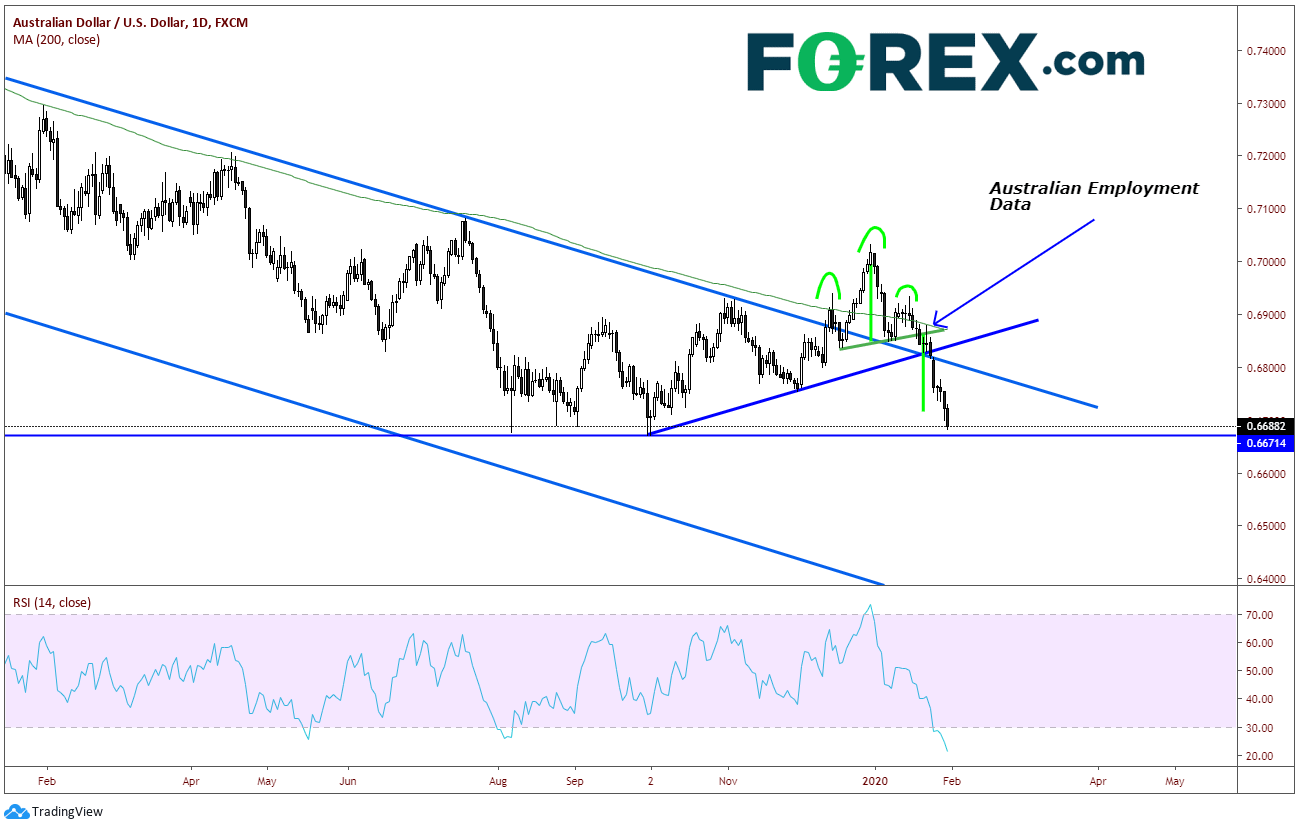
Last week, we discussed how AUD/USD was at an inflection point ahead of Employment data. The headline data was better than expected, and it gave the pair a temporary bounce. As we had discussed last week, AUD/USD was at a confluence of support and resistance areas, including trendline, necklines, moving averages, and Fibonacci Retracement levels. However, as news of the Coronavirus began to spread, price broke lower, and quickly hit the target of the head and shoulders pattern near .6720.
Source: Tradingview, City Index
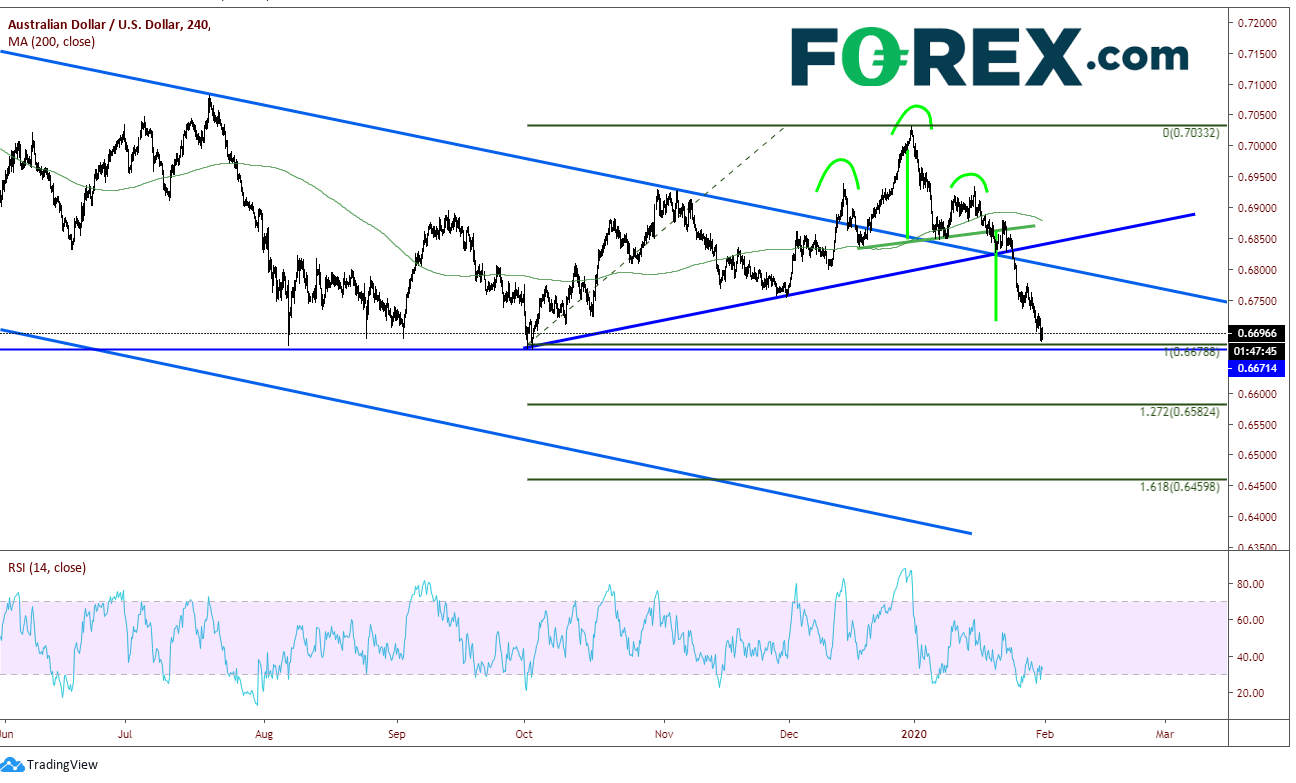
Price is currently closing in on recent lows from late summer near .6670, which are levels that haven’t been seen since 2009. If price breaks .6670, we must look for Fibonacci extensions for next possible support levels. .6582 is the 127.2% extension from the October 2nd low to the December 31st high. The next Fibonacci extension level is the 161.8% extension at .6460. Horizonal resistance above at .6750, and then the downward sloping trendline from back in June 2018 near .6800. The previous support zone (which now acts as resistance) from before the employment data begins at .6825.
Source: Tradingview, City Index
The fear of the virus spreading is real. The low PPI data earlier is real. The actuality of it spreading, or slowing down of the Chinese economy, may or may not be as real. We have data to determine whether fundamentals and technicals are getting better or worse. We don’t have as much data for the coronavirus. Continue to watch the rate at which the virus is spreading, the number of multi nationals temporarily shutting down operations in China, and these key markets. This will help to put the severity of the issue into better context.
Fears of an increase in the contagion of the coronavirus have been causing a selloff in the Australian Dollar across the board. As we have discussed during the US-China trade war, the Australian economy is directly tied to China’s economy. China is a large importer of Australian goods and services. Therefore, if China’s economy is to slow down because of the Coronavirus, the Australian economy may slow down as well. There have already been talks of the virus knocking off up to 2% off Q1 GDP for China. Businesses are temporarily shutting down. Airlines are halting flights to China for as long as 3 months (Delta Airlines just announced). All of this is causing a slowdown in China, and therefore, a potential slowdown in Australia.
In addition, the latest inflation data is not helping. Earlier, Australia released the PPI data for Q4. The actual print was 0.3% vs 0.5% expected and 0.4% previous. Add bad economic data into the mix, and it’s a recipe for AUD/USD to trade lower into the weekend.
Last week, we discussed how AUD/USD was at an inflection point ahead of Employment data. The headline data was better than expected, and it gave the pair a temporary bounce. As we had discussed last week, AUD/USD was at a confluence of support and resistance areas, including trendline, necklines, moving averages, and Fibonacci Retracement levels. However, as news of the Coronavirus began to spread, price broke lower, and quickly hit the target of the head and shoulders pattern near .6720.
Source: Tradingview, FOREX.com
Price is currently closing in on recent lows from late summer near .6670, which are levels that haven’t been seen since 2009. If price breaks .6670, we must look for Fibonacci extensions for next possible support levels. .6582 is the 127.2% extension from the October 2nd low to the December 31st high. The next Fibonacci extension level is the 161.8% extension at .6460. Horizonal resistance above at .6750, and then the downward sloping trendline from back in June 2018 near .6800. The previous support zone (which now acts as resistance) from before the employment data begins at .6825.
Source: Tradingview, FOREX.com
The fear of the virus spreading is real. The low PPI data earlier is real. The actuality of it spreading, or slowing down of the Chinese economy, may or may not be as real. We have data to determine whether fundamentals and technicals are getting better or worse. We don’t have as much data for the coronavirus. Continue to watch the rate at which the virus is spreading, the number of multi nationals temporarily shutting down operations in China, and these key markets. This will help to put the severity of the issue into better context.
Latest market news




Open an account in minutes
Experience award-winning platforms with fast and secure execution.
Economic calendar
Web Trader platform
Our sophisticated web-based platform is packed with features.
Related articles

US dollar outlook: DXY finds fresh support as risk aversion deepens
The dollar is finding fresh support as risk aversion drives investors out of emerging-market and commodity currencies. With tariff threats mounting and today's PCE data in focus, the 104.53 high and 104.60 resistance are back in play.


AUD/USD Outlook: Hot Inflation No Match for Global Risk Aversion
With inflation pressures broadening and the labour market deteriorating, the RBA faces an unenviable task. But for AUD/USD traders, developments offshore may matter far more right now.


Australian Inflation Accelerates, RBA Cut Hopes Get Reality Check
As usual, markets appear to have been premature in pricing RBA rate cuts, judging by today's hot Australian CPI figures. But despite stubborn inflation, I doubt the RBA will be hiking again any time soon.

StoneX Financial Ltd (trading as "FOREX.com") is an execution-only service provider. This material, whether or not it states any opinions, is for general information purposes only and it does not take into account your personal circumstances or objectives. This material has been prepared using the thoughts and opinions of the author and these may change. However, FOREX.com does not plan to provide further updates to any material once published and it is not under any obligation to keep this material up to date.
This material is short term in nature and may only relate to facts and circumstances existing at a specific time or day. Nothing in this material is (or should be considered to be) financial, investment, legal, tax or other advice and no reliance should be placed on it. No opinion given in this material constitutes a recommendation by FOREX.com or the author that any particular investment, security, transaction or investment strategy is suitable for any specific person.
The material has not been prepared in accordance with legal requirements designed to promote the independence of investment research. Although FOREX.com is not specifically prevented from dealing before providing this material, FOREX.com does not seek to take advantage of the material prior to its dissemination. This material is not intended for distribution to, or use by, any person in any country or jurisdiction where such distribution or use would be contrary to local law or regulation. For further details see our full non-independent research disclaimer and quarterly summary.