



EasyJet dives after silence on outlook
EasyJet's silence on the outlook for next year is not golden
Share this:

EasyJet's silence on the outlook for next year is not golden
EasyJet appears to have navigated, more fortunately than expected, around another summer of disruption, rival business collapses and barely relenting seat capacity that continues to weigh on prices. Passenger revenues and ancillary sales (AKA ‘extras’) outperformed, enabling the group to steer expectations to the upper end of 2019/20 earnings that will be released next month. Trouble is, its fourth-quarter trading statement is conspicuously silent about the outlook for the forthcoming 2020/21 year. That undermines the group’s attempt to emit a halo of confidence following investments in “operational resilience” that reduced the impact of disruptions. Investors, whose patience has been worn thin after years of geopolitical and labour disruptions plus over-capacity, aren’t impressed. That’s led to searing share price punishment, with a drop of as much as 6%, EZJ’s biggest since May. With the stock having gained as much as 32% from mid-August lows, the group either had to demonstrate a solid basis for a re-rating, or, at worst, face a return towards the year’s lows.
Silence on the outlook shifts attention back to less than solid aspects of recent trading and outlook comments limited to the current year. Headline costs are set to rise 12%, driven by fuel and adverse FX movements. Excluding fuel and using flat FX rates, cost per seat is falling. This suggests EZJ is currently on the wrong side of its fuel price hedges and that its intermittently poor currency risk management has returned.
The question of how firm revenue momentum was on an underlying basis in peak months also arises. The group has been clear about benefits from BA and Ryanair strikes and Thomas Cook’s collapse. Speaking of the latter, there are signs that some of the recent share price optimism, predicated on capacity reduction, may have run too far. The bankrupt group accounted for just 1.5% of medium-haul, according to Bloomberg data. That means airlines will need to keep statements about potential advantages quite limited. Furthermore, Thomas Cook’s exit is also expected to reduce airline lease rates, tempting capacities even higher. The anticipated return of Boeing’s Max in Q1 2020 should tend towards a similar effect.
Against that backdrop, easyJet’s tacit message about the forthcoming year, still speaks volumes.
EasyJet Plc. chart
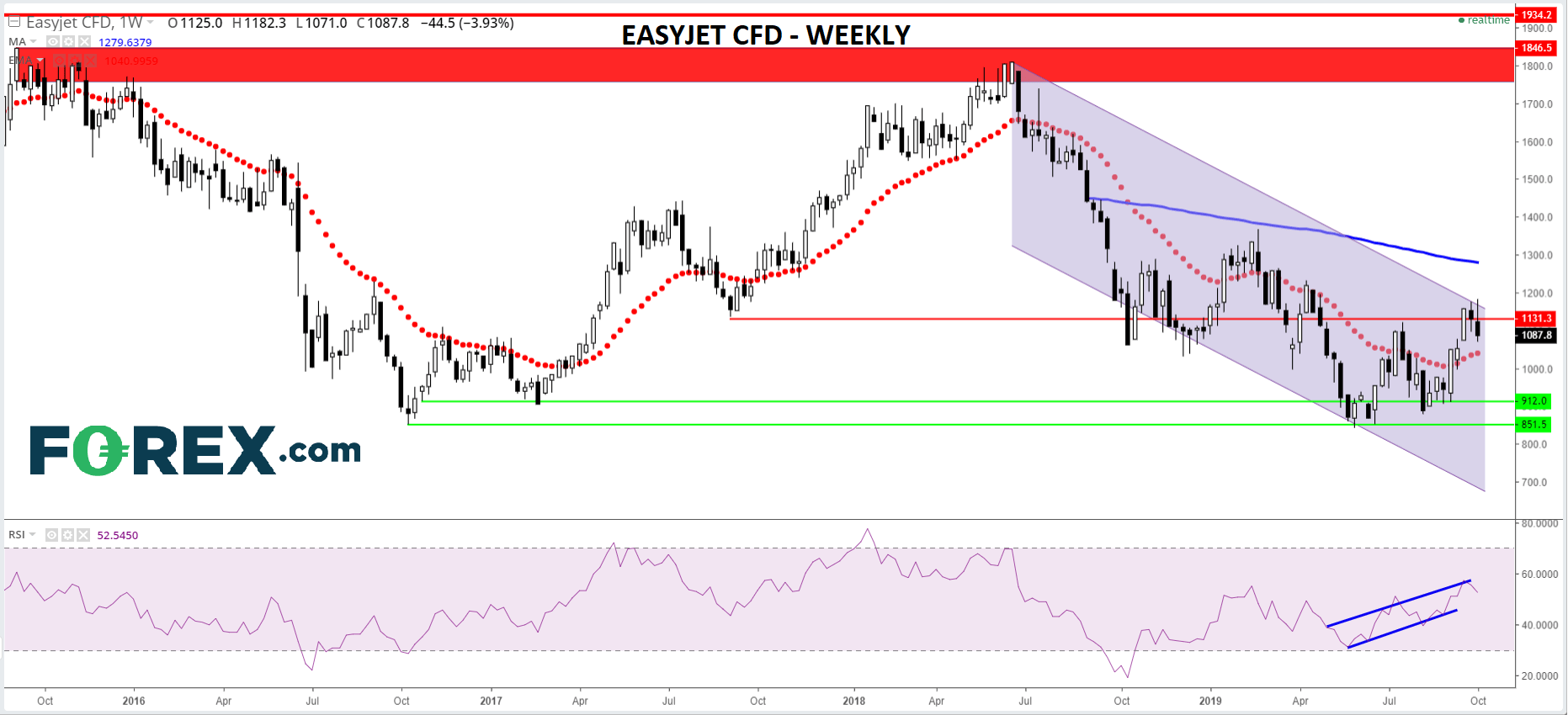
Indications that the shares were about to pull out of their dive since June have been disproved on Tuesday. The stock traded right into the top of its declining channel, backed by a rising RSI and 21-day exponential average, before being overcome. Price action confirms the validity of 1135p as resistance: it was initially an undeniable support on in September 2017, then resistance again earlier this year. Failure to stabilise here tends to suggest EZJ is on its way back down to long-term supports roughly between 850p-912p.
EasyJet plc. CFD – Weekly
Source: FOREX.com
EasyJet's silence on the outlook for next year is not golden
EasyJet appears to have navigated, more fortunately than expected, around another summer of disruption, rival business collapses and barely relenting seat capacity that continues to weigh on prices. Passenger revenues and ancillary sales (AKA ‘extras’) outperformed, enabling the group to steer expectations to the upper end of 2019/20 earnings that will be released next month. Trouble is, its fourth-quarter trading statement is conspicuously silent about the outlook for the forthcoming 2020/21 year. That undermines the group’s attempt to emit a halo of confidence following investments in “operational resilience” that reduced the impact of disruptions. Investors, whose patience has been worn thin after years of geopolitical and labour disruptions plus over-capacity, aren’t impressed. That’s led to searing share price punishment, with a drop of as much as 6%, EZJ’s biggest since May. With the stock having gained as much as 32% from mid-August lows, the group either had to demonstrate a solid basis for a re-rating, or, at worst, face a return towards the year’s lows.
Silence on the outlook shifts attention back to less than solid aspects of recent trading and outlook comments limited to the current year. Headline costs are set to rise 12%, driven by fuel and adverse FX movements. Excluding fuel and using flat FX rates, cost per seat is falling. This suggests EZJ is currently on the wrong side of its fuel price hedges and that its intermittently poor currency risk management has returned.
The question of how firm revenue momentum was on an underlying basis in peak months also arises. The group has been clear about benefits from BA and Ryanair strikes and Thomas Cook’s collapse. Speaking of the latter, there are signs that some of the recent share price optimism, predicated on capacity reduction, may have run too far. The bankrupt group accounted for just 1.5% of medium-haul, according to Bloomberg data. That means airlines will need to keep statements about potential advantages quite limited. Furthermore, Thomas Cook’s exit is also expected to reduce airline lease rates, tempting capacities even higher. The anticipated return of Boeing’s Max in Q1 2020 should tend towards a similar effect.
Against that backdrop, easyJet’s tacit message about the forthcoming year, still speaks volumes.
EasyJet Plc. chart
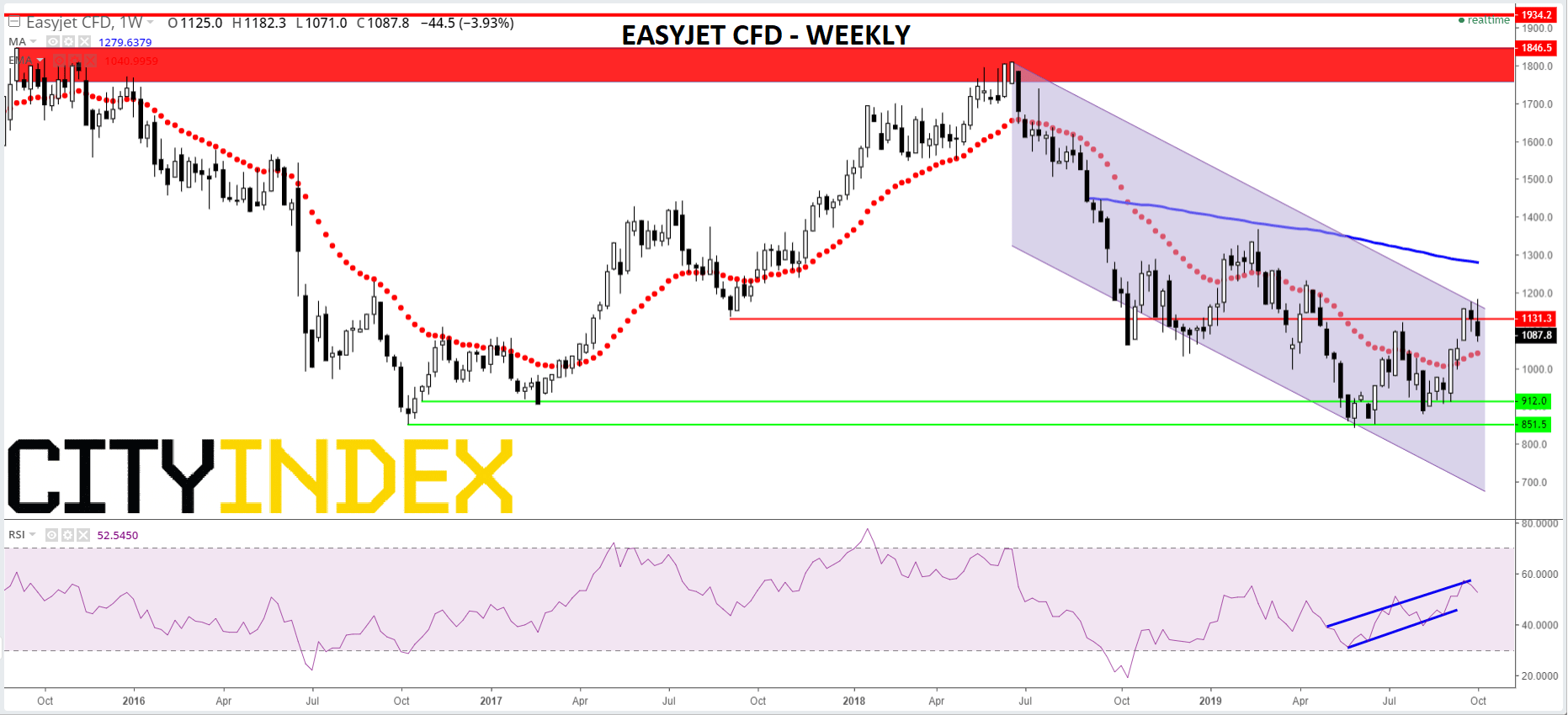
Indications that the shares were about to pull out of their dive since June have been disproved on Tuesday. The stock traded right into the top of its declining channel, backed by a rising RSI and 21-day exponential average, before being overcome. Price action confirms the validity of 1135p as resistance: it was initially an undeniable support on in September 2017, then resistance again earlier this year. Failure to stabilise here tends to suggest EZJ is on its way back down to long-term supports roughly between 850p-912p.
EasyJet plc. CFD – Weekly
Source: City Index
Related tags:
Latest market news




Open an account in minutes
Experience award-winning platforms with fast and secure execution.
Economic calendar
Web Trader platform
Our sophisticated web-based platform is packed with features.
Related articles

Nvidia Earnings Preview: NVDA’s First Test of the Post Jenson Huang Era
Nvidia is expected to report $2.47 in EPS on $108.8B in revenue this quarter, but investors will be more interested in the company's guidance after the unexpected departure of founder and CEO Jenson Huang.


Nvidia Holds Support Ahead of Earnings as Nasdaq 100 Rebounds
Nvidia shares approach major support as selling pressure eases, while the Nasdaq 100 rebounds. Could upcoming earnings fuel a broader recovery?


S&P 500 Analysis: Earnings Uncertainty Continues to Weigh on the SPX
The trading week is coming to an end, and a phase of weakness remains evident across the S&P 500 in the short term. Recent price action reflects this dynamic, with SPX losing more than 2.00% over the last two trading sessions, bringing selling pressure back into focus.

StoneX Financial Ltd (trading as "FOREX.com") is an execution-only service provider. This material, whether or not it states any opinions, is for general information purposes only and it does not take into account your personal circumstances or objectives. This material has been prepared using the thoughts and opinions of the author and these may change. However, FOREX.com does not plan to provide further updates to any material once published and it is not under any obligation to keep this material up to date.
This material is short term in nature and may only relate to facts and circumstances existing at a specific time or day. Nothing in this material is (or should be considered to be) financial, investment, legal, tax or other advice and no reliance should be placed on it. No opinion given in this material constitutes a recommendation by FOREX.com or the author that any particular investment, security, transaction or investment strategy is suitable for any specific person.
The material has not been prepared in accordance with legal requirements designed to promote the independence of investment research. Although FOREX.com is not specifically prevented from dealing before providing this material, FOREX.com does not seek to take advantage of the material prior to its dissemination. This material is not intended for distribution to, or use by, any person in any country or jurisdiction where such distribution or use would be contrary to local law or regulation. For further details see our full non-independent research disclaimer and quarterly summary.