



EUR USD down after German election but not yet out
Although Angela Merkel’s Christian Democratic Union (CDU) party won the most votes (at 33%) on Sunday’s German federal election, as widely expected, the margin of victory was a massive disappointment for both Merkel and her conservative party’s supporters. From the last federal election in 2013 to Sunday’s tally, the CDU lost around 8.5% of the vote share. This significant loss of support was not transferred primarily to Martin Shulz’s Social Democratic Party (SPD), as might have been expected, but instead to the anti-immigration and anti-EU party, Alternative for Germany (AfD). AfD garnered 13% of votes – 7.9% more of the vote share than it had in 2013, placing the far-right party in a comfortable third place after the CDU and SPD. While the CDU has secured 246 seats in the Bundestag, the AfD now has a very substantial 94 seats where before it had none. This is the first time that a far-right party has been represented in German parliament since World War II. Therefore, while Merkel has certainly secured a fourth term as Chancellor, the prominent rise of the AfD has created a serious potential threat to the European Union and euro.
Share this:

Although Angela Merkel’s Christian Democratic Union (CDU) party won the most votes (at 33%) on Sunday’s German federal election, as widely expected, the margin of victory was a massive disappointment for both Merkel and her conservative party’s supporters. From the last federal election in 2013 to Sunday’s tally, the CDU lost around 8.5% of the vote share. This significant loss of support was not transferred primarily to Martin Shulz’s Social Democratic Party (SPD), as might have been expected, but instead to the anti-immigration and anti-EU party, Alternative for Germany (AfD). AfD garnered 13% of votes – 7.9% more of the vote share than it had in 2013, placing the far-right party in a comfortable third place after the CDU and SPD. While the CDU has secured 246 seats in the Bundestag, the AfD now has a very substantial 94 seats where before it had none. This is the first time that a far-right party has been represented in German parliament since World War II. Therefore, while Merkel has certainly secured a fourth term as Chancellor, the prominent rise of the AfD has created a serious potential threat to the European Union and euro.
As we noted prior to the election, the immediate risk to the euro was in just such an outcome, where the AfD would garner more votes than expected, even if the party would have little to no chance of taking part in a coalition government with the CDU. This worst-case scenario for the euro as a result of the election has played out, and the shared currency took a significant hit in the immediate aftermath, particularly after Merkel expressed disappointment at the loss of support for her party to the nationalists.
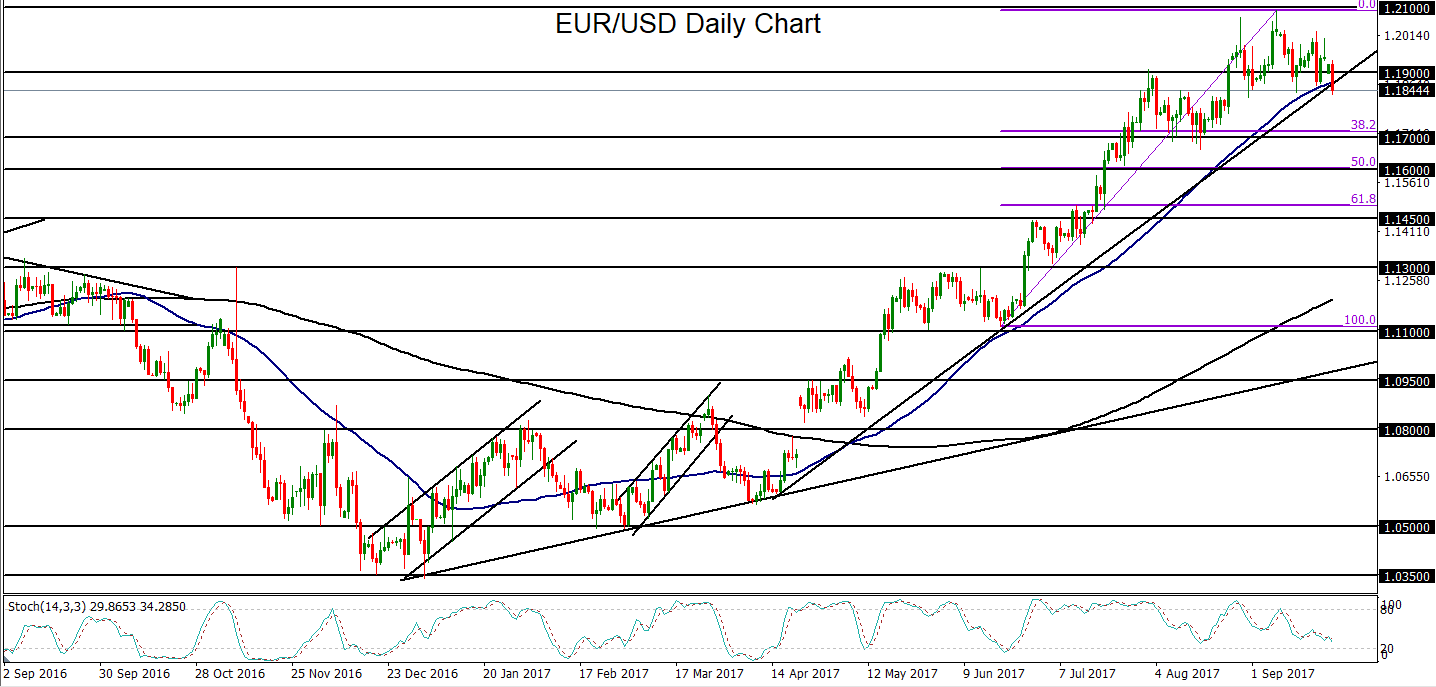
The fall in the euro was pronounced against several other currencies, including the Japanese yen and US dollar. In the case of EUR/USD, the currency pair dropped to its recent range lows below 1.1900, tentatively dipping below both its 50-day moving average and a key uptrend line extending back to mid-April, and has put some pressure on the sharp bullish trend that has been in place for much of this year.
While the rise of the nationalist AfD party does indeed pose a threat to the long-term viability of the euro, as Germany is a dominant member of the EU and Eurozone, that threat is still very limited at the current time. Though the far-right party has now dramatically increased its voice in the German parliament, the clear core of power will remain for now with Merkel, the CDU, and the new coalition government that excludes the AfD. Therefore, after the current pressure on the euro plays out in the short-term, the euro-negative impact of the election is likely to fade. While further residual pressure in the short-term could push the pair down to key support around the 1.1700 level, any sustained rebound back above 1.1900 should lead to a resumption of the bullish bias towards the 1.2100 resistance target once again.


Open an account in minutes
Experience award-winning platforms with fast and secure execution.
Economic calendar
Web Trader platform
Our sophisticated web-based platform is packed with features.
Related articles
China's steel slump leaves iron ore bulls under the pump
Iron ore has broken major support, threatening a return to the lows of 2022 as mounting evidence of weakness in China's steel sector reinforces the bearish outlook.

NZD/USD Forecast: Kiwi faces historic breakdown as RBNZ survey looms
NZD/USD is teetering above support that held through the pandemic and Liberation Day turmoil. With RBNZ hawks repeatedly disappointed, today's inflation expectations survey could open the door to a slide towards the GFC lows.

USD/JPY, AUD/JPY: Central Bank Divergence Creates Two-Way Risk
USD/JPY eyes a breakout above 160, while AUD/JPY faces further losses as Fed, RBA and BoJ interest rate expectations diverge.

StoneX Financial Ltd (trading as "FOREX.com") is an execution-only service provider. This material, whether or not it states any opinions, is for general information purposes only and it does not take into account your personal circumstances or objectives. This material has been prepared using the thoughts and opinions of the author and these may change. However, FOREX.com does not plan to provide further updates to any material once published and it is not under any obligation to keep this material up to date.
This material is short term in nature and may only relate to facts and circumstances existing at a specific time or day. Nothing in this material is (or should be considered to be) financial, investment, legal, tax or other advice and no reliance should be placed on it. No opinion given in this material constitutes a recommendation by FOREX.com or the author that any particular investment, security, transaction or investment strategy is suitable for any specific person.
The material has not been prepared in accordance with legal requirements designed to promote the independence of investment research. Although FOREX.com is not specifically prevented from dealing before providing this material, FOREX.com does not seek to take advantage of the material prior to its dissemination. This material is not intended for distribution to, or use by, any person in any country or jurisdiction where such distribution or use would be contrary to local law or regulation. For further details see our full non-independent research disclaimer and quarterly summary.