



EUR/USD forecast remains tilted lower with French bond troubles ahead of US jobs report
The EUR/USD has tagged a fresh year-to-date low as French public-finance concerns trigger a government bond sell-off. Today's US jobs report may change little, with resilient activity, elevated energy prices and hawkish Fed bets keeping the greenback supported. With the pair trapped below resistance at 1.1410, the risk to the near-term EUR/USD forecast is tilted to the downside.
Share this:

The EUR/USD has this week tagged a fresh year-to-date low as French public-finance concerns triggerred a government bond sell-off. Today's US jobs report may change little, with resilient activity, elevated energy prices and hawkish Fed bets keeping the greenback supported. With the pair trapped below resistance at 1.1410, the risk to the near-term EUR/USD forecast is tilted to the downside.
Key takeaways
- French public-finance worries have sent EUR/USD to fresh year-to-date lows.
- US resilience and hawkish Fed bets keep the greenback supported.
- Below 1.1410, the near-term risk is tilted to the downside.
Watch the Full Video
US jobs expectations underpin the dollar argument
Resilient US economic activity is an important part of the argument for continued dollar support. The September payrolls report is due shortly and a headline print of 85,000-90,000 new jobs are expected to be seen, with the unemployment rate at 4.1% and annual wage growth at approximately 3.1%.
Meanwhile, continued gains in oil prices, and the selling in bond markets, can give the greenback additional support. That leaves the dollar in a tricky situation and the reaction to the jobs report is not going to be straight forward.
French debt concerns complicate the euro outlook
The euro faces a different problem. Concerns over French public finances are linked to a sell-off in government bonds and pressure on the currency. With little prospect of meaningful fiscal consolidation in that assessment, French debt remains vulnerable, while possible contagion to Italy and Spain adds another concern.
That leaves the ECB with a difficult policy balance. Further monetary tightening could exacerbate financial stress when government bond markets are under pressure. The question raised is whether another 75 basis points of rate hikes could be delivered without making the sovereign debt situation more difficult.
Intervention to stabilise bond markets could involve a more cautious policy stance or the use of the ECB's Transmission Protection Instrument. Both possibilities risk adding to pressure on the euro. Sovereign bond volatility combined with softer interest rate expectations could also leave the currency exposed against the Swiss franc.
Strong inflation data illustrate the ECB's dilemma
The September eurozone inflation figures show an acceleration to 3.8% from 3.2%, the highest since 2023. Although largely energy-driven, the increase alongside firmer food and core inflation suggests that higher energy costs may be feeding through into broader prices, rather than remaining confined to energy itself.
Food inflation increased from 1.1% to 1.4% in those figures, while core inflation edged up from 2.4% to 2.5%. That combination complicates the effort to contain inflation when elevated energy prices are also weighing on economic confidence and financial stability. A cautious policy response would not remove those price pressures.
Higher oil prices and rising bond yields can encourage expectations of further rate hikes in the US and elsewhere. But sovereign debt stress makes tighter European policy a less straightforward source of currency support, even when inflation itself argues against a softer stance.
Technical EUR/USD forecast and key levels to watch
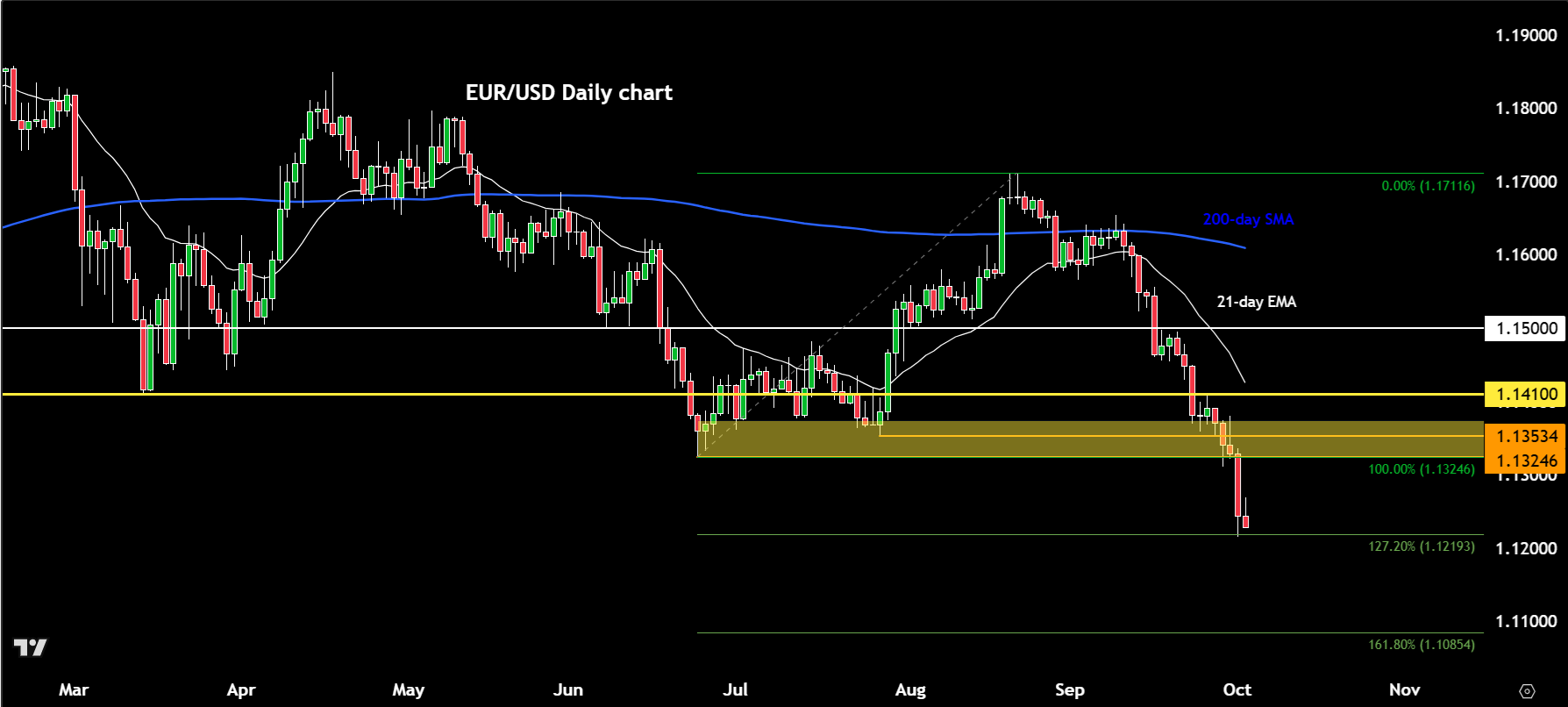
From a technical analysis point of view, the path of least resistance is to the downside. The yellow line at 1.1410 is the key resistance needed to be retained for this assessment, having supported earlier rallies before price broke back below it. Another zone, between, 1.1325-50 area is the more immediate resistance.
Frequently Asked Questions
Which other lower EUR/USD levels were identified?
Further down, 1.1200 is another round handle, while 1.1000 is the next major psychologically important level on EURUSD chart.
What could change the bearish outlook?
An unexpected US-Iran deal could ease crude oil prices and bond yields, providing EUR/USD and other major currency pairs with a reason to rally.

Related tags:

Open an account in minutes
Experience award-winning platforms with fast and secure execution.
Economic calendar
Web Trader platform
Our sophisticated web-based platform is packed with features.
Related articles

ASX 200 Outlook: Potential to Bounce Sits on a Knife Edge
ASX 200 bounce prospects remain on a knife edge as oversold technicals clash with weak financials, commodity pressures and global risk aversion.


US dollar rally loses yield support as Nvidia looms
US yields are retreating, but the dollar isn't following. With risk aversion potentially keeping it supported, Nvidia's results could determine whether emerging reversal signals in AUD/USD and EUR/USD develop further.

GBP/USD, GBP/JPY, GBP/AUD: Sterling Eyes UK Inflation Catalyst
Sterling faces a pivotal UK inflation test as traders weigh BoE tightening, Fed minutes and Australian employment data across GBP/USD, GBP/JPY and GBP/AUD.
StoneX Financial Ltd (trading as "FOREX.com") is an execution-only service provider. This material, whether or not it states any opinions, is for general information purposes only and it does not take into account your personal circumstances or objectives. This material has been prepared using the thoughts and opinions of the author and these may change. However, FOREX.com does not plan to provide further updates to any material once published and it is not under any obligation to keep this material up to date.
This material is short term in nature and may only relate to facts and circumstances existing at a specific time or day. Nothing in this material is (or should be considered to be) financial, investment, legal, tax or other advice and no reliance should be placed on it. No opinion given in this material constitutes a recommendation by FOREX.com or the author that any particular investment, security, transaction or investment strategy is suitable for any specific person.
The material has not been prepared in accordance with legal requirements designed to promote the independence of investment research. Although FOREX.com is not specifically prevented from dealing before providing this material, FOREX.com does not seek to take advantage of the material prior to its dissemination. This material is not intended for distribution to, or use by, any person in any country or jurisdiction where such distribution or use would be contrary to local law or regulation. For further details see our full non-independent research disclaimer and quarterly summary.