



EUR USD maintains bullish trend ahead of German elections
While it may be true that “everything is still possible,” as Former European Parliament President Martin Schulz recently stated to media regarding the upcoming German elections on Sunday, a commanding win by anyone other than current Chancellor Angela Merkel’s Christian Democratic Union (CDU) party is highly improbable, if polls are any indication. Merkel’s party has continued to lead in polling by double-digits over its closest rival, Shulz’s Social Democratic Party (SPD). While there still may be a possibility that the polls may have gotten it all wrong (e.g., Brexit referendum and Trump election), such a substantial polling lead by Merkel’s party would unlikely be so off the mark.
Share this:

While it may be true that “everything is still possible,” as Former European Parliament President Martin Schulz recently stated to media regarding the upcoming German elections on Sunday, a commanding win by anyone other than current Chancellor Angela Merkel’s Christian Democratic Union (CDU) party is highly improbable, if polls are any indication. Merkel’s party has continued to lead in polling by double-digits over its closest rival, Shulz’s Social Democratic Party (SPD). While there still may be a possibility that the polls may have gotten it all wrong (e.g., Brexit referendum and Trump election), such a substantial polling lead by Merkel’s party would unlikely be so off the mark.
The real risk for the euro does not necessarily lie in the unlikely event of Shulz becoming the new Chancellor, but in the ascendance of the anti-immigration and anti-EU party, Alternative for Germany (AfD), which has recently taken third place in polling at around 12% to the CDU’s 37% and the SPD’s 20%. Though it is highly unlikely that the AfD will command enough votes to even be considered for any part in a new coalition government, the threat of the AfD performing well in the elections and potentially being represented in the Bundestag will be of primary concern with respect to the euro. Much like in the French elections earlier this year, the fear of any power in the hands of anti-EU nationalists represents a significant threat to the viability of the shared currency, particularly since Germany is a dominant member of the Eurozone and European Union.
The likeliest scenario this Sunday will be a clear win by the CDU, with Merkel continuing on as Chancellor and forming a probable coalition government that excludes the AfD. Again, however, the risk of the AfD gaining more prominence and power is significant, and could negatively impact the high-flying euro if the party wins substantially more votes on Sunday than expected. Barring such an outcome, however, the probable event of a CDU/Merkel win with a new coalition government would likely see the euro continue to rally as the AfD threat potentially dissipates.
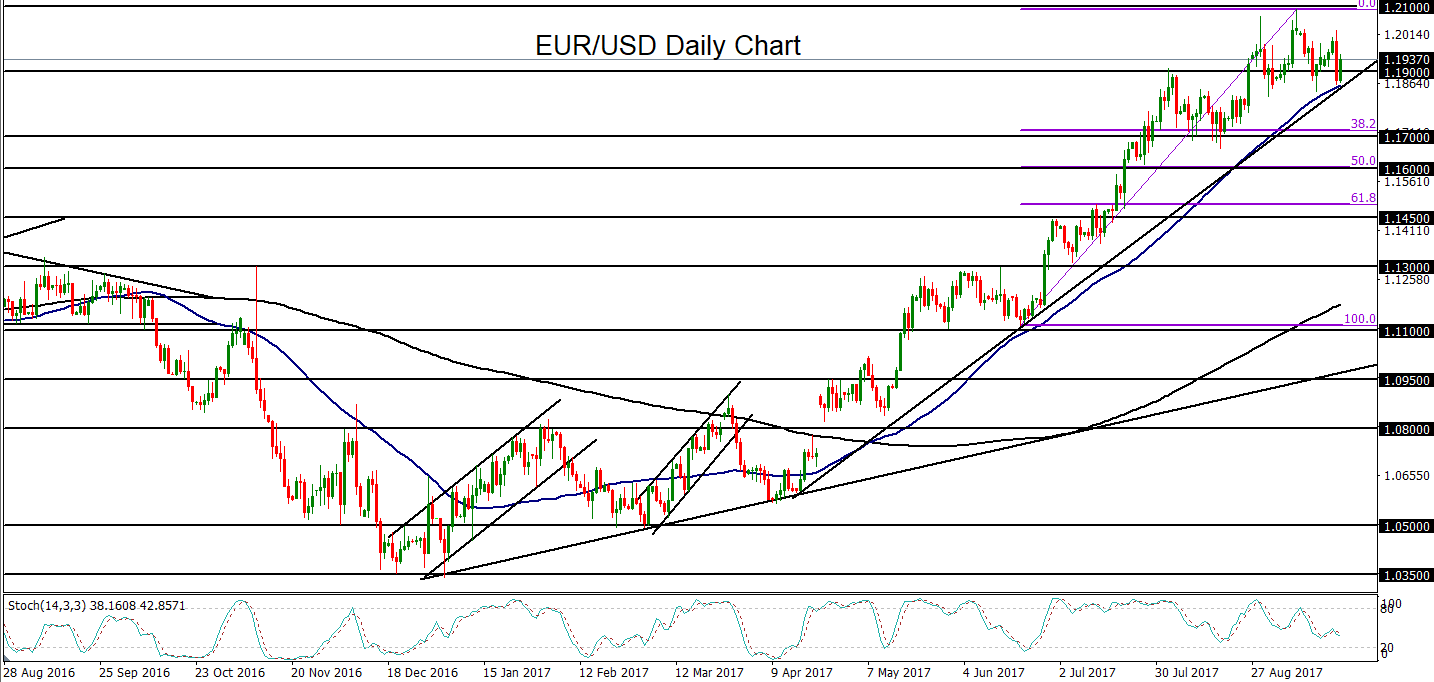
The bullish EUR/USD trend since the beginning of the year has been perpetuated by a long-struggling US dollar along with a rising euro that has been propelled in part by hints of potentially tighter monetary policy from the European Central Bank. The currency pair hit a new multi-year high just shy of 1.2100 only two weeks ago. Wednesday’s US dollar surge on the back of a hawkish Federal Reserve meeting prompted a EUR/USD drop to a key uptrend line extending back to April, as well as the 50-day moving average. Thursday saw a bounce from both the trend line and the moving average after the dollar pared some of its gains. If the German elections turn out as widely expected, EUR/USD could see a boost as election risk is taken off the table. In this event, a rally back up to 1.2100 could occur, with any further rise above 1.2100 confirming a continuation of this year’s sharp bullish trend.


Open an account in minutes
Experience award-winning platforms with fast and secure execution.
Economic calendar
Web Trader platform
Our sophisticated web-based platform is packed with features.
Related articles
China's steel slump leaves iron ore bulls under the pump
Iron ore has broken major support, threatening a return to the lows of 2022 as mounting evidence of weakness in China's steel sector reinforces the bearish outlook.

NZD/USD Forecast: Kiwi faces historic breakdown as RBNZ survey looms
NZD/USD is teetering above support that held through the pandemic and Liberation Day turmoil. With RBNZ hawks repeatedly disappointed, today's inflation expectations survey could open the door to a slide towards the GFC lows.

USD/JPY, AUD/JPY: Central Bank Divergence Creates Two-Way Risk
USD/JPY eyes a breakout above 160, while AUD/JPY faces further losses as Fed, RBA and BoJ interest rate expectations diverge.

StoneX Financial Ltd (trading as "FOREX.com") is an execution-only service provider. This material, whether or not it states any opinions, is for general information purposes only and it does not take into account your personal circumstances or objectives. This material has been prepared using the thoughts and opinions of the author and these may change. However, FOREX.com does not plan to provide further updates to any material once published and it is not under any obligation to keep this material up to date.
This material is short term in nature and may only relate to facts and circumstances existing at a specific time or day. Nothing in this material is (or should be considered to be) financial, investment, legal, tax or other advice and no reliance should be placed on it. No opinion given in this material constitutes a recommendation by FOREX.com or the author that any particular investment, security, transaction or investment strategy is suitable for any specific person.
The material has not been prepared in accordance with legal requirements designed to promote the independence of investment research. Although FOREX.com is not specifically prevented from dealing before providing this material, FOREX.com does not seek to take advantage of the material prior to its dissemination. This material is not intended for distribution to, or use by, any person in any country or jurisdiction where such distribution or use would be contrary to local law or regulation. For further details see our full non-independent research disclaimer and quarterly summary.