


EUR/USD Forecast: The Euro Fails to Recover Despite U.S. Political Uncertainty
The EUR/USD has posted two consecutive losing sessions, with a short-term decline of nearly 0.6% in favor of the U.S. dollar. For now, the pair shows a neutral bias, mainly due to political uncertainty in the U.S., which has pushed the market into a sideways pattern and prevented the formation of consistent directional moves.
Share this:

The EUR/USD has posted two consecutive losing sessions, with a short-term decline of nearly 0.6% in favor of the U.S. dollar. For now, the pair shows a neutral bias, mainly due to political uncertainty in the U.S., which has pushed the market into a sideways pattern and prevented the formation of consistent directional moves. As long as this situation persists, neutrality could continue to dominate in the coming trading sessions.


What’s Happening in the U.S.?
The government shutdown has entered its second day, and there is still no clarity on how it will be resolved or how long it might last. Non-essential government activities have been suspended, leaving hundreds of thousands of federal employees without pay or work, and so far neither the Executive nor the Senate has given clear signs that the situation will be resolved this week.
This event reflects a deterioration in political confidence and poses an institutional risk regarding government functionality. If prolonged, it could cause billions in losses to U.S. GDP due to the paralysis of key economic agencies. Although the impact has not yet been strongly reflected in the dollar, a longer shutdown—like the last one, which lasted more than a month—could significantly erode confidence in the currency.
Another point to consider is that among the agencies affected by the shutdown are those responsible for releasing employment data, meaning tomorrow’s scheduled Non-Farm Payrolls report could be delayed. Without such key economic indicators, the Federal Reserve would have fewer tools for decision-making, reinforcing expectations that there could still be two more rate cuts before the end of the year. Lower rates reduce the appeal of dollar-denominated assets and could, in the medium term, weaken the currency as an indirect consequence of the shutdown.
In conclusion, while the dollar has not yet shown a sharp decline in the face of political risk, if the shutdown continues for several weeks, it would heighten distrust in the greenback—both due to institutional instability and the lack of economic data. In that case, the euro could benefit from more consistent buying pressure in the short term.
What Does the European Central Bank Think?
There were also important ECB updates this week. President Christine Lagarde stated that inflation risks in the eurozone are under control and highlighted that the eurozone economy has held up well despite U.S. tariffs. However, she also noted that the central bank would likely maintain a neutral stance in upcoming decisions to prevent inflation from rising again.
Recent data shows that annual inflation for September rose to 2.2%, up from 2.0% in August, confirming that prices have started to climb again.
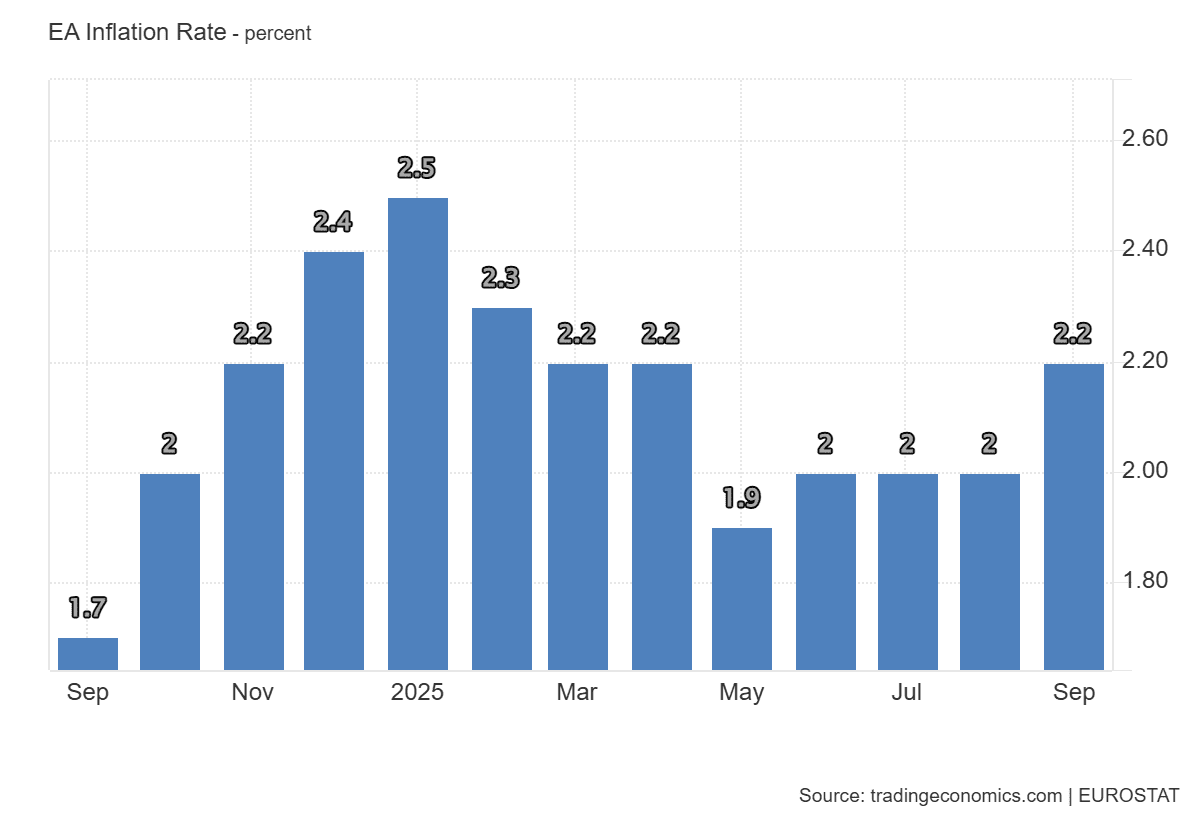
Source: TradingEconomics
Following these remarks, the ECB Watch tool now shows a 98.2% probability that the current 2.00% deposit rate will remain unchanged at the October 28 meeting. This is in line with the ECB’s rhetoric of prioritizing stability without resorting to rate cuts.
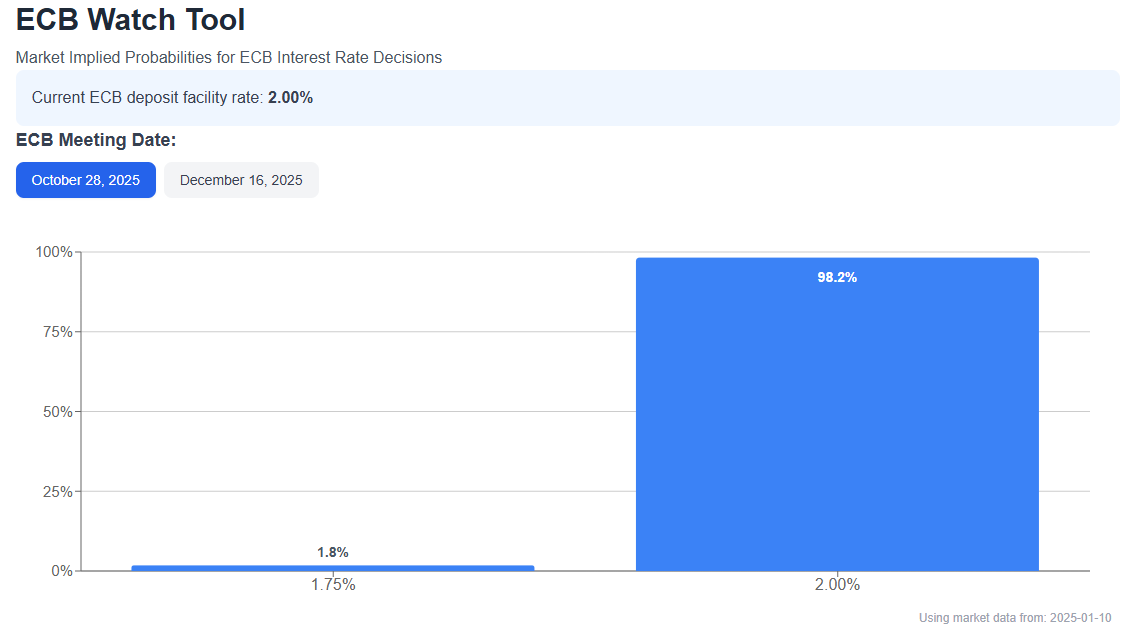
Source: ECBWATCH
In this context, it appears the ECB will remain neutral through the rest of the year. This stance contrasts with the more accommodative policy the Fed may adopt, which would reduce the interest rate differential between the two regions. Over time, this dynamic could make dollar investments less attractive while generating buying pressure on the euro, potentially paving the way for a relevant bullish bias in EUR/USD in the coming weeks.
EUR/USD Technical Outlook
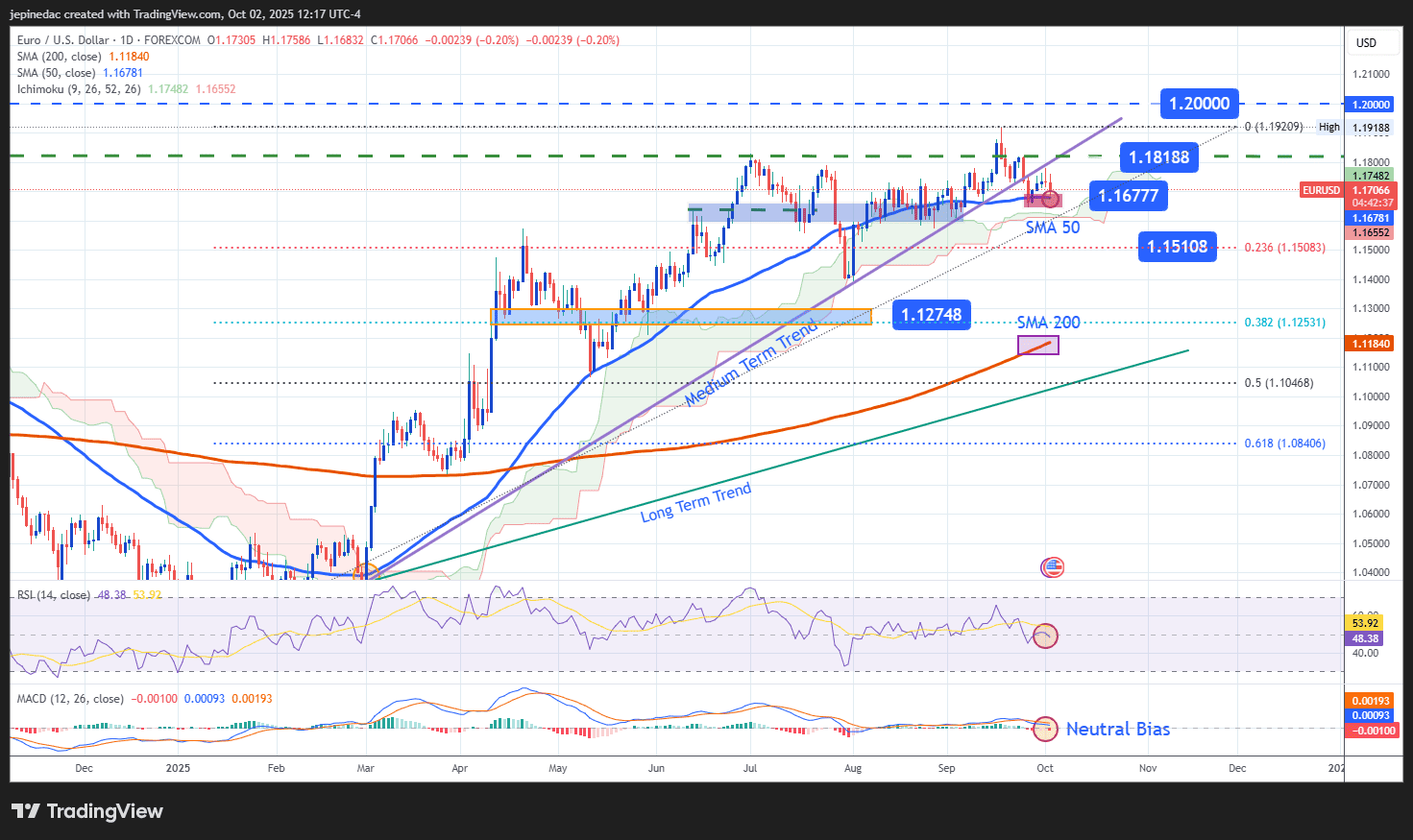
Source: StoneX, Tradingview
- Bearish momentum emerges: Since September 17, EUR/USD has been setting progressively lower lows, reinforcing a short-term bearish bias. However, the emergence of indecision candles around key support levels casts doubt on the strength of this move, which is not yet enough to establish a solid downtrend. Unless selling pressure breaks through key barriers, a neutral scenario could prevail in the short term.
- RSI: The RSI line has crossed below the 50 neutral level and continues to oscillate beneath it in recent sessions, signaling that bearish momentum has taken hold over the average of the last 14 sessions. As long as this downward slope persists, selling pressure could become more relevant in the coming days.
- MACD: The MACD shows a somewhat different picture. While the histogram continues to oscillate below the zero line, it remains close to neutrality, reflecting indecision in short-term moving averages. Unless the histogram pushes further into negative territory, this could indicate the formation of a neutral consolidation around the current EUR/USD support zone.
Key Levels:
- 1.16777 – Current Barrier: Corresponds to the zone marked by the 50-period simple moving average and is also near the Ichimoku cloud, making it the most important bearish barrier to watch. A sustained break below could mark a true reversal of the previous bullish trend and open the door to a new bearish phase.
- 1.18188 – Nearby Resistance: A zone of recent weekly highs where price has repeatedly retreated. As long as price action struggles to break this level, the pair could consolidate into a short-term sideways range.
- 1.20000 – Major Resistance: A key psychological level. A clean breakout above could trigger a more aggressive rally and reactivate the long-term bullish trendline that was broken in previous sessions.
Written by Julian Pineda, CFA – Market Analyst
Follow him: @julianpineda25
Related tags:


Open an account in minutes
Experience award-winning platforms with fast and secure execution.
Economic calendar
Web Trader platform
Our sophisticated web-based platform is packed with features.
Related articles

US dollar outlook: Fed hike priced | FOREX Friday
A December Fed rate hike looks fully priced in, as the dollar stays below this week's highs despite strong US data, while gold, silver and the EUR/USD rebound. Fawad Razaqzada explains why next week's jobs report is the main event, and the Dollar Index levels to watch.


EUR/USD Recovers as Markets Fully Price in Fed Hike
EUR/USD outlook turns on Fed pricing, as the euro recovers while strong U.S. data fails to lift a dollar that has already priced in Fed tightening.

How FX Majors Stack Up Against US Dollar Weakness in December
December has historically favoured a weaker US dollar. We compare the seasonal performance and timing of the major currency pairs.

StoneX Financial Ltd (trading as "FOREX.com") is an execution-only service provider. This material, whether or not it states any opinions, is for general information purposes only and it does not take into account your personal circumstances or objectives. This material has been prepared using the thoughts and opinions of the author and these may change. However, FOREX.com does not plan to provide further updates to any material once published and it is not under any obligation to keep this material up to date.
This material is short term in nature and may only relate to facts and circumstances existing at a specific time or day. Nothing in this material is (or should be considered to be) financial, investment, legal, tax or other advice and no reliance should be placed on it. No opinion given in this material constitutes a recommendation by FOREX.com or the author that any particular investment, security, transaction or investment strategy is suitable for any specific person.
The material has not been prepared in accordance with legal requirements designed to promote the independence of investment research. Although FOREX.com is not specifically prevented from dealing before providing this material, FOREX.com does not seek to take advantage of the material prior to its dissemination. This material is not intended for distribution to, or use by, any person in any country or jurisdiction where such distribution or use would be contrary to local law or regulation. For further details see our full non-independent research disclaimer and quarterly summary.