



Is market volatility down to stay or just in a temporary lull
As equity markets continued to rally sharply on Tuesday on the back of a strong start to corporate earnings season and decreased concerns over geopolitical risk, market fear as measured by the VIX volatility index continued to march lower.
Share this:

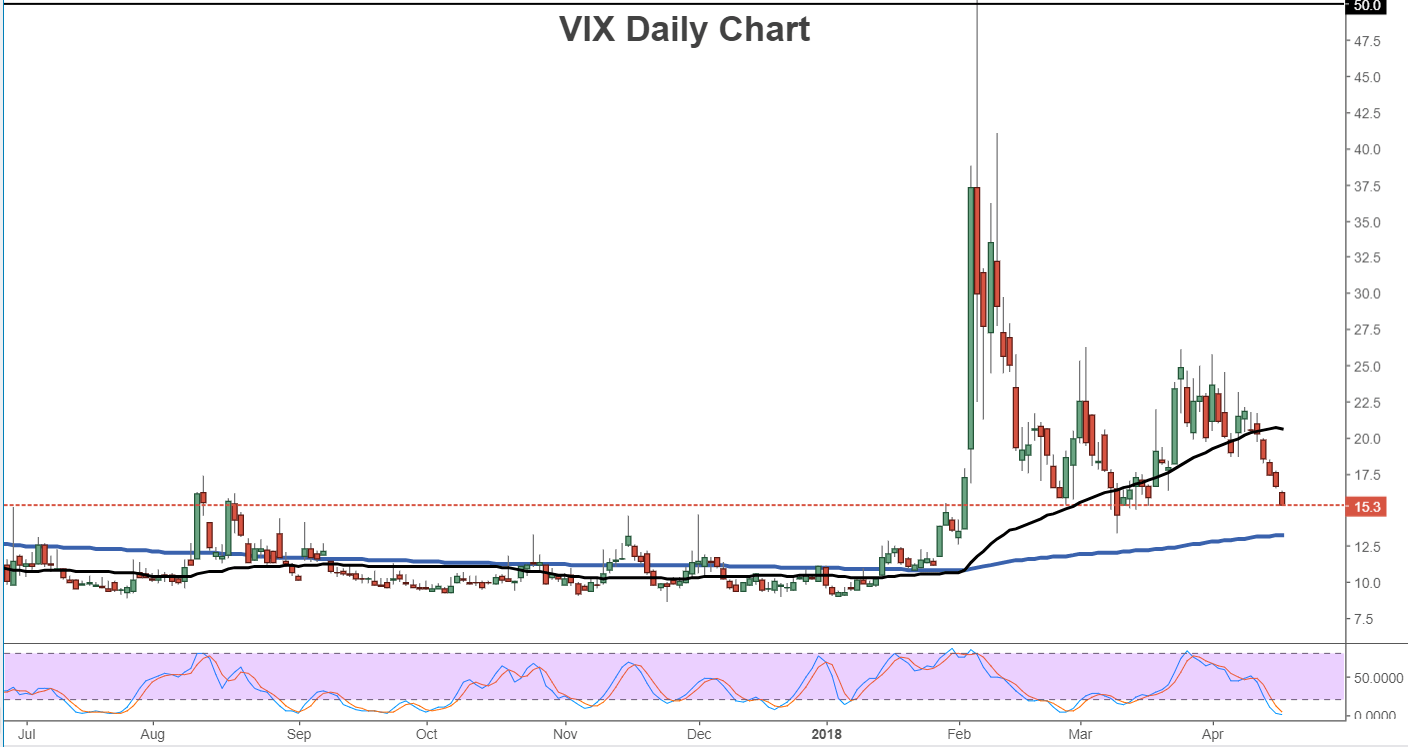
As equity markets continued to rally sharply on Tuesday on the back of a strong start to corporate earnings season and decreased concerns over geopolitical risk, market fear as measured by the VIX volatility index continued to march lower. Since the sharp but short-lived stock correction in early February, during which the VIX recorded its largest one-day rise in its history at 116%, market volatility has declined sharply but has still remained in fluctuation around historically higher levels.
In the past 2-3 months, concerns over rising inflation and interest rates, increased political instability in the White House, President Trump’s protectionist trade policies, the specter of a trade war between the US and China, and rising geopolitical tensions over the Middle East, have all contributed at overlapping times to increased volatility in equity markets and an elevated VIX.
While none of the concern factors noted above have gone away – in fact, some can easily be re-triggered and exacerbated at any moment – markets have recently appeared to become more desensitized to the heightened perception of risk that has prevailed in the last few months. Even last week’s surprise attack on Syrian chemical weapons facilities by the US, UK, and France, which may still result in more intensified conflict between the US and Russia, led to only stronger markets and lowered volatility.
The last several trading days from mid-week last week have seen stock markets rise out of a choppy consolidation while the VIX fear gauge has continued to gap lower and decline to more normal levels, currently just above 15. It should be noted, however, that a similar volatility decline occurred in early March, but was quickly followed by yet another surge in the VIX as market fear returned. Therefore, the question remains as to whether the VIX’s current drop may just be a temporary lull or if it can be seen as a bonafide return to the business-as-usual market environment that prevailed throughout most of last year.
If previous volatility spikes are any indication, most notably the latest major one that began in August of 2015, a return to prior low levels of volatility can often take 2-3 months, but may sometimes take longer. The current VIX elevation is nearing two-and-a-half months old. While this is not to say that markets are fully back to “normal” or that 2017’s exceptionally low levels of volatility will return this year, the reliably mean-reverting tendency of volatility and the VIX suggests that calmer, less violently reactive markets may prevail, at least for the foreseeable future.


Open an account in minutes
Experience award-winning platforms with fast and secure execution.
Economic calendar
Web Trader platform
Our sophisticated web-based platform is packed with features.
Related articles
China's steel slump leaves iron ore bulls under the pump
Iron ore has broken major support, threatening a return to the lows of 2022 as mounting evidence of weakness in China's steel sector reinforces the bearish outlook.

NZD/USD Forecast: Kiwi faces historic breakdown as RBNZ survey looms
NZD/USD is teetering above support that held through the pandemic and Liberation Day turmoil. With RBNZ hawks repeatedly disappointed, today's inflation expectations survey could open the door to a slide towards the GFC lows.

DXY, GBP/USD, AUD/USD, USD/CAD, USD/JPY, Gold Weekly Technical Outlook 11 16 2026
Sr. Technical Strategist Michael Boutros highlights the levels that matter on the USD Majors, commodities, and equity indices charts this week.

StoneX Financial Ltd (trading as "FOREX.com") is an execution-only service provider. This material, whether or not it states any opinions, is for general information purposes only and it does not take into account your personal circumstances or objectives. This material has been prepared using the thoughts and opinions of the author and these may change. However, FOREX.com does not plan to provide further updates to any material once published and it is not under any obligation to keep this material up to date.
This material is short term in nature and may only relate to facts and circumstances existing at a specific time or day. Nothing in this material is (or should be considered to be) financial, investment, legal, tax or other advice and no reliance should be placed on it. No opinion given in this material constitutes a recommendation by FOREX.com or the author that any particular investment, security, transaction or investment strategy is suitable for any specific person.
The material has not been prepared in accordance with legal requirements designed to promote the independence of investment research. Although FOREX.com is not specifically prevented from dealing before providing this material, FOREX.com does not seek to take advantage of the material prior to its dissemination. This material is not intended for distribution to, or use by, any person in any country or jurisdiction where such distribution or use would be contrary to local law or regulation. For further details see our full non-independent research disclaimer and quarterly summary.