



Japanese Yen Short Covering Raises the Stakes for USD/JPY
Japanese yen short covering, intervention risks and US CPI leave USD/JPY at a pivotal level, while AUD/JPY offers alternative trade setups.
Share this:

Japanese yen volatility has returned as traders unwind record short positions ahead of US CPI. With USD/JPY testing major resistance below 163 and intervention risks lingering, futures positioning suggests gains may become harder to come by. Here are the key USD/JPY and AUD/JPY trade setups to watch.
View related analysis:
View related analysis:
Japanese Yen Short Covering Puts USD/JPY at a Critical Juncture
Japanese Yen Volatility Returns Ahead of US CPI
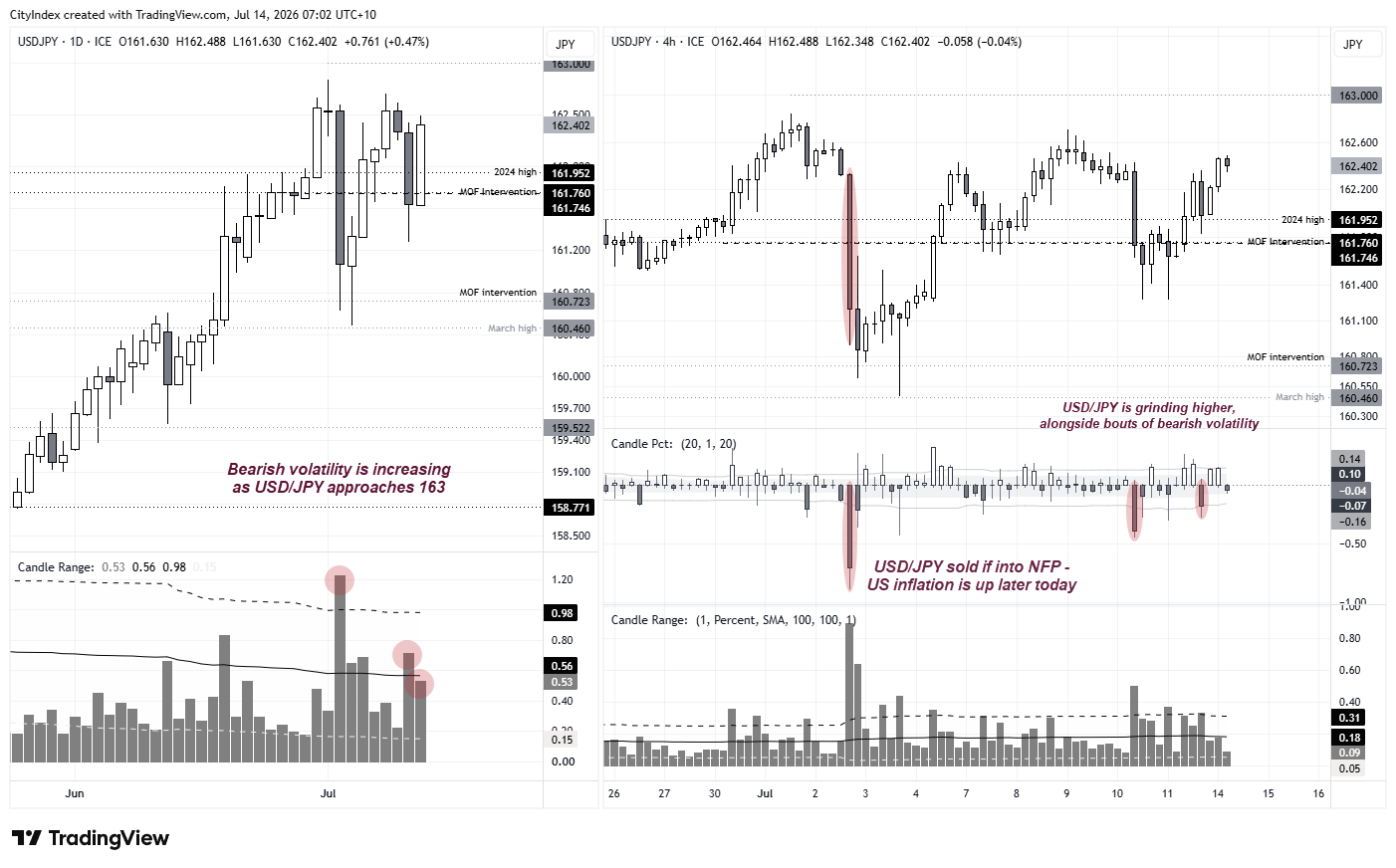
Volatility has perked up for the Japanese yen over the past few weeks, and it has cut both ways. A market-led selloff heading into the 2 July non-farm payrolls (NFP) report saw USD/JPY fall by as much as 200 pips before recouping those losses over the following four days. On Friday, USD/JPY fell more than 100 pips on reports that Japan's largest pension fund had been instructed to purchase domestic assets.
This is quite a significant development because it suggests Japan is exploring alternative ways of supporting the yen besides traditional currency intervention. It could prove a shrewd approach, allowing policymakers to avoid swimming against the tide while the Federal Reserve maintains a hawkish stance and US economic data continues to outperform.
Source: ICE, TradingView
Yen Gains May Be Harder to Come By
I think the bigger takeaway is that easy gains on USD/JPY may be harder to come by, but that is not the same as saying the pair cannot move higher. The combination of traders remaining wary of potential intervention, alongside efforts to support the yen without directly intervening, could allow USD/JPY to grind higher while keeping volatility elevated. Put another way, the broader uptrend may remain intact, but traders should expect more frequent bouts of two-way price action.
With USD/JPY testing resistance ahead of today's US inflation report, traders are on high alert for either a bullish breakout or a sharp reversal. Markets continue to price in a hawkish Fed, so it may not take much of a downside CPI surprise to shake the market from these elevated levels, particularly as Japanese yen bears continue to capitulate in the futures market.


Japanese Yen Futures Positioning: USD/JPY COT Report
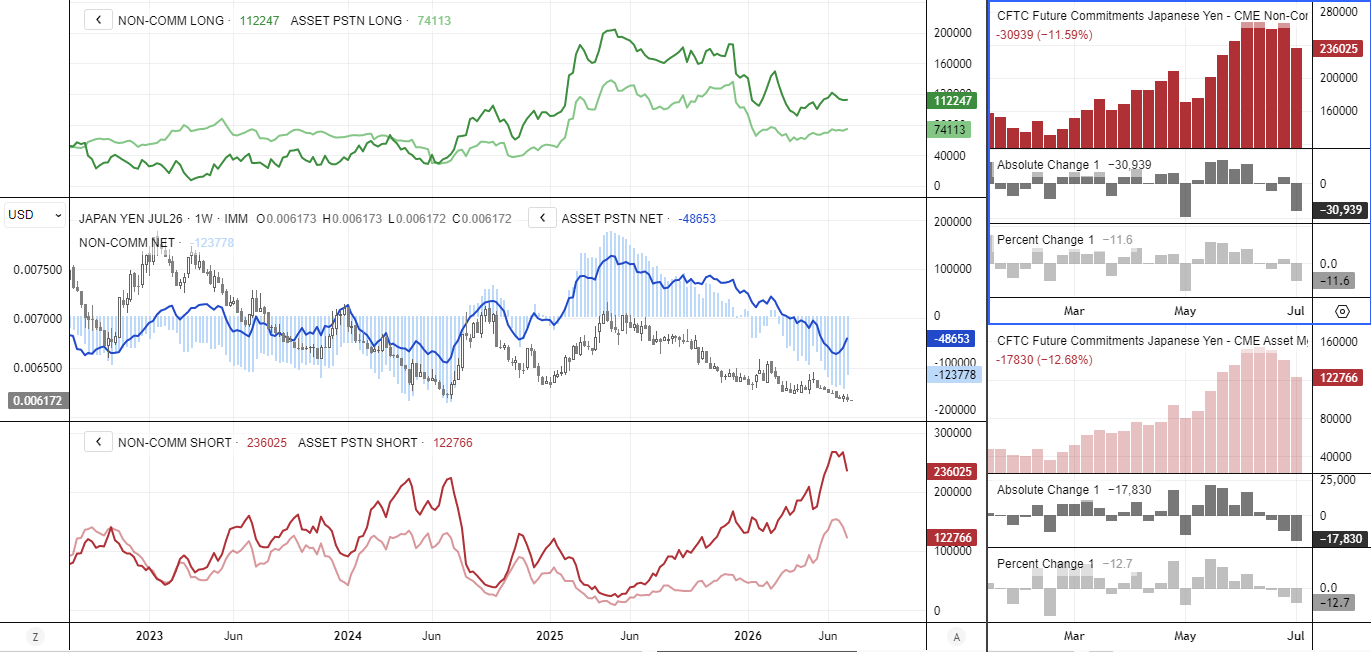
I have been warning for several weeks about the potential sentiment extreme in Japanese yen futures. Gross short positions had climbed to record highs among both asset managers and large speculators, while long positions also edged higher despite the yen's persistent downtrend (USD/JPY uptrend). That pushed net-short exposure close to two-year highs for both groups of traders.
However, the latest Commitment of Traders (COT) report showed a clear reduction in bearish positioning last week. Gross short exposure was cut by a combined 48.8k contracts across both trader groups, falling 11.6% among large speculators and 12.7% among asset managers. Long positions increased only marginally, making this a story of short covering rather than fresh bullish conviction.
The conditions are not yet in place for a sustained yen rally, but if bearish traders continue heading for the exit, gains on USD/JPY may become harder to come by than they have been over recent months.
Source: CFTC (COT), CME, LSEG
USD/JPY Technical Analysis: US Dollar vs Japanese Yen
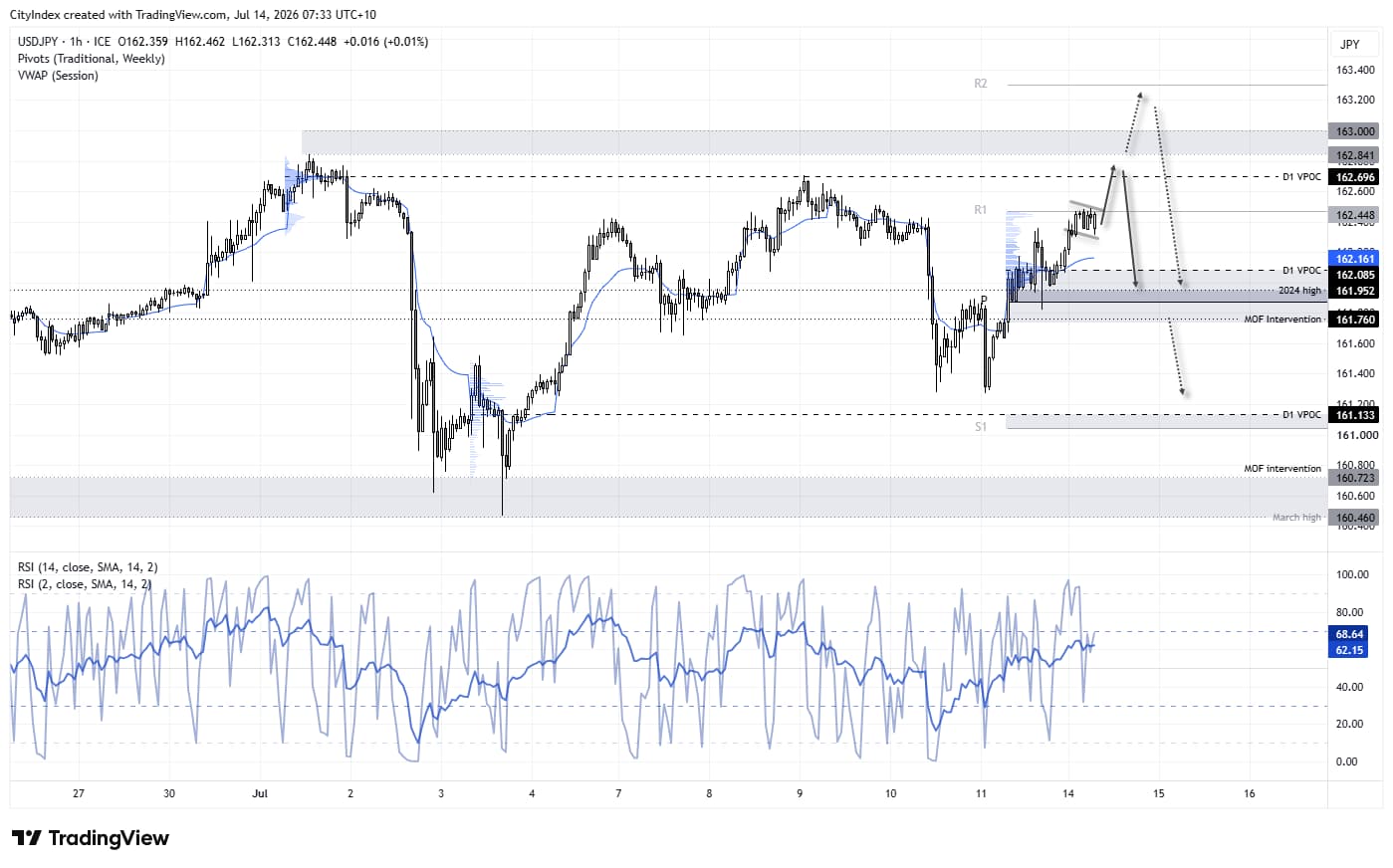
The 1-hour chart shows a decent uptrend from Monday's low. Prices are testing the weekly R1 pivot point while remaining above their daily, weekly and monthly VWAPs. We could see an early breakout attempt during today's session towards the cycle highs, although traders should note the July VPOC at 162.69, which aligns with last week's high and could provide resistance.
Bulls may also want to tread carefully around the cycle highs and take note of the pre-NFP price action, as it could trigger another pre-emptive pullback. Even so, several support levels are clustered around 162, including the 2024 high, the weekly pivot point and Monday's VPOC.
It could then come down to the US inflation report to determine whether we see a meaningful breakout or a deeper pullback. While a hot CPI report could tempt bulls to push above 163, I suspect the bigger move may come from a softer-than-expected print. That could see USD/JPY rotate lower within its recent choppy range between 160 and 162.50.
Ultimately, I suspect CPI will need to surprise decisively to the upside for any breakout above 163 to prove sustainable.
Source: ICE, TradingView
This content was created by an affiliate of FOREX.com and represents the views and opinions of the author/speakers, not the views and opinions of FOREX.com, StoneX Group Inc., or its subsidiaries. The content has not been independently reviewed by FOREX.com
AUD/JPY Technical Analysis: Australian Dollar vs Japanese Yen
Compared with USD/JPY, volatility remains lower on AUD/JPY. Yet it has caught my attention because it presents several clusters of support and resistance that could provide attractive trading setups. It also partially removes some of the event risk associated with the US inflation report.
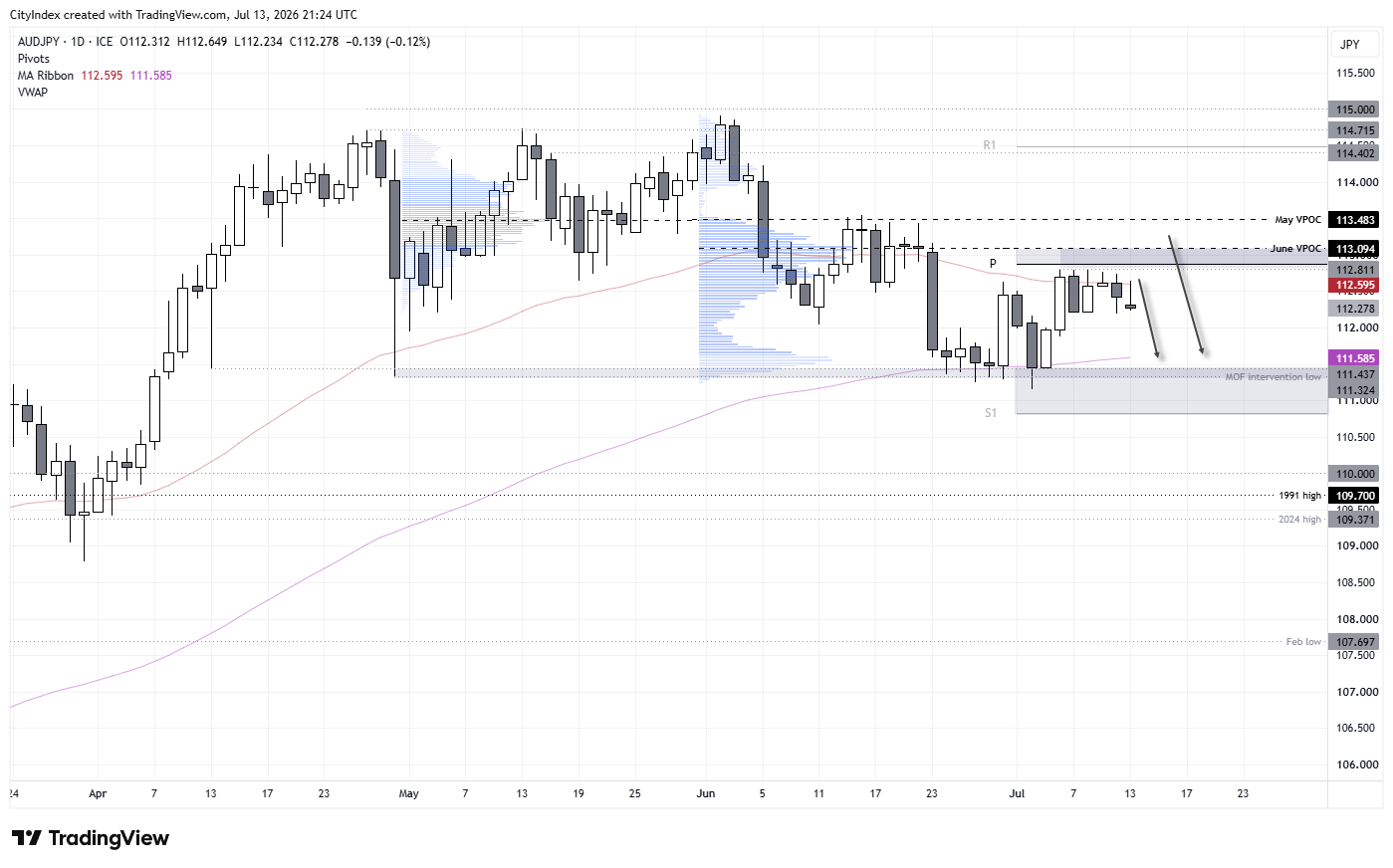
The daily chart shows prices oscillating between the 50-day and 100-day EMAs. Momentum has turned slightly lower from last week's high and monthly pivot point, while Monday's shooting star signals a failed attempt to retest Friday's doji high.
Even if prices spike above last week's high, the June VPOC sits at 113.09 and could provide resistance, followed by the May VPOC at 113.48. While 112 may offer initial support, a break below that level brings the 100-day EMA into focus, near the Ministry of Finance (MOF) intervention low.
Source: ICE, TradingView
View the full economic calendar
View the full economic calendar
-- Written by Matt Simpson
Follow Matt on Twitter @cLeverEdge
How to trade with City Index
You can trade with City Index by following these four easy steps:
- Open an account, or log in if you’re already a customer
• Open an account in the UK
• Open an account in Australia
• Open an account in Singapore
- Search for the market you want to trade in our award-winning platform
- Choose your position and size, and your stop and limit levels
- Place the trade
Related tags:

Open an account in minutes
Experience award-winning platforms with fast and secure execution.
Economic calendar
Web Trader platform
Our sophisticated web-based platform is packed with features.
Related articles

NZD/USD Forecast: Kiwi faces historic breakdown as RBNZ survey looms
NZD/USD is teetering above support that held through the pandemic and Liberation Day turmoil. With RBNZ hawks repeatedly disappointed, today's inflation expectations survey could open the door to a slide towards the GFC lows.

USD/JPY, AUD/JPY: Central Bank Divergence Creates Two-Way Risk
USD/JPY eyes a breakout above 160, while AUD/JPY faces further losses as Fed, RBA and BoJ interest rate expectations diverge.

DXY, GBP/USD, AUD/USD, USD/CAD, USD/JPY, Gold Weekly Technical Outlook 11 16 2026
Sr. Technical Strategist Michael Boutros highlights the levels that matter on the USD Majors, commodities, and equity indices charts this week.

StoneX Financial Ltd (trading as "FOREX.com") is an execution-only service provider. This material, whether or not it states any opinions, is for general information purposes only and it does not take into account your personal circumstances or objectives. This material has been prepared using the thoughts and opinions of the author and these may change. However, FOREX.com does not plan to provide further updates to any material once published and it is not under any obligation to keep this material up to date.
This material is short term in nature and may only relate to facts and circumstances existing at a specific time or day. Nothing in this material is (or should be considered to be) financial, investment, legal, tax or other advice and no reliance should be placed on it. No opinion given in this material constitutes a recommendation by FOREX.com or the author that any particular investment, security, transaction or investment strategy is suitable for any specific person.
The material has not been prepared in accordance with legal requirements designed to promote the independence of investment research. Although FOREX.com is not specifically prevented from dealing before providing this material, FOREX.com does not seek to take advantage of the material prior to its dissemination. This material is not intended for distribution to, or use by, any person in any country or jurisdiction where such distribution or use would be contrary to local law or regulation. For further details see our full non-independent research disclaimer and quarterly summary.