



Mind the Gap after Brexit Vote
Markets are likely to gap on the reopen Monday morning in Asia
Share this:

According to Investopedia, “a gap is an area of a chart where a security’s price either rises or falls from the previous day’s close with no trading occurring in between.” Let’s look at the logic behind this: traders don’t perceive value above or below the previous day’s close until a certain level. Traders will step into the market at a certain level usually for 1 of 2 reasons:
- A trader believes price will reverse (i.e.…move back into the gap) and move in the opposite direction, therefore providing him value
- A trader will take profits and close out a position by buying or selling in the opposite direction of the gap
The first price traded will be the price to measure the distance of the gap (from the previous day’s close to the first price level traded). Large gaps can be dangerous to a solvency of a trader.
It’s rare to have a gap in currency markets, as they are traded 24 hours. Therefore, there is no open or close to “gap”. However, currency markets can gap over weekends, as the market is closed from Friday evening New York until Monday morning Asia.
The UK Parliament vote on Saturday is a binary event. The vote is going to either pass or fail. As a result, the markets are likely to gap on the reopen Monday morning in Asia (Sunday evening in US). If the Brexit vote passes, the Pound and Euro pairs, along with stock indexes, are likely to gap higher. If the Brexit vote fails, the Pound and Euro pair, along with stock indexes, are likely to gap lower.
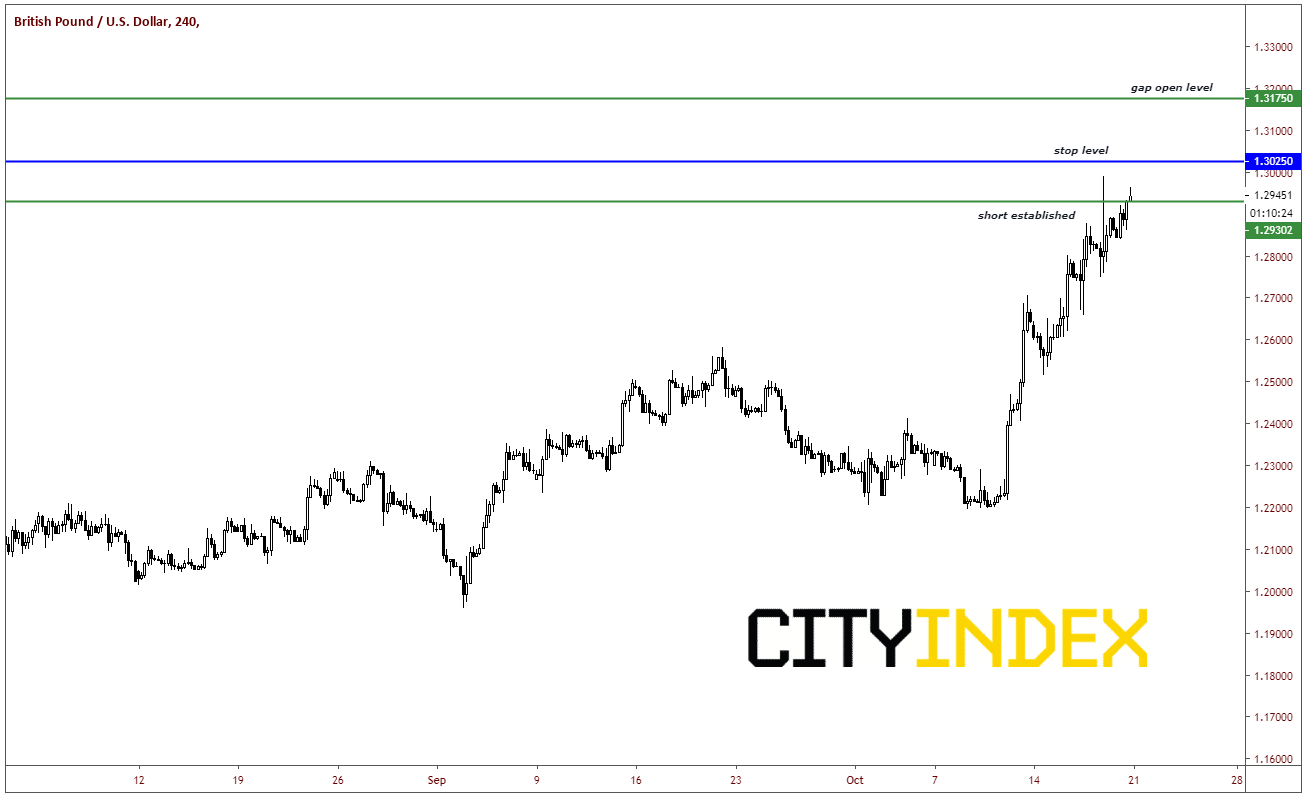
As an example, let’s say that I believe the Brexit vote will fail, and I am short GBP/USD from 1.2925. I have placed a stop at 1.3025 (100 pips away). Assume now that the Brexit vote passes, and price gaps higher on the Monday morning Asian open to 1.3175. My stop order (which is now a buy or “get me out” order) will not be filled until there is a seller, which is at 1.3170 OR HIGHER, depending on how many other sellers are at that level. Therefore on the gap, my stop order, which was a 100-pip loss, now becomes a 250-pip loss. This is the reason gaps can be so dangerous to traders.
Source: Tradingview, City Index
On the other hand, if price gaps lower, I could be in the money by the same amount. Acceptable risk/reward should be considered for each trader.
My colleague Matt Simpson wrote about measuring GBP price possibilities via implied volatility earlier today. Check it out here.
According to Investopedia, “a gap is an area of a chart where a security’s price either rises or falls from the previous day’s close with no trading occurring in between.” Let’s look at the logic behind this: traders don’t perceive value above or below the previous day’s close until a certain level. Traders will step into the market at a certain level usually for 1 of 2 reasons:
- A trader believes price will reverse (i.e.…move back into the gap) and move in the opposite direction, therefore providing him value
- A trader will take profits and close out a position by buying or selling in the opposite direction of the gap
The first price traded will be the price to measure the distance of the gap (from the previous day’s close to the first price level traded). Large gaps can be dangerous to a solvency of a trader.
It’s rare to have a gap in currency markets, as they are traded 24 hours. Therefore, there is no open or close to “gap”. However, currency markets can gap over weekends, as the market is closed from Friday evening New York until Monday morning Asia.
The UK Parliament vote on Saturday is a binary event. The vote is going to either pass or fail. As a result, the markets are likely to gap on the reopen Monday morning in Asia (Sunday evening in US). If the Brexit vote passes, the Pound and Euro pairs, along with stock indexes, are likely to gap higher. If the Brexit vote fails, the Pound and Euro pair, along with stock indexes, are likely to gap lower.
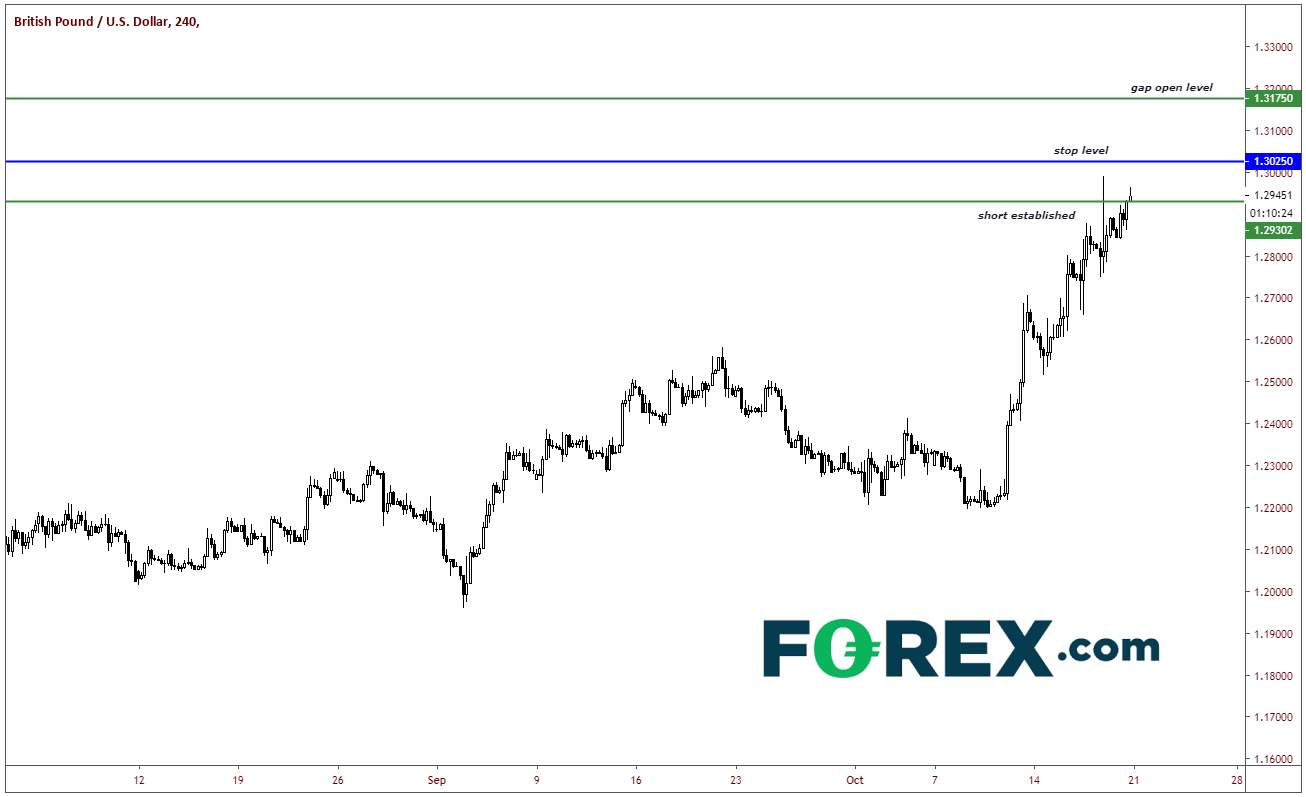
As an example, let’s say that I believe the Brexit vote will fail, and I am short GBP/USD from 1.2925. I have placed a stop at 1.3025 (100 pips away). Assume now that the Brexit vote passes, and price gaps higher on the Monday morning Asian open to 1.3175. My stop order (which is now a buy or “get me out” order) will not be filled until there is a seller, which is at 1.3170 OR HIGHER, depending on how many other sellers are at that level. Therefore on the gap, my stop order, which was a 100-pip loss, now becomes a 250-pip loss. This is the reason gaps can be so dangerous to traders.
Source: Tradingview, FOREX.com
On the other hand, if price gaps lower, I could be in the money by the same amount. Acceptable risk/reward should be considered for each trader.
My colleague Matt Simpson wrote about measuring GBP price possibilities via implied volatility earlier today. Check it out here.
Latest market news



Open an account in minutes
Experience award-winning platforms with fast and secure execution.
Economic calendar
Web Trader platform
Our sophisticated web-based platform is packed with features.
Related articles
USD/JPY, AUD/JPY: Central Bank Divergence Creates Two-Way Risk
USD/JPY eyes a breakout above 160, while AUD/JPY faces further losses as Fed, RBA and BoJ interest rate expectations diverge.
DXY, GBP/USD, AUD/USD, USD/CAD, USD/JPY, Gold Weekly Technical Outlook 11 16 2026
Sr. Technical Strategist Michael Boutros highlights the levels that matter on the USD Majors, commodities, and equity indices charts this week.

EUR/USD forecast: Dollar strength puts 1.1000 support in the spotlight | Currency Pair of the Week
The dollar extended its recent advance at the start of the week, with weakness across risk-sensitive assets reinforcing demand for the US currency. US equity futures slipped ahead of Nvidia’s earnings on Tuesday and an expected stock market debut by Anthropic later this week. Both events represent important tests for an AI trade that has become increasingly vulnerable to shifts in sentiment. In FX, EUR/USD nearly tested the psychologically important 1.1000 level, before bouncing modestly off its lows.

StoneX Financial Ltd (trading as "FOREX.com") is an execution-only service provider. This material, whether or not it states any opinions, is for general information purposes only and it does not take into account your personal circumstances or objectives. This material has been prepared using the thoughts and opinions of the author and these may change. However, FOREX.com does not plan to provide further updates to any material once published and it is not under any obligation to keep this material up to date.
This material is short term in nature and may only relate to facts and circumstances existing at a specific time or day. Nothing in this material is (or should be considered to be) financial, investment, legal, tax or other advice and no reliance should be placed on it. No opinion given in this material constitutes a recommendation by FOREX.com or the author that any particular investment, security, transaction or investment strategy is suitable for any specific person.
The material has not been prepared in accordance with legal requirements designed to promote the independence of investment research. Although FOREX.com is not specifically prevented from dealing before providing this material, FOREX.com does not seek to take advantage of the material prior to its dissemination. This material is not intended for distribution to, or use by, any person in any country or jurisdiction where such distribution or use would be contrary to local law or regulation. For further details see our full non-independent research disclaimer and quarterly summary.