





NZD/USD Outlook: New Zealand Dollar Weakens Ahead of RBNZ Decision
The NZD/USD pair has fallen more than 1% over the past four trading sessions, favoring the U.S. dollar over the New Zealand dollar. For now, the bearish bias remains intact as the market awaits the Reserve Bank of New Zealand’s (RBNZ) interest rate decision.
Share this:

The NZD/USD pair has fallen more than 1% over the past four trading sessions, favoring the U.S. dollar over the New Zealand dollar. For now, the bearish bias remains intact as the market awaits the Reserve Bank of New Zealand’s (RBNZ) interest rate decision, amid continued uncertainty surrounding the Federal Reserve’s next moves. If New Zealand confirms a rate cut, selling pressure on the pair could intensify in the short term.
RBNZ Decision Day Arrives
Today, the RBNZ is expected to announce its next monetary policy decision, and current consensus points to a 25-basis point cut, bringing the rate from 3.25% down to 3.00%. Markets believe the central bank views inflation as under control, with the most recent annual figure at 2.7%, comfortably below the 3% upper limit of its inflation target. Signs of labor market weakness have also emerged, reinforcing the case for starting a new rate-cutting cycle, likely holding the rate at 3.00% in the short term.
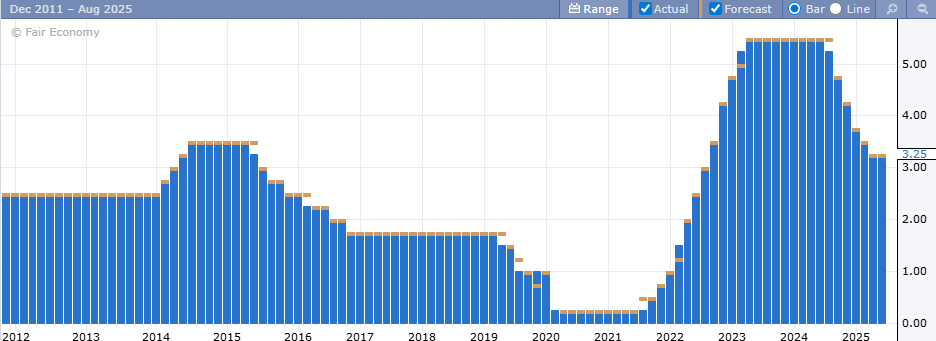
Source: ForexFactory
In this environment, pressure on the New Zealand dollar has started to build. A lower interest rate reduces the country’s investment appeal, particularly for fixed-income instruments, and could lead to capital outflows toward economies with higher yields, weakening demand for the NZD. If the RBNZ confirms a dovish tone and signals further cuts ahead, downward pressure on NZD/USD is likely to persist in the coming sessions.
What About the U.S.?
The situation at the Federal Reserve is becoming increasingly similar. Market participants are raising the probability that the Fed will also begin a rate-cutting cycle. According to data from CME Group, there is currently an 83.1% chance of a rate cut from 4.5% to 4.25% at the next September 17 meeting, which would align with the stance expected from the RBNZ.
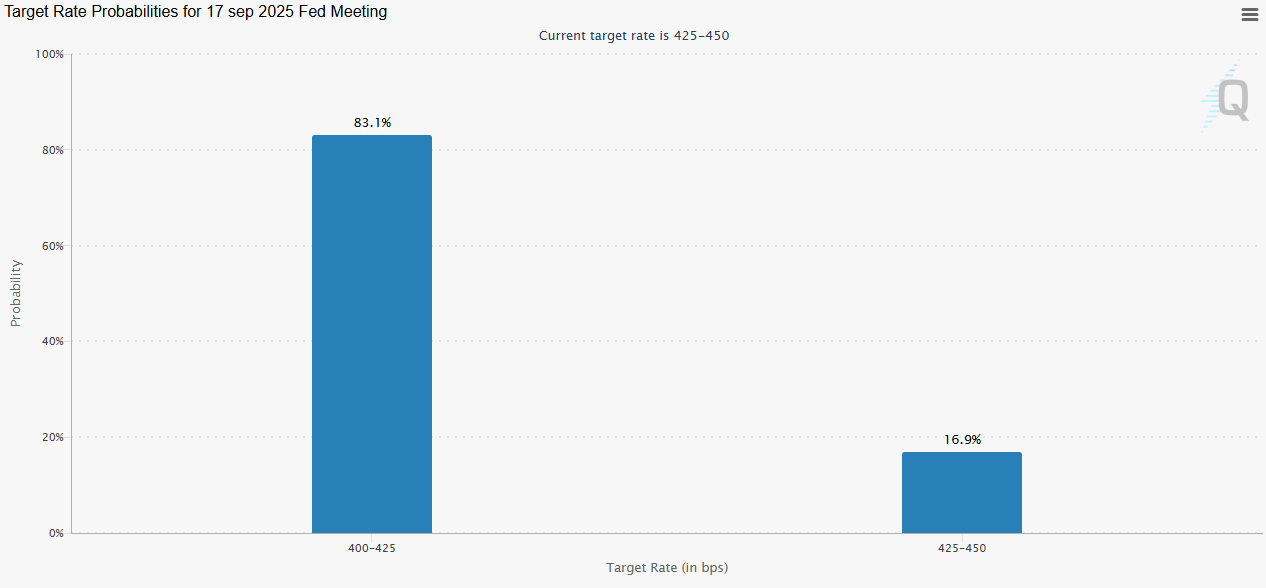
Source: CMEGroup
However, the market remains more focused on the current interest rate differential, as the U.S. rate (4.5%) is still significantly higher than that of New Zealand (potentially 3.0%). Additionally, the Jackson Hole Symposium takes place this week, and key remarks from the Fed are expected. These could clarify whether the Fed is truly ready to begin cutting rates soon, or if it prefers a more cautious approach.
For now, this rate differential and the uncertainty around U.S. monetary policy continue to favor the U.S. dollar, which also offers more attractive returns on its dollar-denominated securities. This dynamic has increased demand for the greenback and may continue to put downward pressure on NZD/USD, especially if the Fed maintains a less dovish stance than the RBNZ.
NZD/USD Technical Outlook
Source: StoneX, Tradingview
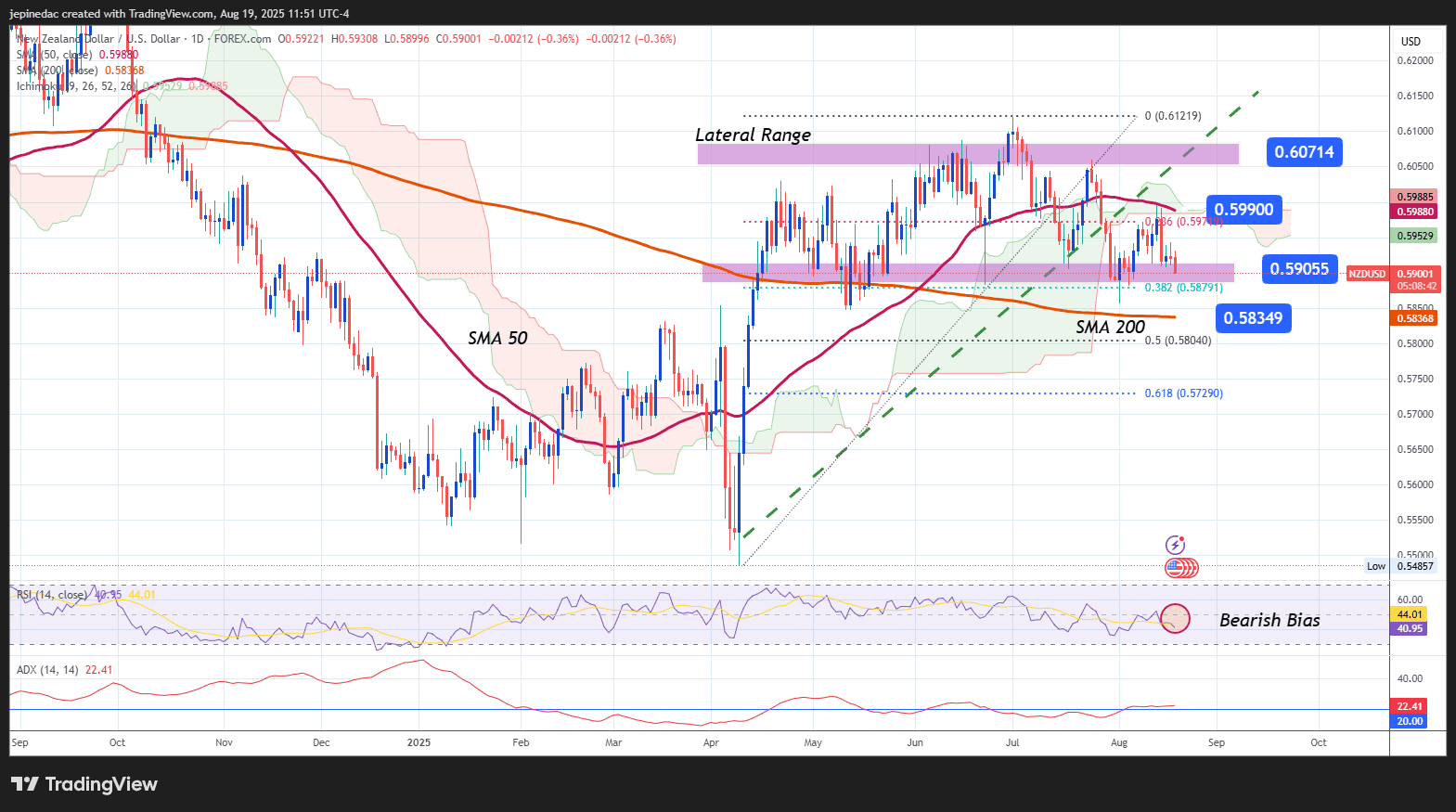
- Consolidated Sideways Channel: Since late April, the NZD/USD pair has traded within a well-defined lateral channel, with resistance around 0.60714 and support at 0.59055. So far, bearish swings have not been strong enough to break below the channel’s base, keeping this structure as the main technical reference for the coming sessions. However, if selling pressure continues to build, a breakdown of the channel could signal the start of a new bearish trend.
- RSI: The Relative Strength Index has begun fluctuating consistently below the 50 level, indicating that bearish momentum is gaining ground. If this persists, the downward bias could strengthen in the short term.
- ADX: The ADX line remains above the neutral level of 20, suggesting active volatility, though without a clearly dominant direction yet. As the RBNZ decision approaches, volatility may increase, and the indicator could reflect stronger directional movement if a channel break is confirmed.
Key Levels:
- 0.59900 – Key Resistance: Located at the midpoint of the channel, this level also aligns with the Ichimoku cloud and the 50-period moving average. Price action near this zone could keep the pair within its current range.
- 0.59055 – Immediate Support: This marks the bottom of the channel and coincides with the 38.2% Fibonacci retracement. A bearish breakout here could trigger a stronger selling bias in the short term.
- 0.58349 – Major Support: Aligned with the 200-period simple moving average, this is the most critical technical barrier in the event of a breakdown. If price moves below this level, it could confirm a structural shift, opening the door to a sustained downtrend.
Written by Julian Pineda, CFA – Market Analyst
Follow him on: @julianpineda25
Related tags:

Open an account in minutes
Experience award-winning platforms with fast and secure execution.
Economic calendar
Web Trader platform
Our sophisticated web-based platform is packed with features.
Related articles

NZD/USD Forecast: Kiwi faces historic breakdown as RBNZ survey looms
NZD/USD is teetering above support that held through the pandemic and Liberation Day turmoil. With RBNZ hawks repeatedly disappointed, today's inflation expectations survey could open the door to a slide towards the GFC lows.

USD/JPY, AUD/JPY: Central Bank Divergence Creates Two-Way Risk
USD/JPY eyes a breakout above 160, while AUD/JPY faces further losses as Fed, RBA and BoJ interest rate expectations diverge.


DXY, GBP/USD, AUD/USD, USD/CAD, USD/JPY, Gold Weekly Technical Outlook 11 16 2026
Sr. Technical Strategist Michael Boutros highlights the levels that matter on the USD Majors, commodities, and equity indices charts this week.

StoneX Financial Ltd (trading as "FOREX.com") is an execution-only service provider. This material, whether or not it states any opinions, is for general information purposes only and it does not take into account your personal circumstances or objectives. This material has been prepared using the thoughts and opinions of the author and these may change. However, FOREX.com does not plan to provide further updates to any material once published and it is not under any obligation to keep this material up to date.
This material is short term in nature and may only relate to facts and circumstances existing at a specific time or day. Nothing in this material is (or should be considered to be) financial, investment, legal, tax or other advice and no reliance should be placed on it. No opinion given in this material constitutes a recommendation by FOREX.com or the author that any particular investment, security, transaction or investment strategy is suitable for any specific person.
The material has not been prepared in accordance with legal requirements designed to promote the independence of investment research. Although FOREX.com is not specifically prevented from dealing before providing this material, FOREX.com does not seek to take advantage of the material prior to its dissemination. This material is not intended for distribution to, or use by, any person in any country or jurisdiction where such distribution or use would be contrary to local law or regulation. For further details see our full non-independent research disclaimer and quarterly summary.