



Rising dollar and stocks exert pressure on gold for now
The new week, month and quarter has started brightly for the US dollar, with both the GBP/USD and EUR/USD trading lower at the time of this writing. Dollar-denominated and safe haven gold has consequently fallen out of favour. But are risk-seeking investors being a bit… reckless?
Share this:

The new week, month and quarter has started brightly for the US dollar, with both the GBP/USD and EUR/USD trading lower at the time of this writing. The euro has been undermined in part by the controversial independence referendum in Catalonia region of Spain at the weekend, while the pound has been hit by weaker-than-expected UK manufacturing PMI data. The dollar itself has been in demand over the past several weeks as the bulls took advantage of oversold conditions on renewed hawkish rhetoric from the Federal Reserve to buy the dip. Meanwhile investors are continuing to ignore geopolitical risks, as their insatiable appetite for risk continues: US index futures have hit new record high levels, while European equities – except in Spain – have also risen. Dollar-denominated and safe haven gold has consequently fallen out of favour. But are risk-seeking investors being a bit… reckless?
Sunday’s “illegal” independence referendum in Catalonia saw just under 90% of the people vote in favour of the region seceding from Spain, even if not all were allowed to vote. There was another terrorist attack in France, where a man stabbed two women outside of Marseille’s main train station. Overnight another terrorist attack in Las Vegas has left at least 50 people killed and scores injured in a mass shooting at a concert. North Korean tensions rose again after US President Donald Trump in a tweet described the talks between his foreign minister Rex Tillerson and North Korea as a “waste of time.” Yet, the global equity markets have hardly reacted to any of these events in a meaningful way and there’s been very little interest in gold, for otherwise its price should have surely been higher.
But sentiment could turn sour very quickly, especially given the overstretched US equity market rally. Any sudden drop in the equity markets should see demand for gold rise again on safe haven flows. I think it is only a matter of time before this happens. But so far a Wall Street sell-off hasn’t materialised and there is no point in trying to predict when this will happen. But when it does, it will be very obvious. Regardless of the equity markets, gold could find support in the event the dollar rally stalls again. This could happen if, for example, Friday’s US jobs report turns out to be extremely weaker than expected. Already, not many people are expecting to see a big print on the headline number, owing to the impact of the recent hurricanes.
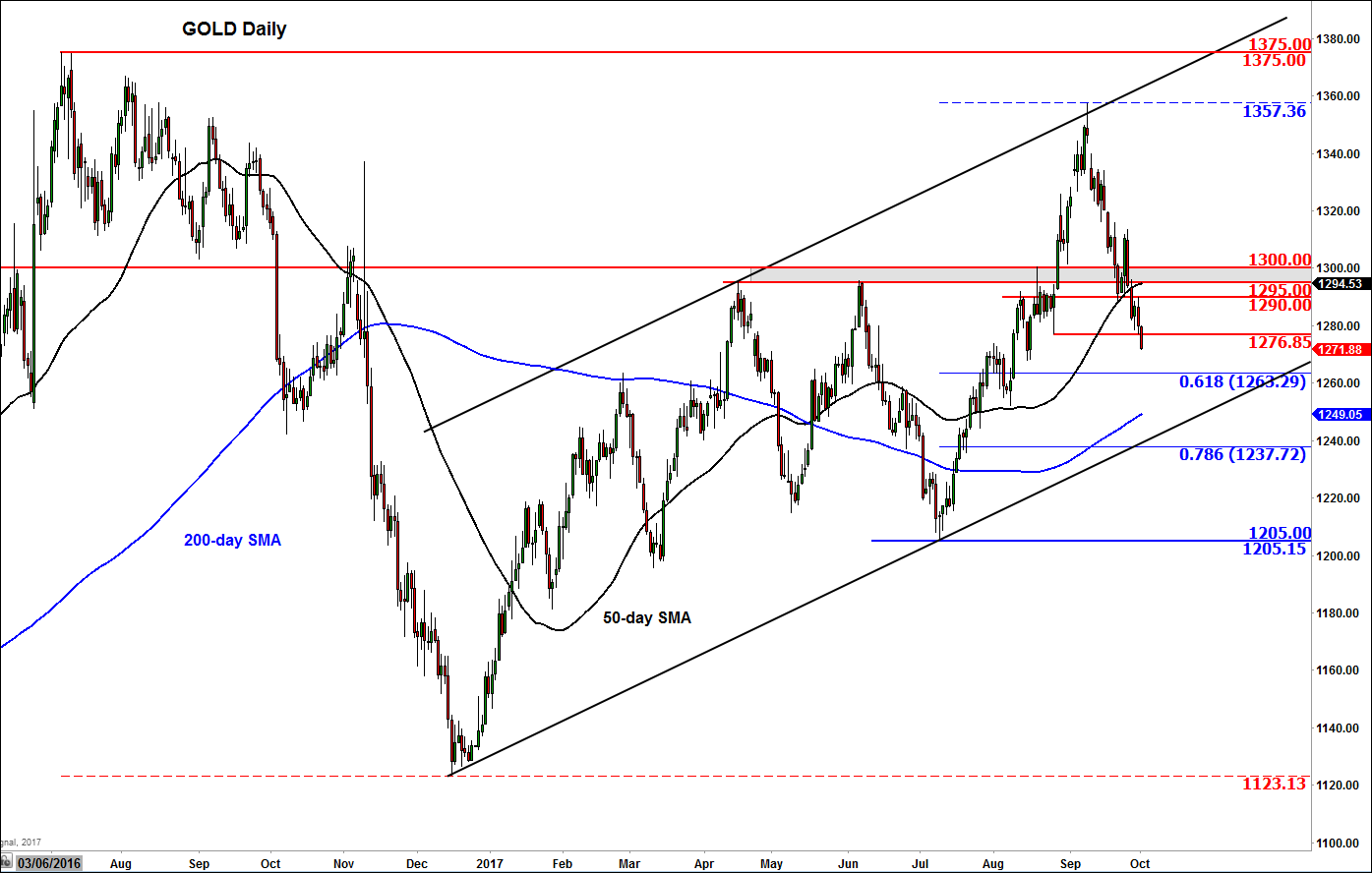
For now, though, the trend is clearly bearish and has been so ever since gold failed to hold its own above the breakout level of $1295-$1300 last month. Only if and when gold reclaims this resistance area will the trend turn bullish again, unless of course we see some significantly bullish price structure at lower levels first. But as things stand, gold looks like it wants to head further lower in the short-term outlook. The longer-term outlook is not very clear at the moment. But when you take into account the above fundamental consideration then gold may come back strongly at some point down the line. For now, it is worth watching for signs of support around the Fibonacci levels shown on the chart, the 200-day average, or around the support trend of the bullish channel. Once the buyers step in, we should see a sharp bounce; then we know that a low – at least a short-term one – has been established.
Source: eSignal and FOREX.com.

Open an account in minutes
Experience award-winning platforms with fast and secure execution.
Economic calendar
Web Trader platform
Our sophisticated web-based platform is packed with features.
Related articles

NZD/USD Forecast: Kiwi faces historic breakdown as RBNZ survey looms
NZD/USD is teetering above support that held through the pandemic and Liberation Day turmoil. With RBNZ hawks repeatedly disappointed, today's inflation expectations survey could open the door to a slide towards the GFC lows.

USD/JPY, AUD/JPY: Central Bank Divergence Creates Two-Way Risk
USD/JPY eyes a breakout above 160, while AUD/JPY faces further losses as Fed, RBA and BoJ interest rate expectations diverge.


DXY, GBP/USD, AUD/USD, USD/CAD, USD/JPY, Gold Weekly Technical Outlook 11 16 2026
Sr. Technical Strategist Michael Boutros highlights the levels that matter on the USD Majors, commodities, and equity indices charts this week.

StoneX Financial Ltd (trading as "FOREX.com") is an execution-only service provider. This material, whether or not it states any opinions, is for general information purposes only and it does not take into account your personal circumstances or objectives. This material has been prepared using the thoughts and opinions of the author and these may change. However, FOREX.com does not plan to provide further updates to any material once published and it is not under any obligation to keep this material up to date.
This material is short term in nature and may only relate to facts and circumstances existing at a specific time or day. Nothing in this material is (or should be considered to be) financial, investment, legal, tax or other advice and no reliance should be placed on it. No opinion given in this material constitutes a recommendation by FOREX.com or the author that any particular investment, security, transaction or investment strategy is suitable for any specific person.
The material has not been prepared in accordance with legal requirements designed to promote the independence of investment research. Although FOREX.com is not specifically prevented from dealing before providing this material, FOREX.com does not seek to take advantage of the material prior to its dissemination. This material is not intended for distribution to, or use by, any person in any country or jurisdiction where such distribution or use would be contrary to local law or regulation. For further details see our full non-independent research disclaimer and quarterly summary.