



USD/JPY forecast: Currency Pair of the Week | August 10, 2026
Friday’s US employment report was the first of four major pieces of economic data due before the Federal Reserve’s September meeting. The figures delivered a significant downside surprise, prompting markets to scale back expectations of a September rate hike to around 44%, from above 55% ahead of the release.
Share this:

Friday’s US employment report was the first of four major pieces of economic data due before the Federal Reserve’s September meeting. The figures delivered a significant downside surprise, prompting markets to scale back expectations of a September rate hike to around 44%, from above 55% ahead of the release. Yet, the data hasn’t materially changed the USD/JPY forecast much. The pair has already recovered towards the levels seen before the payrolls release, trading close to 159.00. That leaves the pair once again within striking distance of the psychologically important 160.00 level. Unless upcoming US data deliver further negative surprises, or Japanese authorities step back into the market, USD/JPY could once again test that threshold.
The next major catalyst is US inflation, with CPI due later this week. At the same time, developments in oil markets remain important, particularly as uncertainty surrounding the Strait of Hormuz continues to complicate the inflation outlook.
Oil remains a key variable for the dollar outlook
Crude oil prices continue to find support from the uncertainty surrounding shipping through the Strait of Hormuz. Although Donald Trump has indicated that Washington is “semi-negotiating” with Iran, the language suggests that economic pressure remains central to the strategy rather than an immediate move towards military escalation.
There have also been reports that Iran and Oman are edging towards an understanding over a shipping route through the Strait. However, any meaningful and sustained reopening of the waterway is likely to depend on wider progress in US-Iran negotiations.
A prolonged disruption to energy flows should keep inflationary pressures elevated. That could make it harder for the Fed to ease policy, even if we see further data weakness, potentially providing an underlying source of support for the greenback.
The Fed’s data-dependent approach puts CPI in the spotlight
The latest market reaction reinforces just how important incoming economic data have become for the dollar. Rather than relying heavily on oil prices alone, markets are increasingly being forced to assess individual data release through the Fed’s evolving reaction function.
That shift follows Federal Reserve Chair Kevin Warsh’s decision to move away from providing firm forward guidance. His recent messaging has left greater room for incoming data to reshape expectations around monetary policy.
There are still several important data points to come before the September 16 FOMC meeting: another payrolls report and two further CPI releases, including this week’s figures.
Inflation is particularly important because of Warsh’s admission that the Fed has consistently gotten it wrong and is looking to address it. As a result, any surprises in CPI or other inflation data like PPI could generate much larger moves in the dollar than we have seen from Friday’s jobs report alone.
This also helps explain why the weak payrolls figures did not trigger a sustained collapse in USD/JPY. Markets still have several opportunities to reassess the Fed outlook before September.
What is expected from CPI data?
US CPI is now arguably the most important event on this week’s calendar. The previous CPI report had certainly surprised to the downside. Headline inflation slowed more sharply than expected to 3.5% from 4.2%, while core CPI eased to 2.6%. This time, economists expect moderate weakness. Headline CPI is expected to rise 0.1% month-on-month, taking the annual rate to 3.4%. Core CPI is forecast to increase 0.2% on the month, leaving annual core inflation at 2.5%.
The question now is whether we will see that moderation, and if so, whether it is enough to trigger further dovish repricing in US dollar. But as mentioned, alongside data it is also the developments in oil prices which will determine whether expectations for a tighter Fed are rebuilt or continue to unwind.
Why the yen is struggling to capitalise on softer US data
In theory, the yen should be among the clearest beneficiaries of weaker US economic data because USD/JPY remains highly sensitive to the interest-rate differential between the two economies.
Yet the yen continues to face selling pressure, even following intervention episodes. The USD/JPY sold of sharply in late July as both the US and Japanese authorities jointly intervened in the foreign exchange market to support the yen. Such coordinated action is unusual and suggests that the US Treasury may be taking a more active role in attempts to stabilise the currency.
However, intervention alone is unlikely to deliver a durable change in the direction of USD/JPY. Foreign exchange intervention can disrupt positioning, reduce excessive volatility and alter market psychology. What it generally cannot do is permanently overturn a powerful macroeconomic trend.
Even growing expectations of a September Bank of Japan rate increase have so far struggled to generate a sustained reversal in the pair.
This is partly because the interest-rate gap with the US remains wide enough to keep carry-trade demand for the dollar alive.
Softer US data may improve the fundamental case for a stronger yen, but positioning and yield differentials can continue to work in the opposite direction – especially if oil prices remain elevated for longer.
USD/JPY forecast: 160 remains firmly on the radar
Technically and fundamentally, USD/JPY remains caught between competing forces. The pair has already recovered to above 158.50, effectively returning to the area where it traded before Friday’s payrolls shock.
That recovery suggests the market has not yet fully embraced a sustained dovish repricing of the Federal Reserve. With the USD/JPY now also back above the 200-day average, the near-term path of least resistance is no longer to the downside.
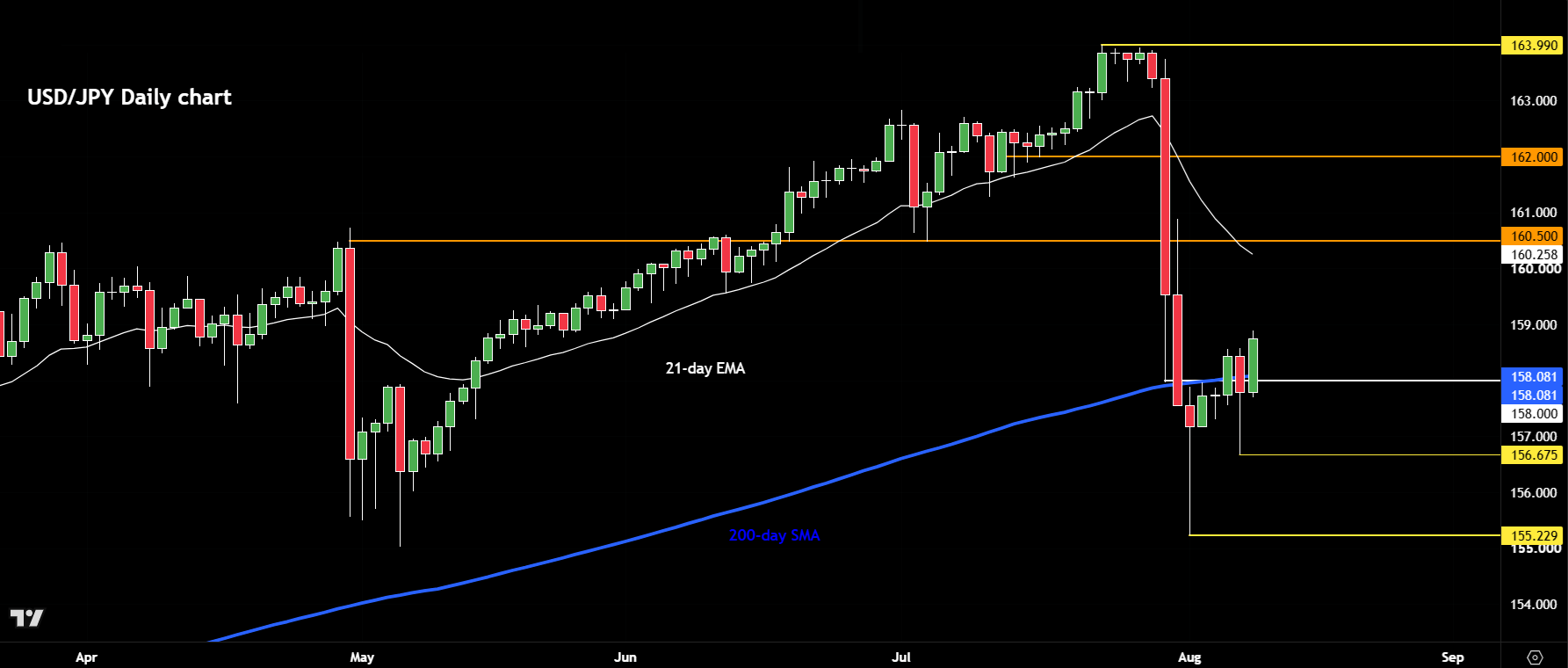
The path ahead is therefore likely to remain volatile. A return towards 160.00 remains a realistic possibility, particularly if US inflation proves sticky or oil prices remain elevated. 160.50 is the next obvious resistance followed by 162.00.
Meanwhile, if support around 158.00 area gives way and price moves below the 200-day again, then in the case, a return to 157.00 and possibly 156.00 will become likely. For that to happen, you’d feel US CPI will have to be quite weak this week.

-- Written by Fawad Razaqzada, Market Analyst
Follow Fawad on Twitter @Trader_F_R
Related tags:


Open an account in minutes
Experience award-winning platforms with fast and secure execution.
Economic calendar
Web Trader platform
Our sophisticated web-based platform is packed with features.
Related articles
ASX 200 Outlook: Potential to Bounce Sits on a Knife Edge
ASX 200 bounce prospects remain on a knife edge as oversold technicals clash with weak financials, commodity pressures and global risk aversion.

US dollar rally loses yield support as Nvidia looms
US yields are retreating, but the dollar isn't following. With risk aversion potentially keeping it supported, Nvidia's results could determine whether emerging reversal signals in AUD/USD and EUR/USD develop further.


GBP/USD, GBP/JPY, GBP/AUD: Sterling Eyes UK Inflation Catalyst
Sterling faces a pivotal UK inflation test as traders weigh BoE tightening, Fed minutes and Australian employment data across GBP/USD, GBP/JPY and GBP/AUD.
StoneX Financial Ltd (trading as "FOREX.com") is an execution-only service provider. This material, whether or not it states any opinions, is for general information purposes only and it does not take into account your personal circumstances or objectives. This material has been prepared using the thoughts and opinions of the author and these may change. However, FOREX.com does not plan to provide further updates to any material once published and it is not under any obligation to keep this material up to date.
This material is short term in nature and may only relate to facts and circumstances existing at a specific time or day. Nothing in this material is (or should be considered to be) financial, investment, legal, tax or other advice and no reliance should be placed on it. No opinion given in this material constitutes a recommendation by FOREX.com or the author that any particular investment, security, transaction or investment strategy is suitable for any specific person.
The material has not been prepared in accordance with legal requirements designed to promote the independence of investment research. Although FOREX.com is not specifically prevented from dealing before providing this material, FOREX.com does not seek to take advantage of the material prior to its dissemination. This material is not intended for distribution to, or use by, any person in any country or jurisdiction where such distribution or use would be contrary to local law or regulation. For further details see our full non-independent research disclaimer and quarterly summary.