



USD/MXN Analysis: Mexican peso stalls following inflation data and Banxico decision
USD/MXN price action has returned to a phase of neutrality, following the bearish bias in favor of the Mexican peso seen in the previous two sessions. In today’s session, the pair is posting a move of around 0.14%, despite the release of inflation data and the interest rate decision from Banxico.
Share this:

USD/MXN price action has returned to a phase of neutrality, following the bearish bias in favor of the Mexican peso seen in the previous two sessions. In today’s session, the pair is posting a move of around 0.14%, despite the release of inflation data and the interest rate decision from Banxico.
While no major surprises were observed relative to expectations, it is worth highlighting that the central bank mentioned the possibility of slowing the rate-cutting cycle, which could become a relevant catalyst for peso strength in the coming weeks. However, the market is also closely watching the upcoming US employment data (NFP), suggesting that a phase of indecision could persist ahead of the end of the trading week.


Central bank and inflation take center stage
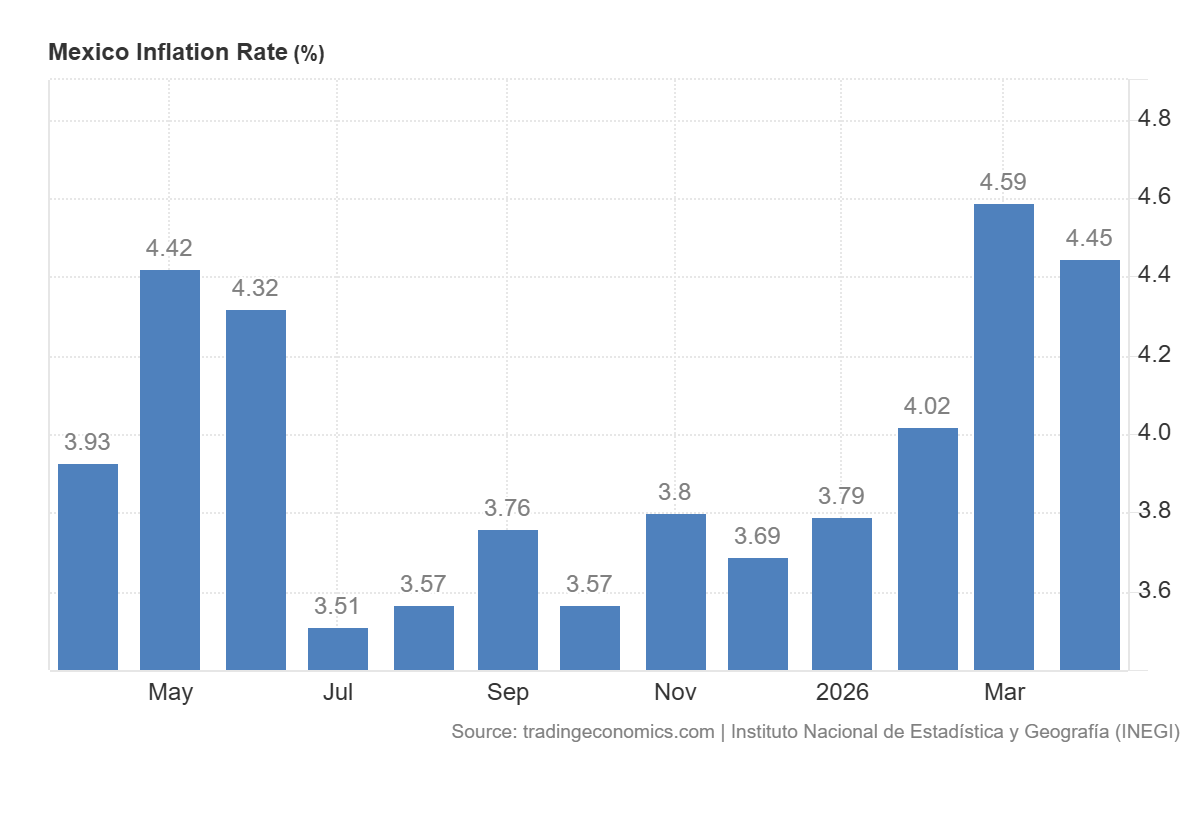
First, inflation data for Mexico was released ahead of the Banxico decision. Annual inflation came in at 4.45%, below the 4.5% expected, representing a slight improvement compared to the 4.59% recorded in March.
Although inflation remains elevated and above the central bank’s target, this moderation has started to ease upward pressure on prices, partially reducing the inflation concerns seen in recent weeks.
Source: TradingEconomics
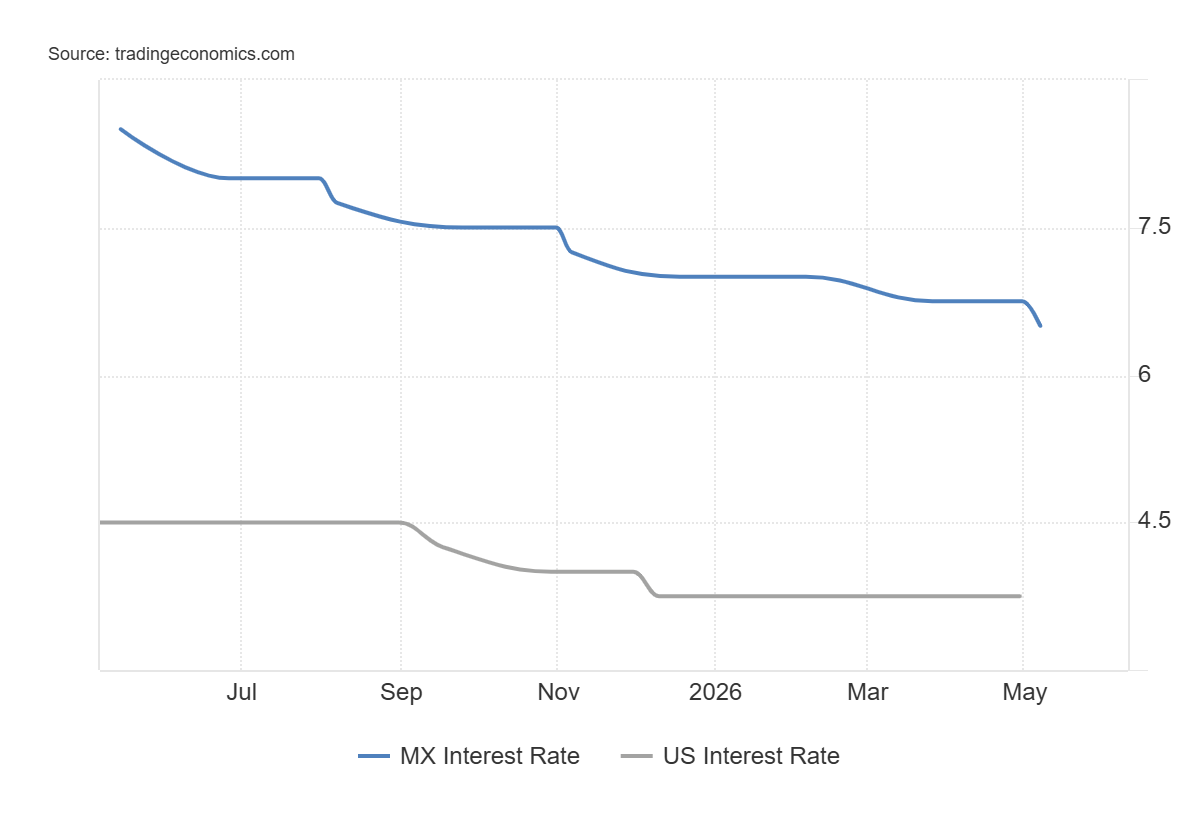
Shortly after, Banxico announced a rate cut to 6.5%, in line with market expectations. However, the most relevant takeaway was the forward guidance, which suggested that the rate-cutting cycle may be nearing its end.
This reflects the fact that, despite some stabilization in inflation, risks remain and levels are still above the upper bound of the 4.00% target, which points to a potential pause in monetary policy in the coming months.
Despite this rate cut, the rate differential versus the United States continues to favor the Mexican peso. With Mexico’s rate now at 6.5% compared to 3.75% in the US, peso-denominated assets remain relatively more attractive, which has been one of the key factors supporting the peso in recent months.
Source: TradingEconomics
However, the peso’s reaction has been limited, as the rate cut was accompanied by a more restrictive tone, reinforcing expectations of policy stability. This scenario had already been largely priced in by the market, which explains the lack of significant volatility in the short term.
Additionally, market attention has shifted toward US employment data. For the upcoming NFP release, expected during the next session, forecasts point to 65k new jobs versus the previous 178k, and this data could be key in shaping the Federal Reserve’s future stance.
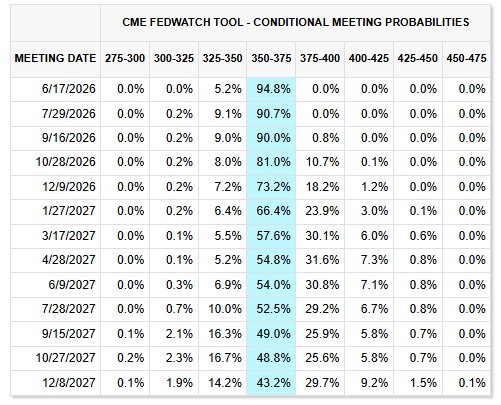
In this context, probability models show a broad expectation of unchanged rates, with more than a 70% chance that this dynamic will persist through December 2026. However, there is also a growing probability, above 30%, that the Fed could consider a rate hike by March 2027.
This implies that if employment data comes in stronger than expected, it could reinforce a scenario where the Fed adopts a more aggressive stance, potentially affecting the rate differential in favor of Mexico.
Source: CMEGROUP
Taking all of this into account, the short-term outlook remains largely unchanged: inflation data and the Banxico decision did not deliver surprises, resulting in a muted reaction from the peso.
However, the market’s focus is now on the United States. If employment data alters expectations regarding Fed policy, it could reduce the rate differential that currently favors Mexico and affect the peso’s ability to continue gaining ground in the medium term.
In this context, USD/MXN may continue to show a phase of indecision, or even mild buying pressure in the coming weeks if employment data surprises to the upside. On the other hand, if the data comes in below expectations, the peso could once again rely on the rate differential and attempt to recover ground in the short term.
Technical outlook for USD/MXN
Source: StoneX, Tradingview
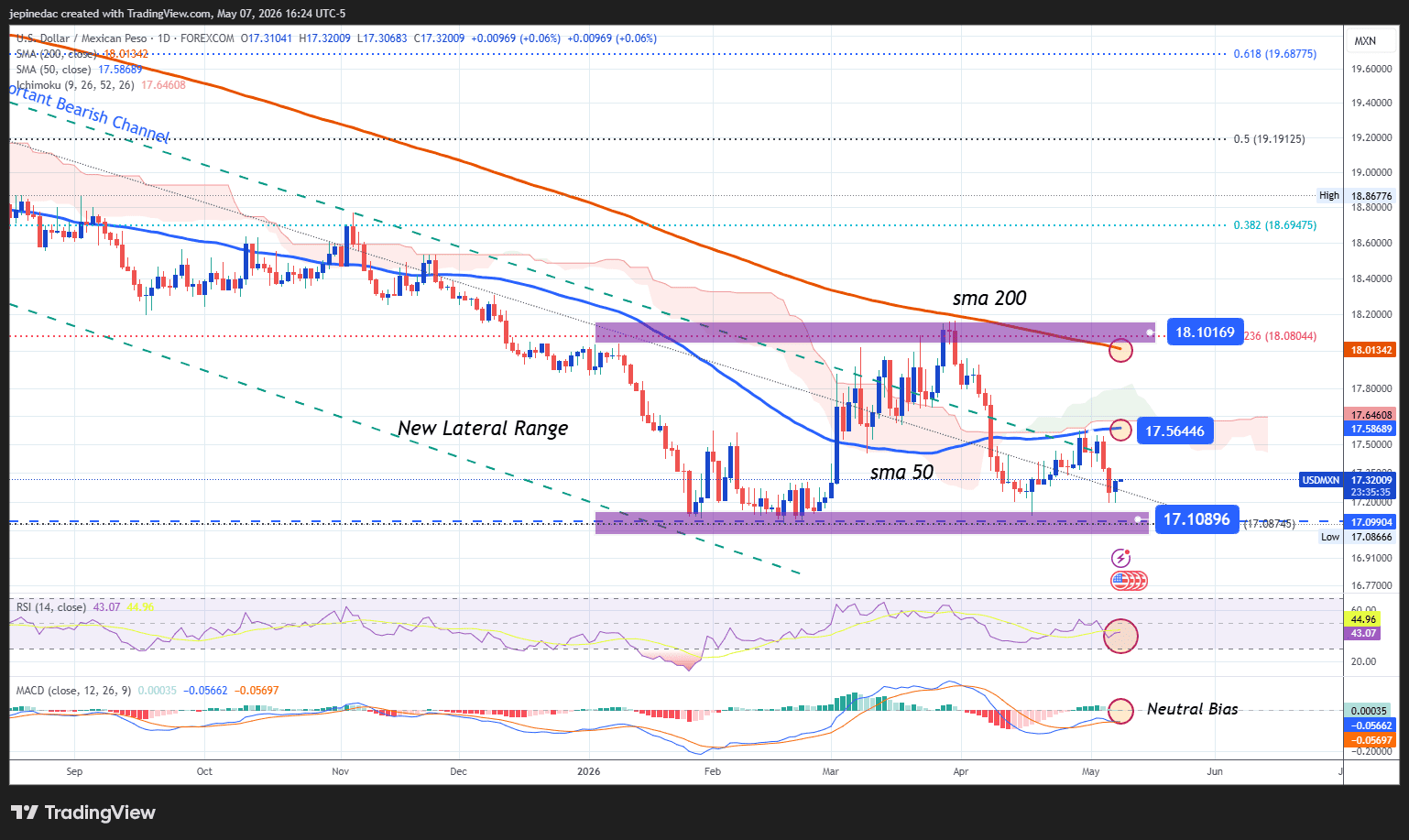
- A new range begins to gain relevance: Recent USD/MXN price action has started to reflect a meaningful neutral bias in the short term, with price movements currently holding between a resistance near 18.10 pesos per dollar and support around 17.10. As long as the pair fails to break out of this range, a more defined sideways structure could continue to develop in the coming sessions.
- RSI: The RSI remains close to the 50 level, suggesting a balance between buying and selling pressures over the past 14 sessions. This behavior reinforces the idea of a short-term indecision phase in price action.
- MACD: The MACD shows a similar dynamic, with the histogram hovering around the zero level, indicating neutrality in short-term moving average strength and reinforcing the presence of an indecisive market environment.
Key levels:
- 18.10 – Key resistance: A zone of recent highs aligned with the 200-period moving average and the 23.6% Fibonacci retracement. This level represents the most important short-term barrier. A sustained break above it could confirm a structural shift and lead to a more consistent bullish bias, potentially extending over several weeks and even opening the door to a short-term uptrend.
- 17.56 – Current barrier: A level aligned with the descending trendline and the 50-period moving average. Price action near this zone could reinforce indecision and extend the current sideways range observed in recent sessions.
- 17.10 – Key support: A zone of 2026 lows acting as the main downside barrier. A move toward this level could bring selling pressure back into focus and confirm the continuation of the long-term descending channel as the dominant structure.
Written by Julian Pineda, CFA, CMT – Market Analyst
Follow him on: @julianpineda25
Related tags:

Open an account in minutes
Experience award-winning platforms with fast and secure execution.
Economic calendar
Web Trader platform
Our sophisticated web-based platform is packed with features.
Related articles

NZD/USD Forecast: Kiwi faces historic breakdown as RBNZ survey looms
NZD/USD is teetering above support that held through the pandemic and Liberation Day turmoil. With RBNZ hawks repeatedly disappointed, today's inflation expectations survey could open the door to a slide towards the GFC lows.

USD/JPY, AUD/JPY: Central Bank Divergence Creates Two-Way Risk
USD/JPY eyes a breakout above 160, while AUD/JPY faces further losses as Fed, RBA and BoJ interest rate expectations diverge.


DXY, GBP/USD, AUD/USD, USD/CAD, USD/JPY, Gold Weekly Technical Outlook 11 16 2026
Sr. Technical Strategist Michael Boutros highlights the levels that matter on the USD Majors, commodities, and equity indices charts this week.

StoneX Financial Ltd (trading as "FOREX.com") is an execution-only service provider. This material, whether or not it states any opinions, is for general information purposes only and it does not take into account your personal circumstances or objectives. This material has been prepared using the thoughts and opinions of the author and these may change. However, FOREX.com does not plan to provide further updates to any material once published and it is not under any obligation to keep this material up to date.
This material is short term in nature and may only relate to facts and circumstances existing at a specific time or day. Nothing in this material is (or should be considered to be) financial, investment, legal, tax or other advice and no reliance should be placed on it. No opinion given in this material constitutes a recommendation by FOREX.com or the author that any particular investment, security, transaction or investment strategy is suitable for any specific person.
The material has not been prepared in accordance with legal requirements designed to promote the independence of investment research. Although FOREX.com is not specifically prevented from dealing before providing this material, FOREX.com does not seek to take advantage of the material prior to its dissemination. This material is not intended for distribution to, or use by, any person in any country or jurisdiction where such distribution or use would be contrary to local law or regulation. For further details see our full non-independent research disclaimer and quarterly summary.