
- EUR/JPY coiling beneath highs after extended compression
- Markets chase Iran de-escalation headlines, fade escalation
- Breakout risk skewed higher unless conflict intensifies
Summary
EUR/JPY is coiling just beneath recent highs after more than a month of compression, with the technical structure and market reaction function pointing to upside risk. Traders continue to latch onto even small pieces of positive news related to the Iran conflict while fading negative developments, leaving directional risks skewed towards a bullish breakout.
Iran headlines skew directional risks higher
That skew in reaction to Iran-related headlines is being reinforced by reports on Tuesday suggesting the US has put forward a multi-point plan aimed at ending the conflict, centred on curbing Iran’s nuclear ambitions, limiting support for proxy groups and reopening the Strait of Hormuz, alongside the idea of a temporary ceasefire to allow negotiations to take place. On the surface, the gap between what’s being proposed and what Iran is demanding still looks wide, leaving the probability of a near term agreement far from assured.
Yet that hasn’t stopped markets from reacting quickly to the headlines. We saw that clearly on Monday when Trump postponed a planned strike on Iran’s power infrastructure for five days, triggering a sharp relief rally across risk assets, even as Iranian officials pushed back and insisted no negotiations were underway. While that initial move faded, the price never seriously threatened a return to pre-announcement levels, highlighting a clear reluctance to fully reprice the downside.
That behaviour is telling. Traders are actively seeking out any hint of de-escalation while showing far less conviction on negative developments, reinforcing the idea that the path of least resistance for risk-sensitive FX crosses, including EUR/JPY, remains to the upside. In a scenario where a lasting peace agreement is reached, that move would likely be reinforced by EUR outperforming JPY, as safe-haven demand unwinds and energy-related risks facing Europe begin to ease.
Compression tightens as volatility fades
Source: TradingView
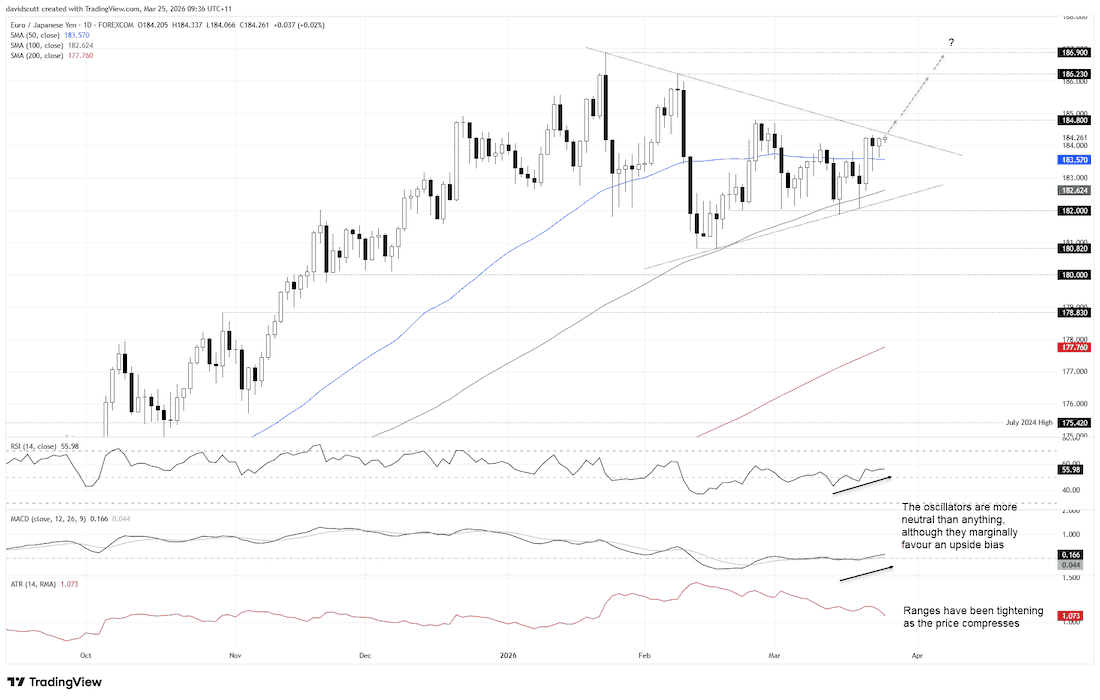
We can see EUR/JPY has been coiling within a compression structure for more than a month, with downtrend resistance from the January 23 highs now marginally overhead after the price moved back above the influential 50DMA earlier this week. With ATR (14) declining to the lowest level since late January as the structure narrows, it gives a sense that if and when we do see a breakout, it could be powerful.
With the price continuing to trade well above longer-term moving averages which are still sloping higher, and having entered the structure following an extended bullish trend, it feels like the more likely outcome is a bullish rather than bearish breakout, putting a potential retest of the January highs in play. Standing in the way of that outcome, swing highs of 184.80 and 186.23 sit beyond the January trendline, making them reference points of note for bulls. Should the pair take out the January high of 186.90, it would signal a resumption of the prior bullish trend.
If the price is rejected at the downtrend once again, the 50 and 100DMAs are the levels to watch before the February uptrend comes into view. A break of the latter would put 182 support and the double bottom of 181.80 in play for shorts.
The oscillators are more neutral than anything, although they marginally favour an upside bias. RSI (14) is setting higher lows and higher highs and is now back above 50, while MACD has confirmed the marginally bullish signal by staging a bullish crossover above zero.