

At the start of the new trading week, the EUR/USD began to lose ground with a decline of about 0.6%, as markets digest the implications of the Jackson Hole Symposium and the shifting expectations around central banks. For now, uncertainty over the direction of monetary policy has drained the euro of its bullish momentum, and as long as this uncertainty persists, a neutral bias may continue to dominate in the coming sessions.

What’s Next for Central Banks?
Comments from Christine Lagarde reflected a highly neutral tone regarding the outlook for the European Central Bank (ECB). At Jackson Hole, she stressed the need to continue monitoring key economic indicators and highlighted the role of migration in supporting recovery after the pandemic, which has contributed to stability in economic data. She also noted that high interest rates have helped bring inflation down to a point where a neutral stance could now be appropriate in the short term.
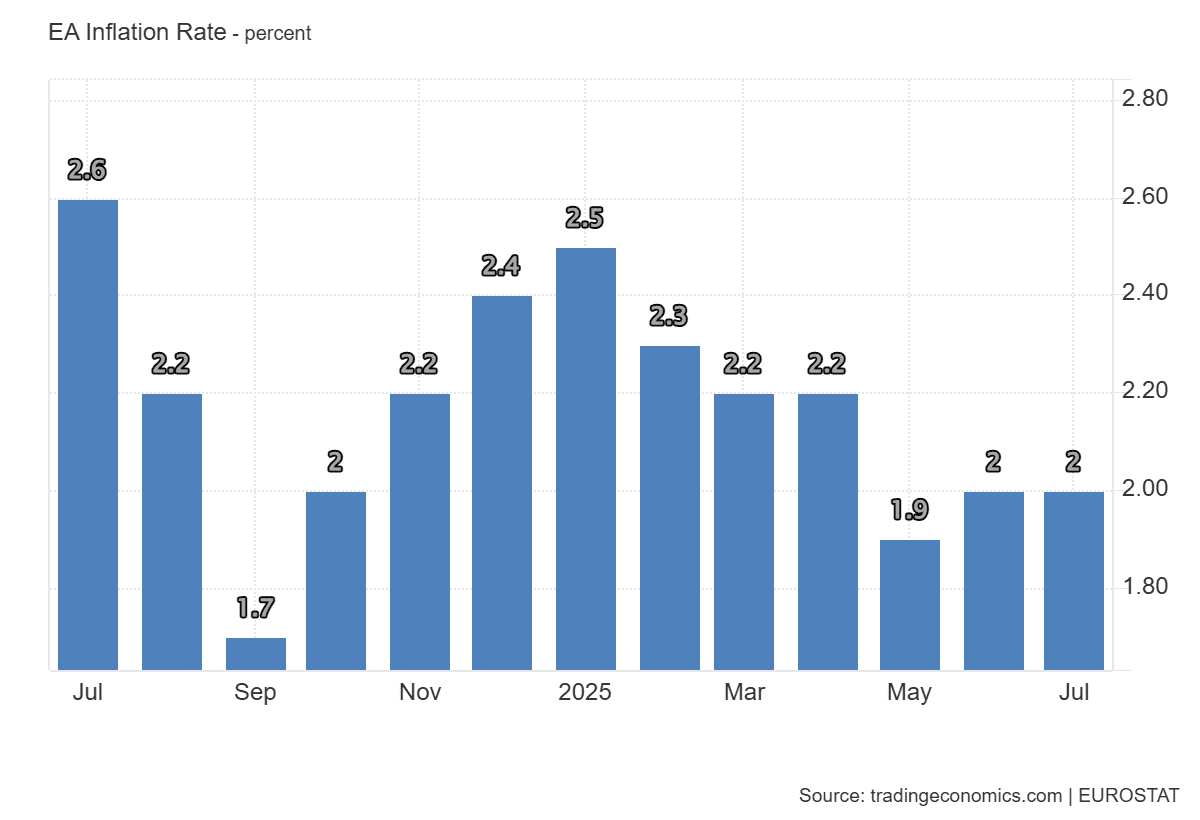
Recent data supports this view: the July annual CPI in Europe stood at 2%, in line with the ECB’s target. This reinforces Lagarde’s message that inflation is no longer the primary concern in the short term.
Source: TradingEconomics
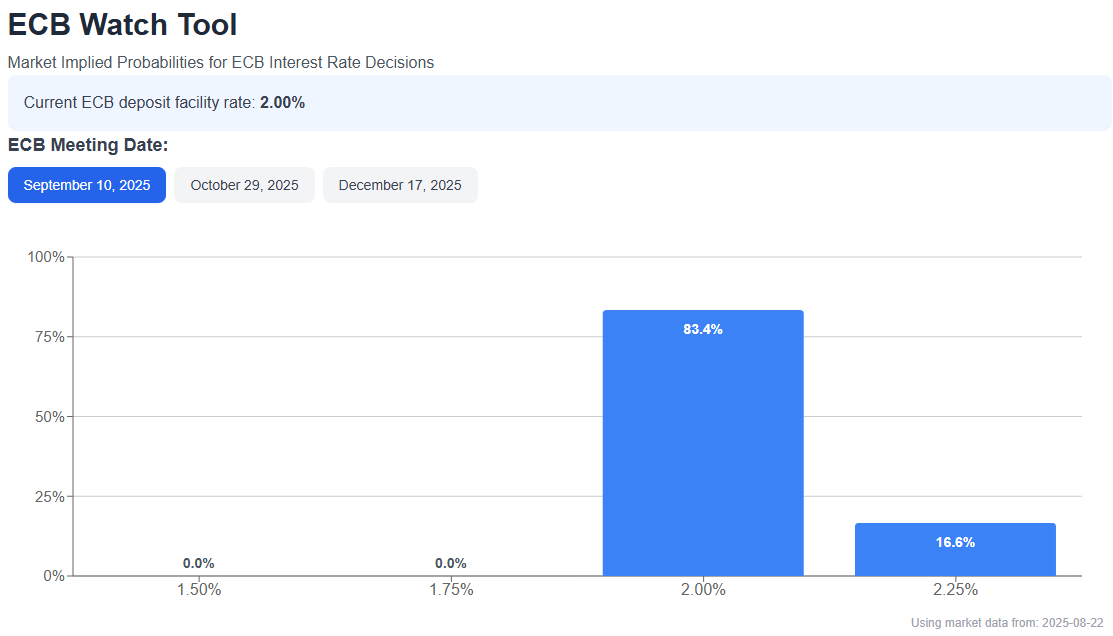
In line with this, expectations suggest the ECB will hold policy steady. Current probability models show an 83.4% chance that at the next meeting, scheduled for September 10, the deposit rate will remain at 2.00%, further consolidating the neutral stance in the short term.
Source: TradingEconomics
The biggest surprise, however, came from the United States. At Jackson Hole, it was suggested that inflation is becoming more contained and that employment and economic activity are now the Fed’s priority. This represents a shift in outlook, with the central bank potentially adopting a more flexible stance to reduce debt costs and stimulate consumption. Under this scenario, markets are considering that 2025 could mark the start of the first cycle of rate cuts by the Federal Reserve.
According to CME Group data, there is now an 86.3% probability that at the September 17 meeting, the Fed will begin cutting rates, lowering the benchmark from 4.5% to 4.25%. This would be the first confirmed shift toward a dovish outlook this year.
At the end of last week, the euro gained momentum on expectations that the Fed would finally move toward rate cuts. However, as this new week began, speculation has eased, and investors are now more focused on how both central banks’ new dynamics will play out. It’s worth noting that a significant divergence in interest rates remains: the U.S. holds at 4.5% while the ECB deposit rate stands at 2%, keeping dollar-denominated investments attractive and helping the dollar strengthen early this week. Still, with the Fed turning more dovish and the ECB holding neutral, the rate gap could narrow, reducing the appeal of U.S. fixed income and potentially supporting buying pressure on the euro in the weeks ahead.
EUR/USD Technical Outlook
Source: StoneX, Tradingview
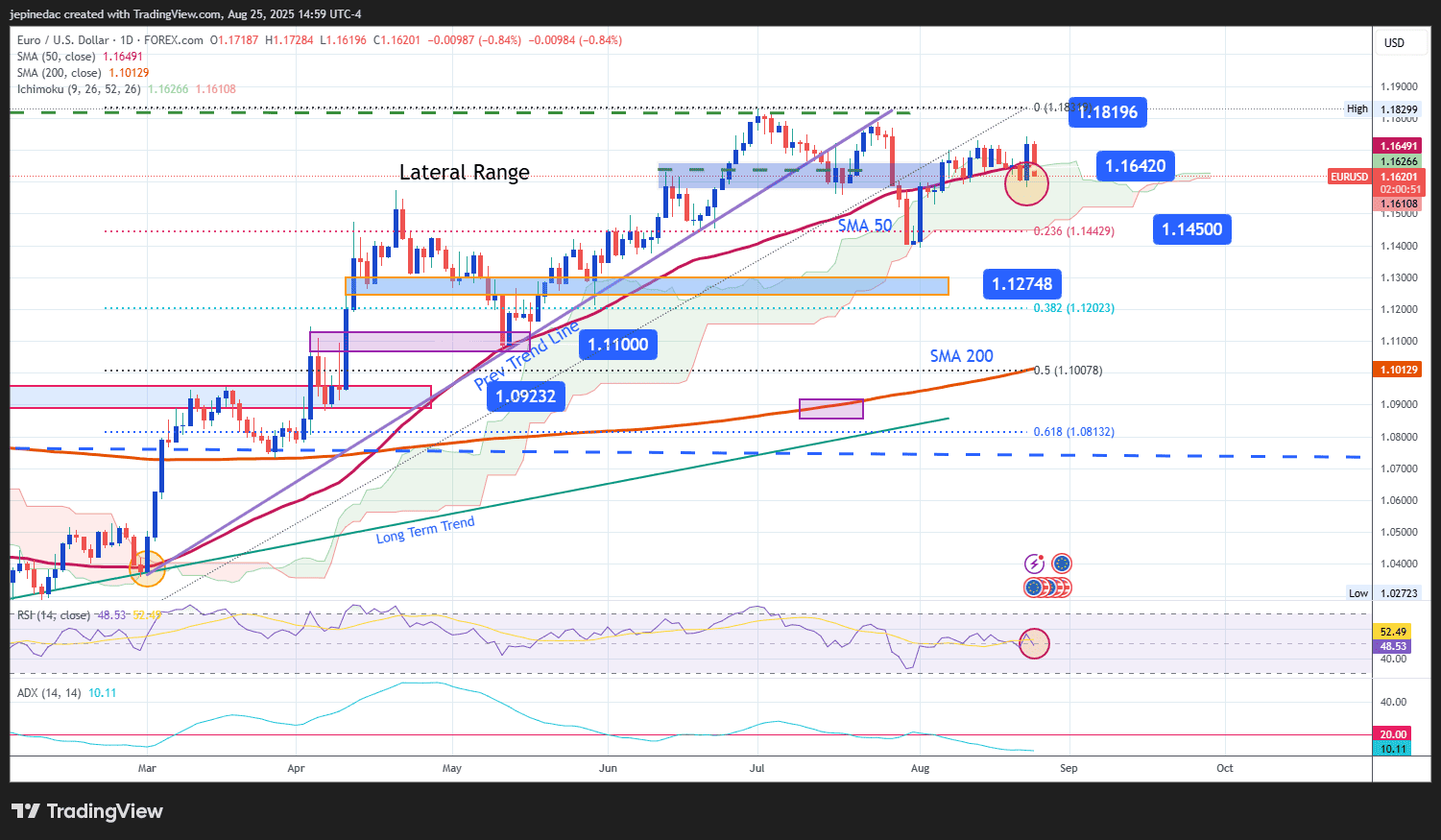
- Neutral Bias Persists: In recent weeks, EUR/USD has established a sideways range between 1.18196 as resistance and 1.1450 as support. Price action has not been strong enough to break out of this range, keeping neutrality as the prevailing short-term scenario.
- RSI: continues to hover around the neutral 50 level, signaling an ongoing balance between buyers and sellers. This suggests the sideways range could persist in the short term.
- ADX: remains below 20, showing that volatility is low on average. This supports the view that neutrality could dominate in upcoming sessions.
Key Levels:
- 1.18196 – Relevant Resistance: corresponds to this year’s highs and represents the most important barrier for buyers. A sustained breakout above this level would open the door to new highs and confirm a stronger bullish trend.
- 1.16420 – Near-Term Support: aligned with the 50-period SMA and the Ichimoku cloud, making it the most important short-term support. A breakdown here could trigger a more dominant bearish bias.
- 1.1450 – Critical Support: corresponds to the 23.6% Fibonacci retracement and represents the most important floor. A drop toward this level could confirm a structural shift into a more defined bearish trend.
Written by Julian Pineda, CFA – Market Analyst
Follow him: @julianpineda25