

As the third week of November begins, EUR/USD continues to show a steady bearish bias, with the pair declining for three consecutive sessions, marking a depreciation of more than 0.4% in favor of the U.S. dollar in the short term. The recent selling pressure stems partly from uncertainty over the Federal Reserve’s next move ahead of its December policy decision. The long-awaited Non-Farm Payrolls (NFP) report—key labor market data—is expected this week and could help define the monetary policy outlook for the United States. Until then, indecision is likely to dominate EUR/USD movements, keeping the pair under persistent downward pressure in the short term.

What to Expect from the U.S. Employment Data
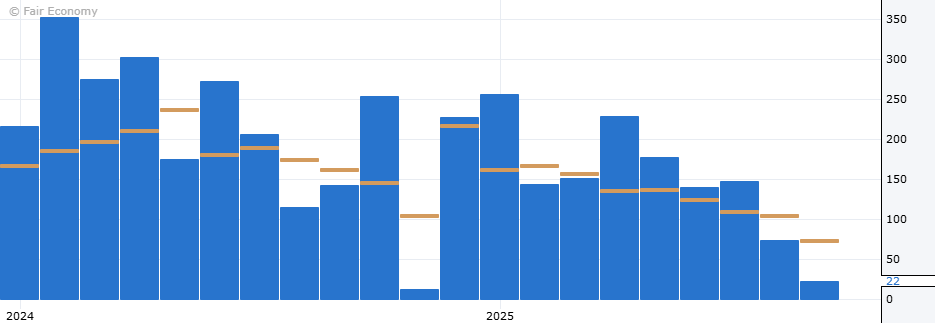
With the end of the U.S. government shutdown, delayed labor data for September will finally be released, including the NFP report, expected on Thursday, November 20. Market consensus anticipates 58,000 new jobs, compared with 22,000 in August. However, investors will focus on whether the data meets or falls short of expectations. A weak result would likely confirm the slowdown in the U.S. labor market observed throughout 2025, a year that began with over 200,000 new jobs per month, but has since seen figures drop below 50,000 as the months progressed.
Source: ForexFactory
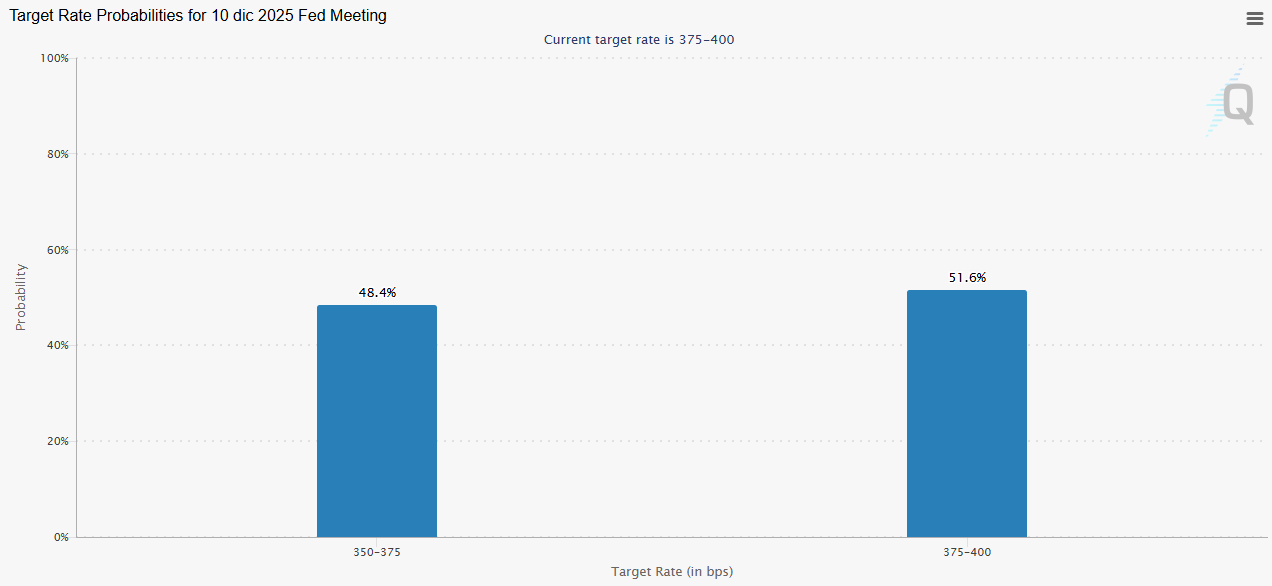
Given this outlook, employment data will serve as a key indicator for the Federal Reserve’s upcoming decision in December. According to CME Group, there is currently a 51.6% probability that the central bank will keep interest rates steady at 4.00% on December 10, compared with a 48.4% chance of a rate cut to 3.75%. These figures highlight the Fed’s ongoing indecision, with no clear consensus on whether to adopt a more restrictive or accommodative stance.
Source: CMEGroup
In this context, Thursday’s NFP data could be the decisive catalyst that removes some of the uncertainty. If the results exceed expectations, the Fed may choose to keep rates unchanged, postponing any potential rate cuts. Under this scenario, the U.S. dollar could strengthen, supported by strong demand for high-yield fixed-income instruments, attracting foreign capital into the U.S. Treasury market.
Conversely, if the data reveals significant labor weakness, the probability of rate cuts would increase, reducing demand for the dollar and weakening the currency in the short term. In summary, this week’s employment report will be crucial in defining the direction of EUR/USD: a scenario of steady or higher rates would favor the U.S. dollar, while expectations of lower rates could temporarily support the euro.
In the most likely outcome, where rates remain unchanged, EUR/USD may continue under selling pressure, reinforcing a stronger bearish bias in the coming sessions.
What About the European Central Bank?
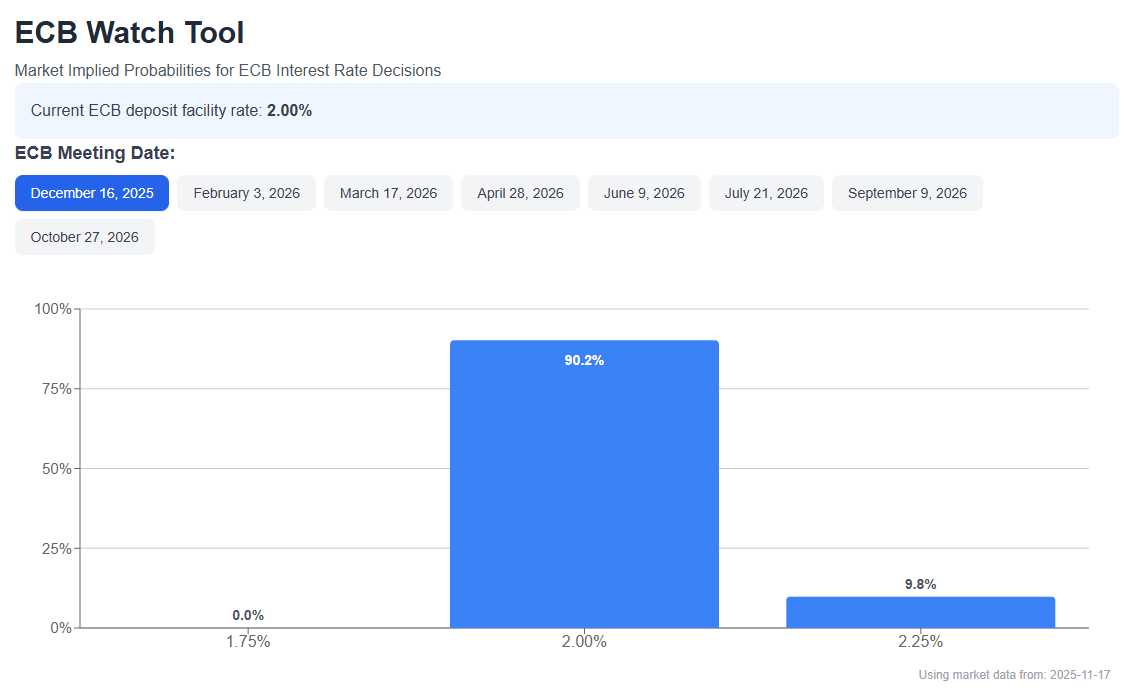
Unlike the Federal Reserve, the European Central Bank (ECB) is not expected to deliver any major surprises in the short term. According to ECB Watch, there is a 90.2% probability that the current deposit rate will remain unchanged at 2.00% during its upcoming December 16 meeting. So far, there are no indications of policy changes or comments suggesting a shift in the near term.
Source: ECBWATCH
Under this scenario, the euro’s strength will depend largely on the Federal Reserve’s direction. As long as the ECB’s rate remains significantly lower than that of the U.S., European fixed-income assets will remain less attractive compared to their U.S. counterparts. This wide interest rate gap could continue to dampen demand for euro-denominated assets while boosting appetite for the dollar, maintaining downward pressure on EUR/USD into year-end.
EUR/USD Technical Outlook
Source: StoneX, Tradingview
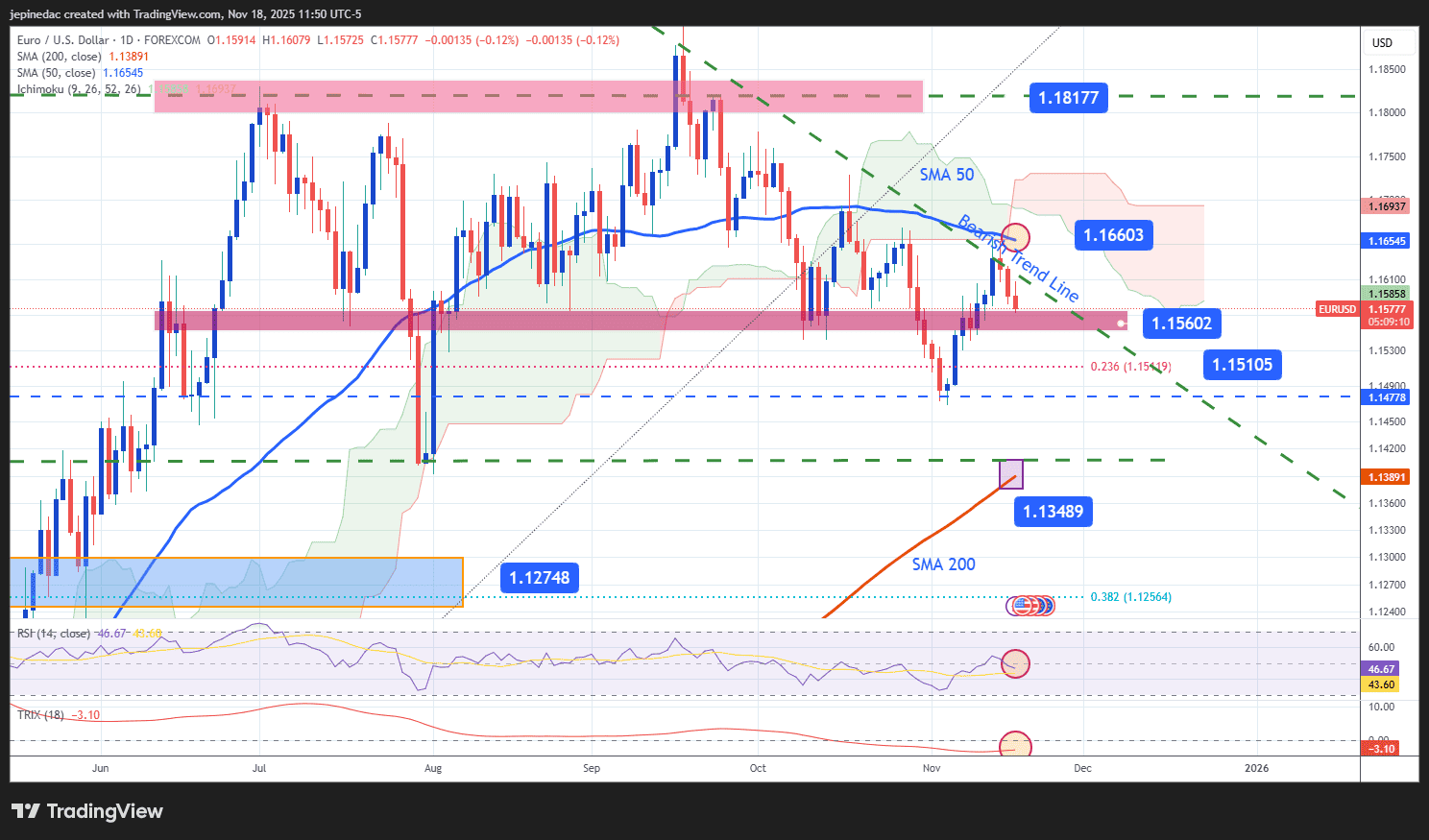
- Downtrend Holds Firm: The recent price action in EUR/USD continues to outline a clear downward trajectory in the medium term. Despite multiple attempts at bullish corrections, none have been strong enough to break the dominant bearish trend. For now, selling pressure remains the key technical factor, and as long as the price stays below the 50-period moving average, the downtrend is likely to extend further in the short term.
- RSI: The RSI indicator maintains a steady downward slope, oscillating below the neutral 50 level, indicating a dominant bearish momentum over the past 14 sessions. As long as this pattern continues, selling pressure is likely to intensify in the coming days.
- TRIX: The TRIX indicator also remains below the zero line, confirming a prevailing bearish bias across the exponential moving averages. If this pattern persists, the EUR/USD technical structure could maintain a sustained downward trajectory over the longer term.
Key Levels to Watch:
- 1.16603 – Major Resistance: Corresponds to the 50-period simple moving average and stands as the most important resistance level in the short term. A sustained move toward this area could test the existing downtrend and potentially trigger a temporary bullish bias.
- 1.15602 – Current Barrier: Represents a nearby support area, coinciding with a retracement zone observed since June. As long as the price remains near this level, sideways and indecisive movements could persist.
- 1.15105 – Key Support: Aligns with the 23.6% Fibonacci retracement level, marking the most important support zone on the chart. A break below this level could accelerate the downtrend, leading to a more aggressive selling phase in the sessions ahead.
Written by Julian Pineda, CFA, CMT – Market Analyst
Follow him on: @julianpineda25