The GBP/USD outlook is in focus this week, with both sides of the pair offering meaningful catalysts. The US dollar stabilised on Friday after its wobble recent wobble, helped by a correction in precious metals and a reassessment of how far the recent US dollar sell-off can really stretch. At the same time, sterling faces a key test with the Bank of England’s rate decision on Thursday. The cable has room to fall in the short-term outlook.
Dollar finds support as data takes centre stage
The dollar is looking a bit more stable after what had started to feel like an overextended sell-off in January. Part of the move lower seemed driven by the debasement trade, which was especially visible in the surge in gold and silver. But that narrative has cooled as precious metals corrected and as Kevin Warsh, who is not an outright dove or hawk, emerged as Donald Trump’s nominee for Federal Reserve Chair.
In fact, the recent dollar selling looked increasingly detached from the macro backdrop, and a corrective move higher was long overdue. After all, US economic growth remains decent while financial conditions are not especially tight. While the labour market has cooled, it hasn’t been alarming enough to warrant such a big slide in US dollar.
With the dollar rebounding slightly, traders will now want validation from incoming data. That brings this week’s heavy US calendar into focus. ISM surveys, JOLTS, ADP and Friday’s payrolls should give a fairly comprehensive read on whether the US slowdown remains orderly.
For the jobs report, the market is looking for a print of around 67-70K with unemployment rate seen steady at 4.4%. That’s not strong, but it is consistent with a cooling economy rather than one slipping into recession – a backdrop that still argues for near-term dollar stabilisation rather than a renewed sell-off.
GBP/USD outlook: Bank of England could signal March cut
On the UK side, the Bank of England is almost certain to keep rates on hold come Thursday. That won’t shock anyone given December’s relatively hawkish cut – where the Bank warned that the tempo of rate cuts could slow, and we haven’t had much in the way of new information since. Therefore, BoE policymakers have little incentive to rush into further easing, especially with the internal split also being well established. With that in mind, markets shouldn’t be surprised if the likes of Alan Taylor and Swati Dhingra were to vote for a cut again.
Since the December meeting, the UK data has been mixed: weak jobs numbers, slightly better PMIs, and inflation a touch higher than expected at 3.4% y/y. None of that forces the Bank’s hand.
That said, the direction of travel is clearly dovish for UK inflation and interest rates, and possibly the GBP/USD outlook. Wage growth is falling quickly, hiring surveys continue to weaken, and headline inflation is expected to drop sharply into the spring once the impact of base effects fall out of the y/y equation. That keeps a March rate cut firmly on the table. But will the Bank actively signal that this week? I am doubtful. But I do expect to hear is the typical message to signal options are wide open and that data will guide timing of the next rate move.
So, what does it all mean for the GBP/USD outlook?
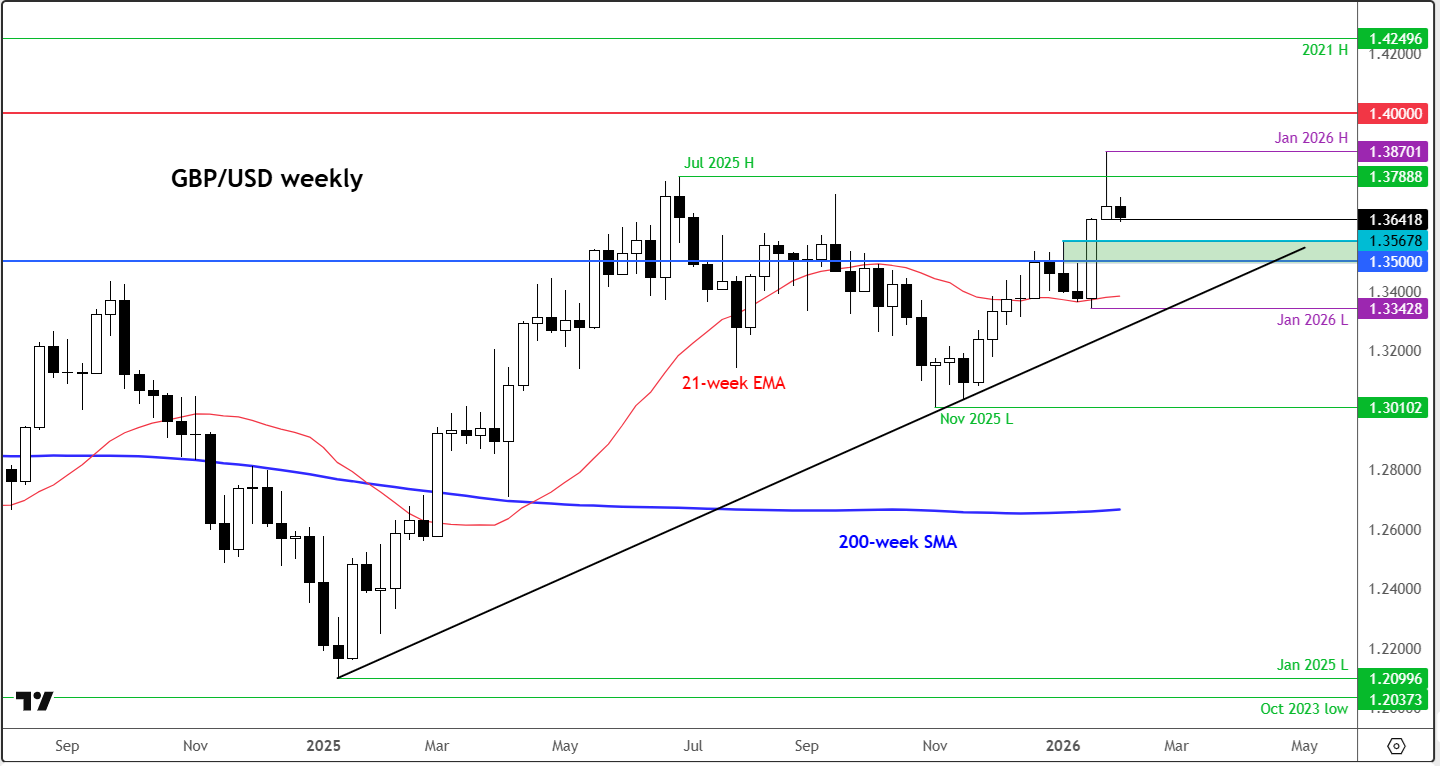
The GBP/USD could be facing some resistance here amid a stabilising dollar, and ahead of the BoE rate decision where policymakers are likely to stick to a cautious, non-committal tone. Technically, the inverted hammer-like candle on the weekly chart of the cable is bearish-leaning – especially given the false breakout above last year’s high of 1.3789. Last week’s low of 1.3641 needs to be watched now for a potential breakdown. A clean move below this level could put the next zone of support between 1.3500-1.3568 into focus next.

-- Written by Fawad Razaqzada, Market Analyst
Follow Fawad on Twitter @Trader_F_R