
- Year-long consumer loan subsidy aims to unlock household spending
- Equity rally helps offset weak property market confidence
- Hang Seng trades above rising 50 and 200-day moving averages
Summary
China’s back to the old playbook, rolling out a year-long consumer loan subsidy to get households spending again. Confidence is still soft after the property slump, so equities may be tasked with doing much of the heavy lifting to improve the odds of success.
Seeking Successful Stimulus
Everything that’s old is new again in China, including measures from policymakers to underpin flagging economic growth. The latest is a year-long plan to subsidise interest costs on consumer loans to encourage households spending. It joins a long list of stimulus efforts rolled out this year targeting consumption, but the problem is convincing people to borrow when confidence is low. Years of property weakness and a soft jobs market have left many households reluctant to commit to big-ticket purchases, even with cheaper credit.
That’s why keeping the equity rally rolling may be just as important as the loan subsidies. Higher stock prices can generate a positive wealth effect, helping to offset the hit to sentiment from ongoing property market weakness. Recent gains suggest the strategy might be working, with margin lending hitting multi-year highs while retail turnover is climbing.
It’s not the first time Beijing has turned to the stock market as an economic support tool. In 2014, policymakers encouraged equity investment to boost activity, a push that sent markets soaring before unravelling less than a year later as hype, rather than fundamentals, underpinned the rally. That remains a risk if this move extends further, especially with consumer and producer prices either flat or falling, highlighting ongoing weakness in domestic demand.
However, with sentiment improving and liquidity abundant, many Chinese indices are on the cusp of joining other major markets around the world in breaking out, including Hong Kong’s Hang Seng.
Hang Seng to Join the Bullish Breakout Club?
There’s not a lot not to like about the Hang Seng right now: it trades in an ascending channel, setting higher highs and higher lows. It also sits above the 50 and 200-day moving averages, both of which are trending higher. Momentum indicators are positive with RSI (14) trending above 50 but not yet overbought, while MACD is curling higher towards the signal line above zero, set to confirm the bullish signal.
Beyond technicals, the broader index remains cheap even with the rally seen this year, especially relative to other high-beta indices around the world. The case for bulls is easy to see, but as with any trending market, evaluating the merits of potential setups is key.
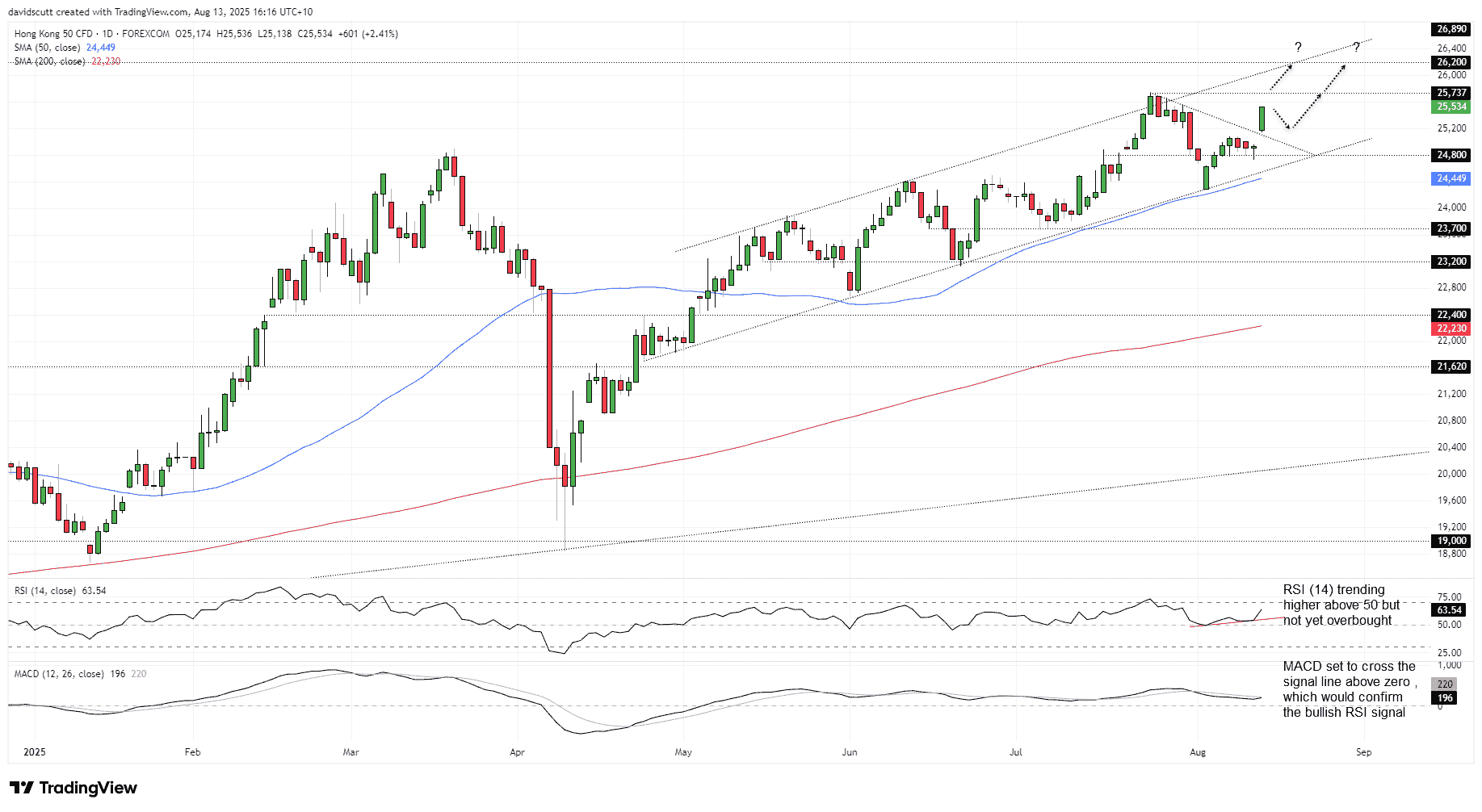
Source: TradingView
Even with the bullish break of the downtrend running from the July highs, the Hang Seng has already run hard on Wednesday, so getting long now feels like a risky, lower probability play unless you’re assessing a long-term setup. Instead, a pullback towards 25,200 would make for a more appealing entry level, allowing for a stop to be placed beneath it or the July downtrend for protection against reversal. 25,737 screens as an initial target, with 26,200 and 26,890 others after that.
Another option would be to wait for a potential breakout above 25,737, creating a setup where longs could be established with a stop beneath for protection. The levels mentioned above would remain valid targets.
Other potential entry levels if there was a deeper pullback include 24,800, channel support, or the 50-day moving average. If the price were to slide beneath those levels, it would raise serious questions about retaining a bullish bias.