
- Nasdaq 100 forecast uncertain as tech stocks pause after strong rally
- Traders eye Fed policy clues following government reopening
- Index recently reached a technical exhaustion area
US stock index futures struggled for direction this morning, with traders appearing hesitant after the end of the longest US government shutdown in history. While it’s unclear whether the shutdown was ever a real drag on equities – given that stocks largely rallied through it – the question now is whether the market’s recent exuberance has run its course. After a stellar rally since April, technology shares look increasingly overvalued and overstretched, with sentiment tempered by a lack of fresh catalysts and a lull in economic data. It wouldn’t be surprising to see the Nasdaq 100 remain range-bound in the near term. Yet, it’s far too early to call a top in this cycle, especially with the underlying trend still supported by strong liquidity and investor enthusiasm for AI-driven growth.
Interest rates clarity ahead as US government re-opens
Now that the government has reopened, markets can soon expect the flow of economic data to resume, albeit gradually. According to the White House, October figures, including CPI and payrolls, are unlikely to be released, but November’s data should surface in early December. That leaves traders with continued US data void for a while yet, which means price action could be driven more by sentiment and positioning than by hard data.
The Nasdaq 100 forecast may hinge on how dovish or hawkish the Federal Reserve appears once the data finally rolls in. For now, the market is pricing in around 15 basis points of rate cuts, suggesting investors still see scope for further easing. Any fresh signs of economic slowdown could amplify those bets and provide near-term support to equity valuations.
Tech stocks lose some momentum
Technology stocks, long the poster children of Wall Street’s AI revolution, have started to show signs of fatigue recently. Investors seem increasingly uneasy about just how far, and how fast, the AI narrative has inflated valuations. Over the past few sessions, a noticeable rotation has occurred, with traders moving out of high-growth names and back into defensive and value-oriented sectors.
Is this a sign that risk appetite is fading, or merely the sort of rotation one expects in a healthy bull market? Time will tell. But it’s worth noting that insider selling within the tech space has picked up lately, which rarely bodes well. Traders would do well to stay alert – overconfidence has undone many in markets like these.
Technical Nasdaq 100 forecast and key levels to watch
From a technical perspective, the long-term trend for the Nasdaq 100 forecast remains bullish. However, the index has recently formed a series of lower highs since hitting a near-term exhaustion zone around 25,900–26,250 at the end of October. The lower end of that range coincides with the 161.8% Fibonacci extension of the prior downswing that commenced in February. This particular extension level is used by traders to identify objective profit-target areas, so it often acts as a temporary ceiling.
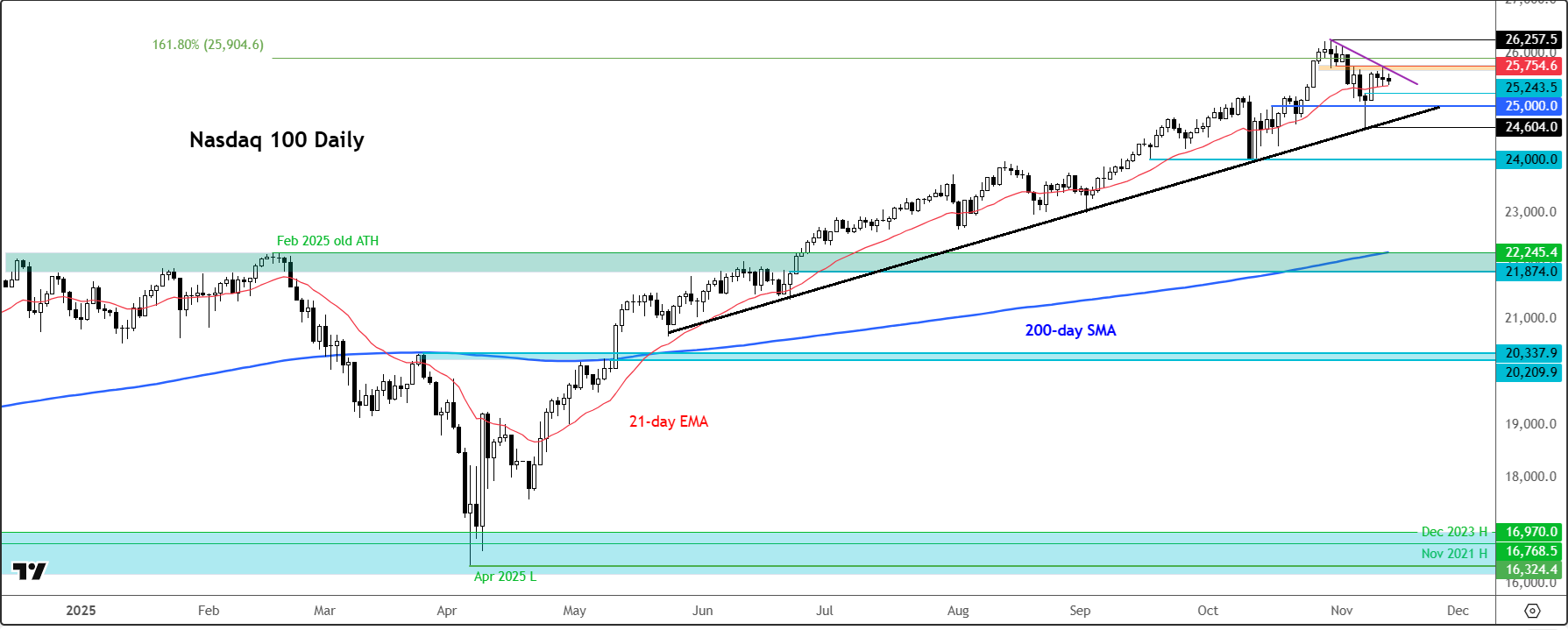
On the downside, the 25,380/25,400 area marks an important short-term support zone on our US tech 100 chart, which is derived from the underlying Nasdaq 100 futures chart. Having held over the past couple of sessions, can we see another bounce here, or will it break down this time? A break below this could open the door to 25,240/5, which represents the top of Friday’s range, when a bullish hammer candle was formed. Beyond that, 24,600 stands out as the key line in the sand—breaching it would confirm a break below the bullish trend line that has been in place since May. Ahead of that, 25,000 serves as a crucial interim psychologically-important support.
On the upside, short-term resistance is seen around 25,750. A move above this band could reawaken bullish momentum and bring the 25,900–26,250 zone back into focus.
In summary, the Nasdaq 100 forecast suggests a market caught between strong underlying optimism and a cooling sense of reality. With tech valuations stretched and Fed expectations still fluid, traders may have to settle for range-bound price action until clearer data—or a fresh catalyst—emerges.

-- Written by Fawad Razaqzada, Market Analyst
Follow Fawad on Twitter @Trader_F_R