
- Higher energy prices may continue to favour USD/JPY
- US labour market weakness remains the key downside risk
- Ueda may need to validate BOJ hike expectations
- 160 remains a major level overhead for USD/JPY
Energy Shock Hits Japan Harder
While no one knows when a truce in the Gulf will truly hold, allowing energy supplies to transit the Strait of Hormuz freely, the uncertainty continues to expose a major vulnerability for Japan. As a significant net energy importer, higher prices threaten to worsen both its terms of trade and current account position, creating a headwind for the yen. The opposite forces are at play in the US, helping to support the dollar.
Throw in continued US economic exceptionalism, fuelled in part by the ongoing buildout of AI infrastructure, and it's a potent mix for USD/JPY upside.
But beyond the noise created by the constant torrent of Gulf-related headlines, it will likely take something far more significant to trigger meaningful USD/JPY downside. Right now, that probably means a genuine US growth scare driven by a deterioration in labour market conditions, similar to what we saw in 2024 and again last year.
That's what makes this week's run of US economic data especially important.
Positive Surprises Everywhere
Source: LSEG
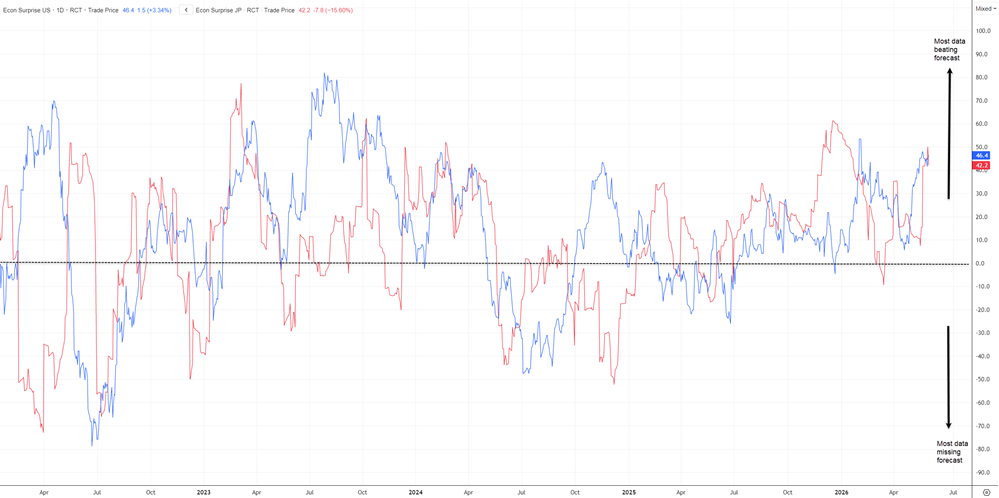
Looking at Citi's economic surprise indices above, what stands out is that it's not just the US (blue line) that has delivered a sustained run of positive surprises over the past year. Japanese data (red line) has also generally topped forecasts, with both countries spending most of the period in positive territory aside from a handful of brief setbacks.
Yet despite that, it has done little to support the yen. If anything, the weaker currency may have contributed to the resilience seen in the Japanese economy by improving export competitiveness and helping to lift imported inflation.
As a result, the fact Japanese data continues to beat forecasts appears of secondary importance for USD/JPY. Instead, the focus remains firmly on whether incoming US data can continue to support the exceptionalism narrative that has helped underpin the pair's recovery in recent months.
Watching for US Labour Market Cracks
Source: TradingView (Japan standard time)
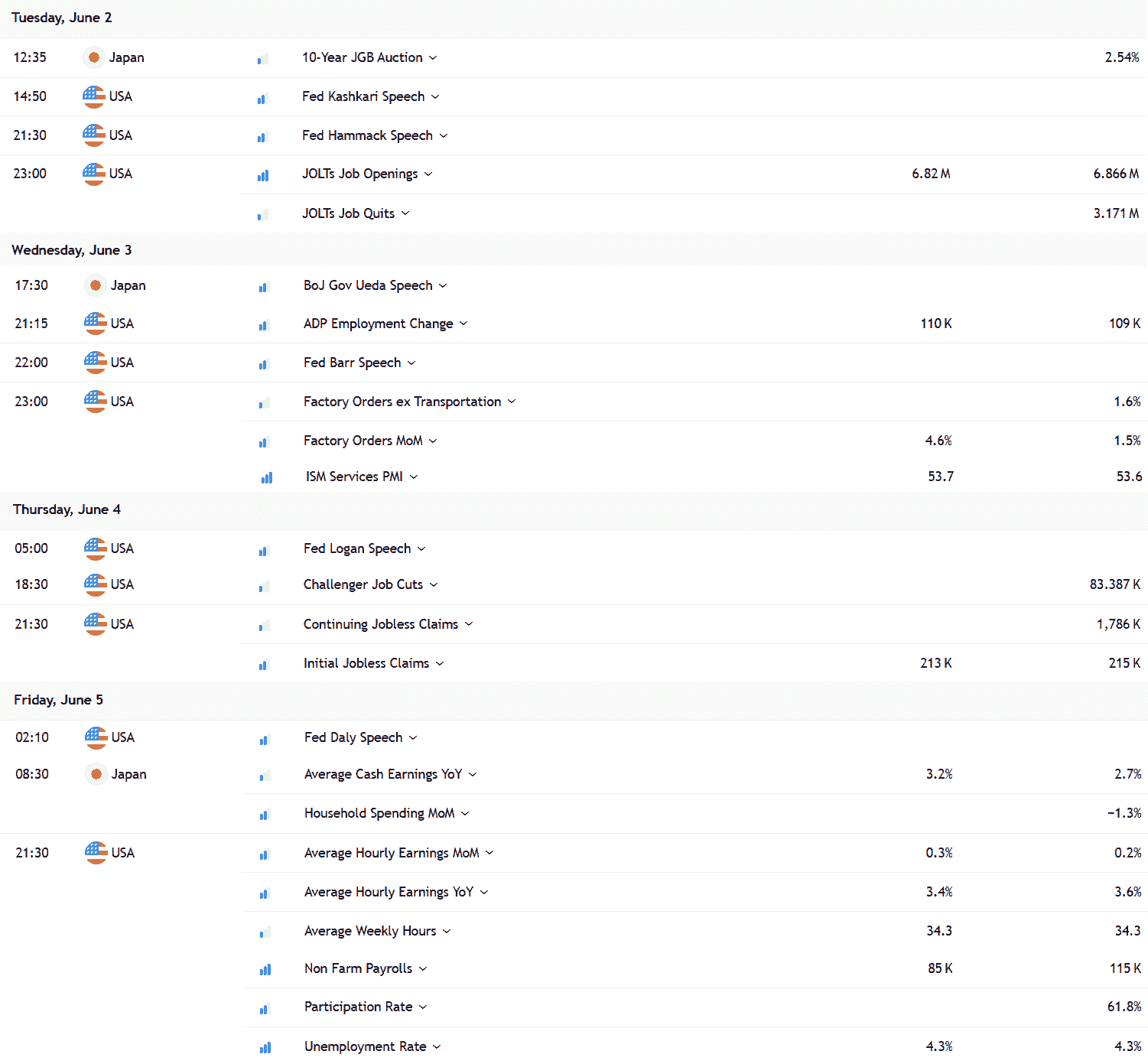
The calendar is loaded with US economic releases this week, headlined by nonfarm payrolls on Friday.
Before then, attention turns to the JOLTS report later Tuesday. While job openings tend to be volatile from month to month, perhaps of greater interest is whether the improvement seen in the hires and quits rates in March, both of which are generally associated with stronger labour market conditions, extended into April.
A further pickup would help reinforce the view that labour market conditions remain solid, reducing the likelihood of the type of growth scare capable of delivering meaningful USD/JPY downside.
The ISM services PMI will also be closely watched given it covers the largest and most important segment of the US economy. ADP employment may generate volatility too, having done a reasonable job of signalling trends in private sector hiring ahead of the official payrolls report in recent months.
On the Japanese side, attention will centre on Governor Ueda's speech on Wednesday. With markets continuing to favour a rate hike later this month, his job is to sound confident that continuing to normalise policy remains the appropriate course of action. Failure to do so risks sparking another round of yen weakness, potentially sending USD/JPY hurtling higher.
The 10-year JGB auction later Tuesday may also be worth watching for any meaningful shift in demand relative to prior auctions of similar maturity, especially given the recent focus on longer-dated government bond yields globally.
Looking further ahead, wages and household spending data due on Friday are the other releases to watch. After several softer inflation prints impacted by government subsidies and cost-of-living measures, markets will want confirmation that wage pressures remain firm enough to support household spending in the current inflationary environment. That would help reinforce the case for further policy normalisation from the BOJ.
160 Back on the Radar
Source: TradingView
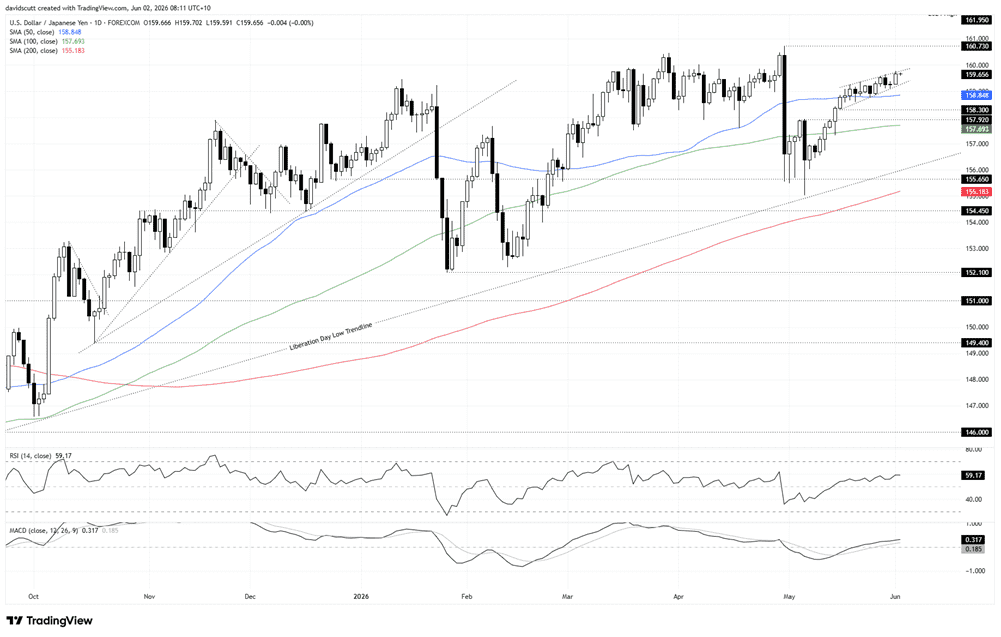
USD/JPY finds itself coiling within a rising wedge currently, grinding higher after a sharp rebound following a string of intervention episodes from the BOJ on behalf of Japan's finance ministry either side of the calendar turn from April into May.
While the structure warns of the potential for an eventual downside break, putting the 50DMA and 158.30 on the radar given the latter marks where the wedge started to form, there's little need to pre-empt such a move until wedge support breaks given it would run counter to both the prevailing trend and fundamental backdrop. The former breakout zone at 157.92, which also coincides with the 50% retracement of the April-May decline, is another level of note on the downside alongside the 100DMA.
Overhead, 160 remains a significant psychological level given it has been the scene of multiple intervention episodes in recent years. Above that, the year-to-date high of 160.73 and the multi-decade high of 161.95 set in 2024 are the levels to watch.
The message from the oscillators remains mildly bullish with RSI (14) continuing to grind higher above 50 while MACD has done the same after crossing above the signal line midway through last month. Combined, the message favours buying dips over fading rips.