

The week started on slightly favorable ground for the yen. At the moment, USD/JPY is opening the week with a notable decline, marking at least two consecutive sessions with losses of around 0.3% in favor of the Japanese yen in the short term.
For now, the mild selling pressure seen in the pair is mainly driven by market expectations ahead of the Bank of Japan’s decision later today, an event that could begin to reshape the outlook for the yen in the coming sessions. If comments pointing toward a more aggressive monetary policy emerge, this could further reinforce downside pressure in USD/JPY in the short term.

Central bank day arrives
The central bank week kicks off with Japan, as the Bank of Japan is set to announce its decision during today’s session. So far, expectations suggest that the institution will keep interest rates unchanged at 0.75%, a level that has been in place since December 2025. At this stage, no significant changes are anticipated in the short term.
However, it is important to note that the central bank has recently emphasized factors such as wage growth, currency weakness—which can lead to imported inflation—and overall consumer price dynamics. As a result, while the rate decision itself may not bring surprises, the focus will likely be on post-decision commentary.
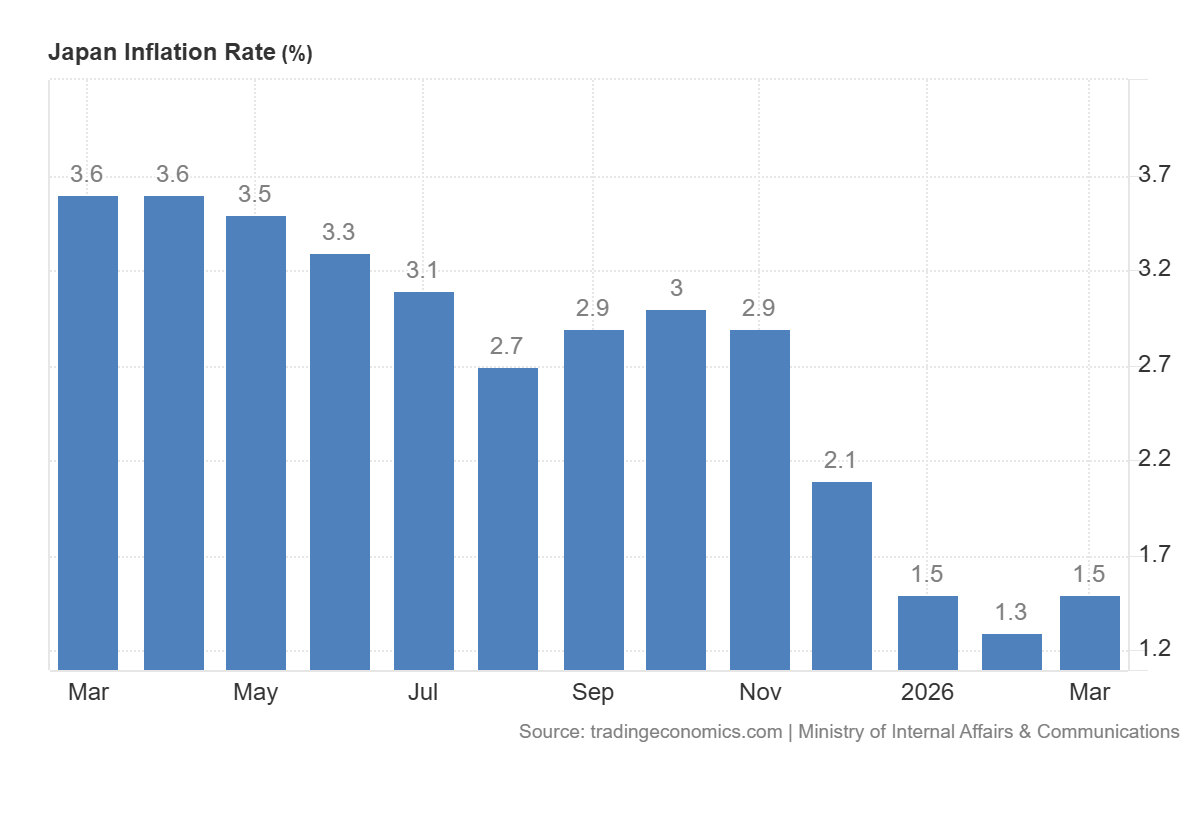
In this context, inflation levels in Japan have not shown a clear slowdown. According to the latest year-over-year CPI data for March, inflation came in at 1.5%, matching January’s reading and rising from February’s 1.3%. This reflects persistent inflationary pressure, which could begin to influence future central bank decisions.
Source: TradingEconomics
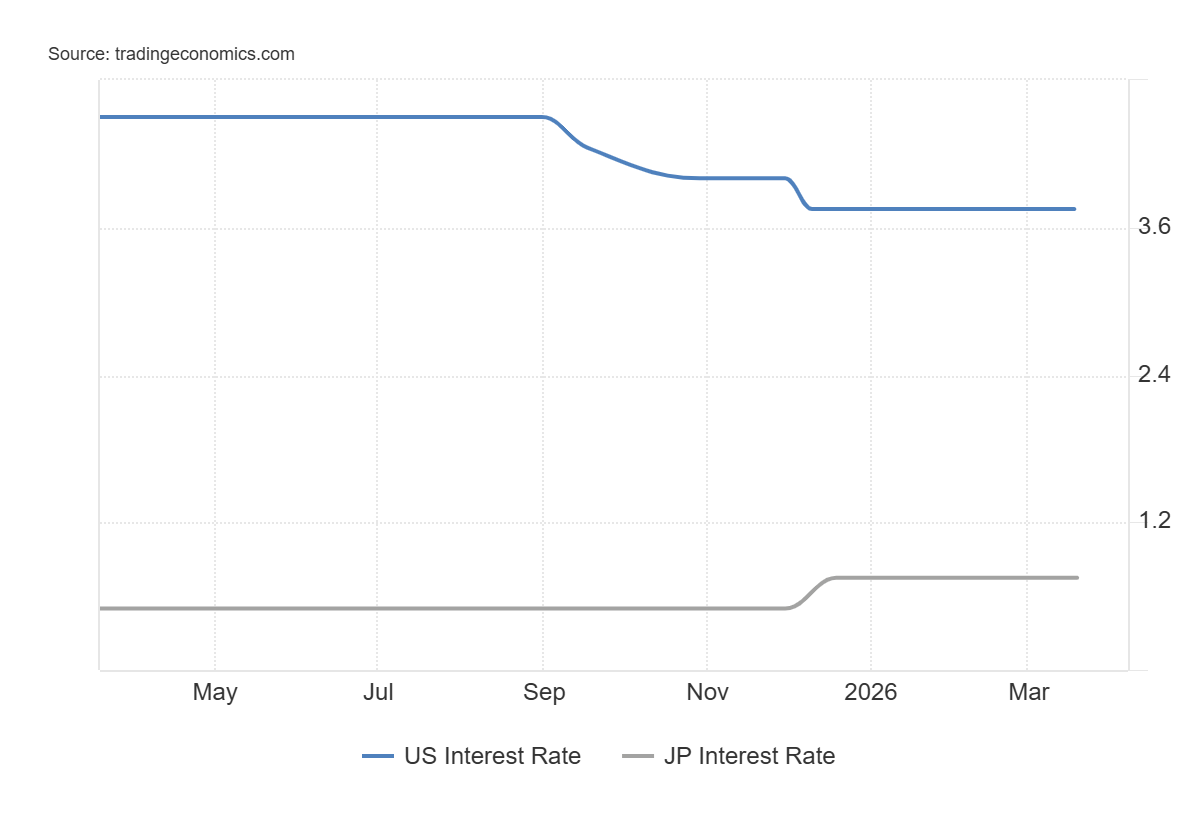
This point becomes especially relevant when considering that one of the main factors weakening the yen in recent months has been the interest rate differential with the United States. While the Federal Reserve maintains rates at 3.75%, the Bank of Japan remains at 0.75%.
Therefore, any signal pointing to a potential rate hike in Japan could narrow this differential and increase the attractiveness of yen-denominated assets relative to the dollar.
Source: TradingEconomics
Taking all of this into account, the central bank decision will act as a key catalyst. Any indication of a more restrictive stance could restore strength to the yen and reinforce downside pressure in USD/JPY in the coming sessions.
Dollar begins to lose ground again
Another important factor has been the recent weakening of the US dollar. Over the weekend, talks between the United States and Iran resumed, with Iran signaling it could fully reopen the Strait of Hormuz if US naval blockades are lifted.
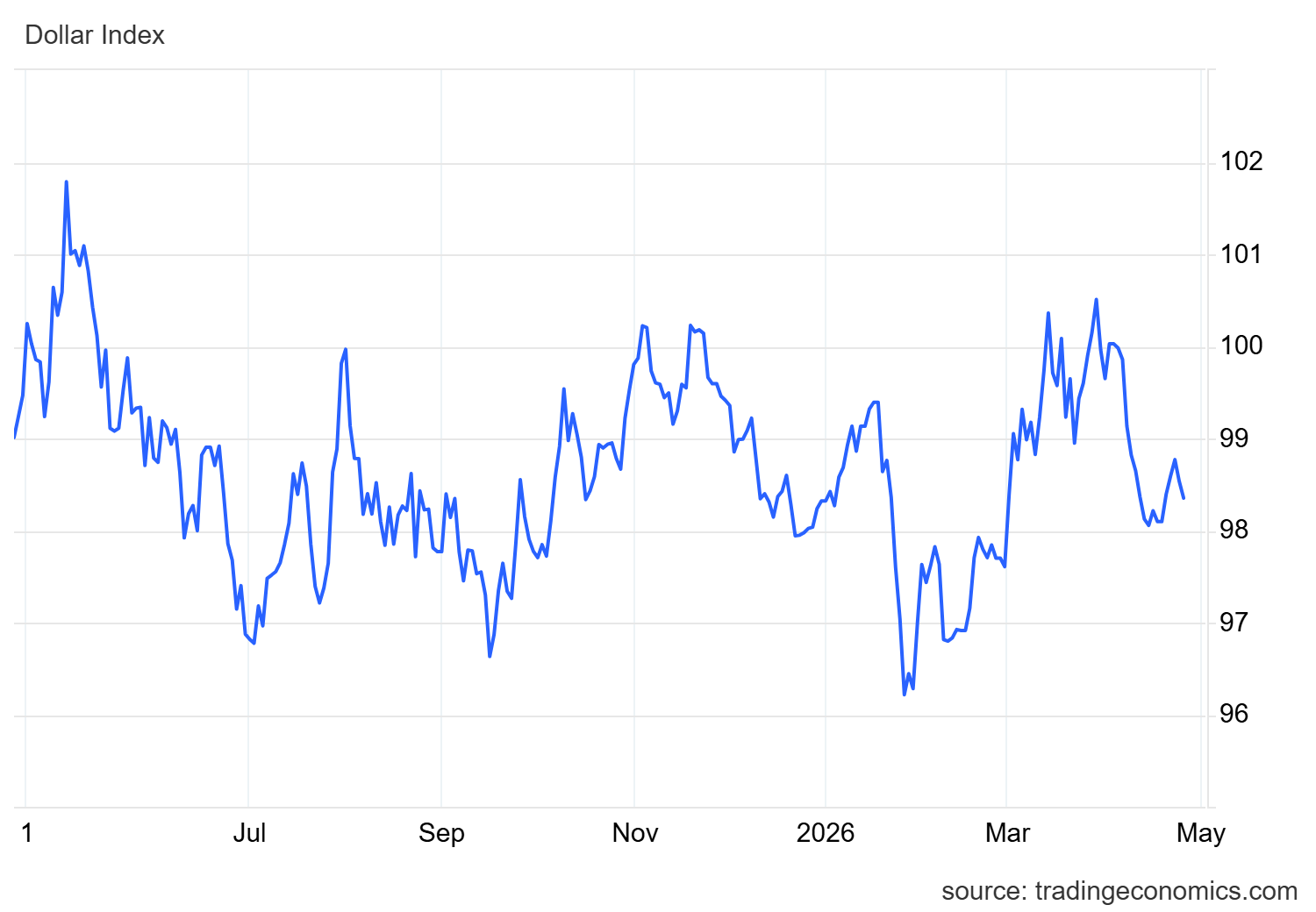
This environment has supported a degree of market optimism, reducing demand for the dollar as a safe-haven asset. This is already reflected in the DXY index, which has started the week with a decline toward the 98 level, showing renewed weakness in the dollar in the short term.
Source: TradingEconomics
This dynamic is relevant because a weaker dollar tends to support yen appreciation. If this trend continues, the bearish pressure on USD/JPY could remain in place in the coming sessions.
Technical outlook for USD/JPY
Source: StoneX, Tradingview
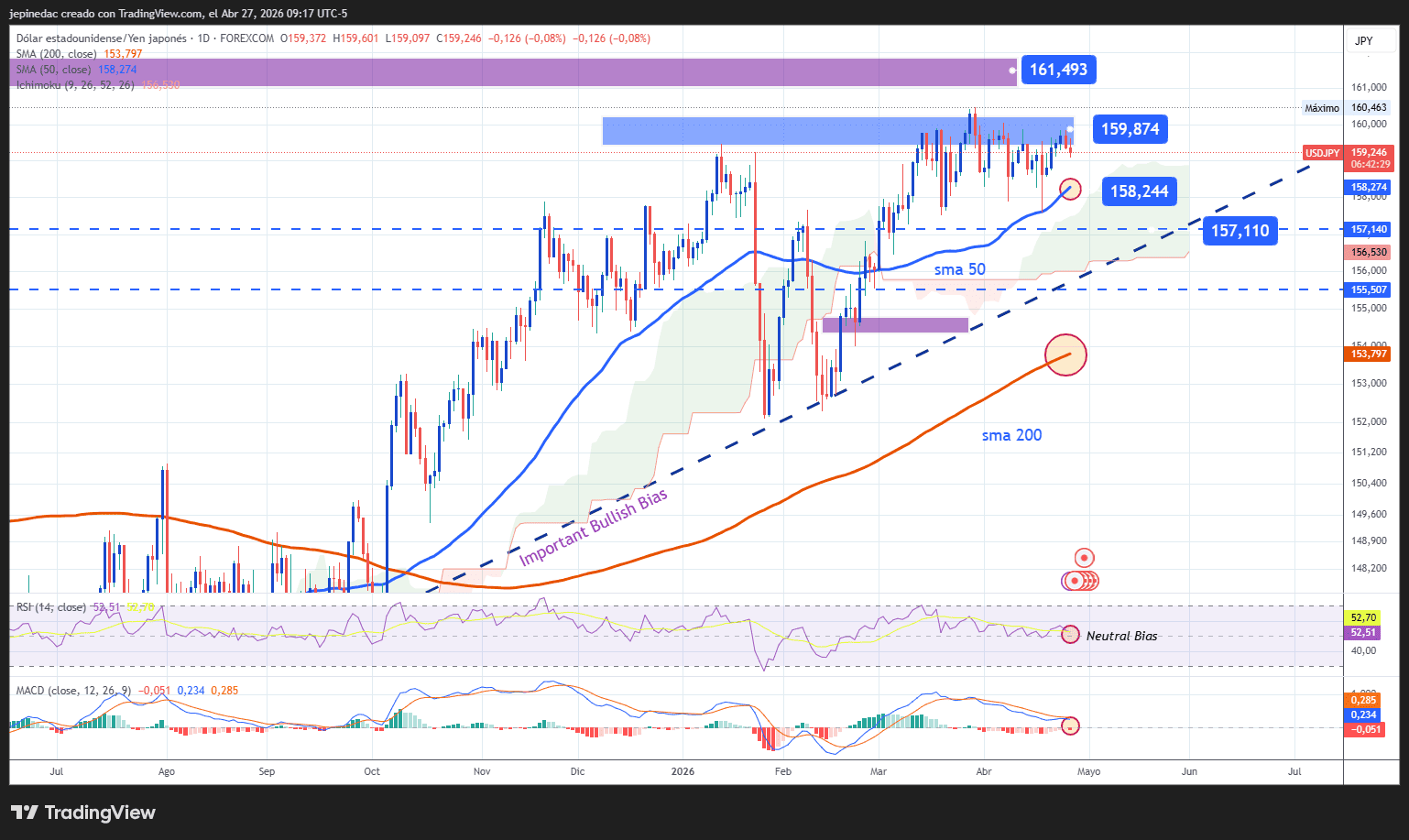
- Long-term uptrend remains in place: Despite recent attempts by the yen to strengthen, the dominant technical factor remains the long-term upward trendline that has been in place for several months. So far, selling pressure has not been strong enough to invalidate this structure. Therefore, unless downside momentum builds more convincingly, this trendline is likely to remain the key technical element in the coming weeks.
- RSI: The RSI indicator remains close to the 50 level, reflecting a balance between buying and selling forces. This suggests that neutrality could continue to dominate in the short term.
- MACD: Similarly, the MACD histogram remains close to the zero level, indicating a balance in short-term moving averages. This reinforces the likelihood that indecision may persist as the market awaits new catalysts.
Key levels:
- 159.874 – Key resistance: A level of recent highs and an important barrier for bullish moves. A break above this level could reactivate buying momentum and support the continuation of the uptrend in the coming sessions.
- 158.244 – Near-term barrier: A neutral zone aligned with the 50-period moving average. Moves toward this level could reinforce a short-term bearish bias.
- 157.110 – Key support: A level of recent lows aligned with the base of the uptrend. A move toward this zone could begin to challenge the current structure and open the door to a more significant trend shift in the coming weeks.
Written by Julian Pineda, CFA, CMT – Market Analyst
Follow him on: @julianpineda25