

The USD/MXN continues to recover, advancing approximately 0.5% above the key support level in the 20 pesos per dollar zone, favoring the U.S. dollar. This recent bullish movement remains firm as the market awaits comments from the Federal Reserve later today and evaluates the impact of a potential trade war, which has increased uncertainty regarding the Mexican economy.

What to Expect from the Fed’s Decision?
Analyzing the trends of the Federal Reserve and the Bank of Mexico, the U.S. currently maintains a neutral interest rate policy, holding steady at 4.5%, while Mexico has taken a more flexible approach, reducing its rate to 9.5% in its most recent decision on February 6.
At this moment, the market estimates a 99% probability that the Federal Reserve will keep its interest rate unchanged within the 4.25% - 4.5% range, according to CME Group data. Therefore, the uncertainty lies not in the Fed's decision itself but in Jerome Powell’s post-announcement comments regarding the monetary policy outlook for the U.S.
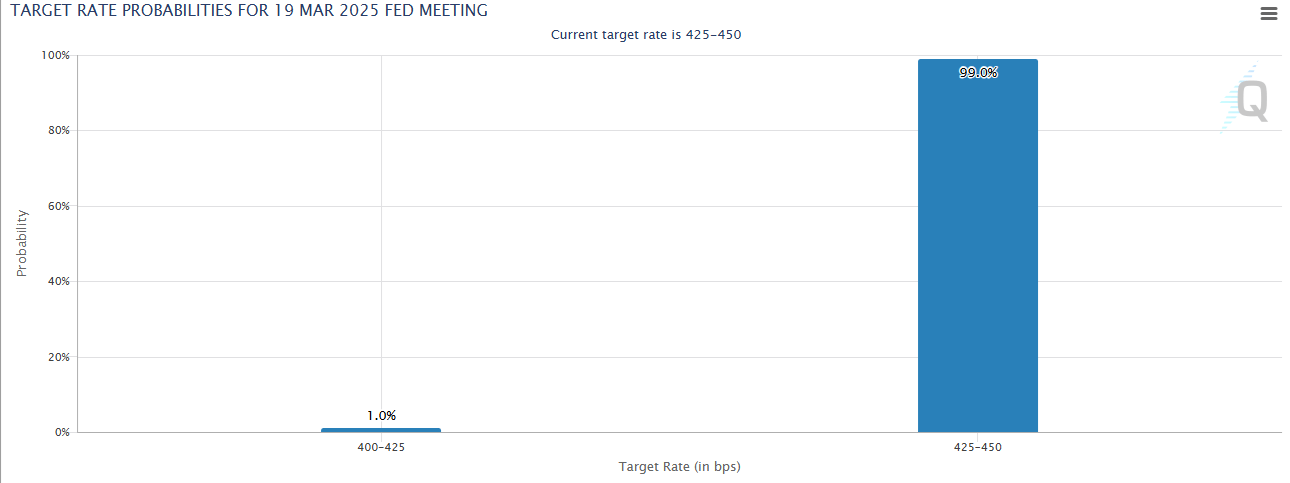
Source: CMEGroup
If Powell hints at the possibility of future rate cuts, the market may interpret it as a loss of confidence in the U.S. dollar, as this would reduce fixed-income yields. In such a scenario, the Mexican peso could benefit, reactivating the bearish pressure on USD/MXN, which had eased in recent sessions.
It is important to remember that Mexico maintains a 9.5% interest rate, significantly higher than the 4.5% rate in the U.S. The primary factor sustaining demand for U.S. bonds is their lower risk and greater stability compared to Mexican markets. However, if the Federal Reserve begins a rate-cutting cycle, the balance could shift in favor of the Mexican peso in the short term.
Impact of the Trade War
The trade war has become the main focus of financial markets. Despite the threat of a 25% tariff on Mexican exports to the U.S., President Claudia Sheinbaum has chosen to remain calm in response to the trade measures imposed by the White House.
Mexico has paused the implementation of new tariffs until April 2, while the government has stated that it does not currently plan to impose retaliatory measures.
The market’s concern is that Mexico has not yet managed to definitively avoid the tariffs, which has begun to impact long-term economic expectations. According to the Organization for Economic Cooperation and Development (OECD), Mexico could enter a recession, with a projected GDP contraction of 1.3% this year and an additional 0.6% decline in 2026.
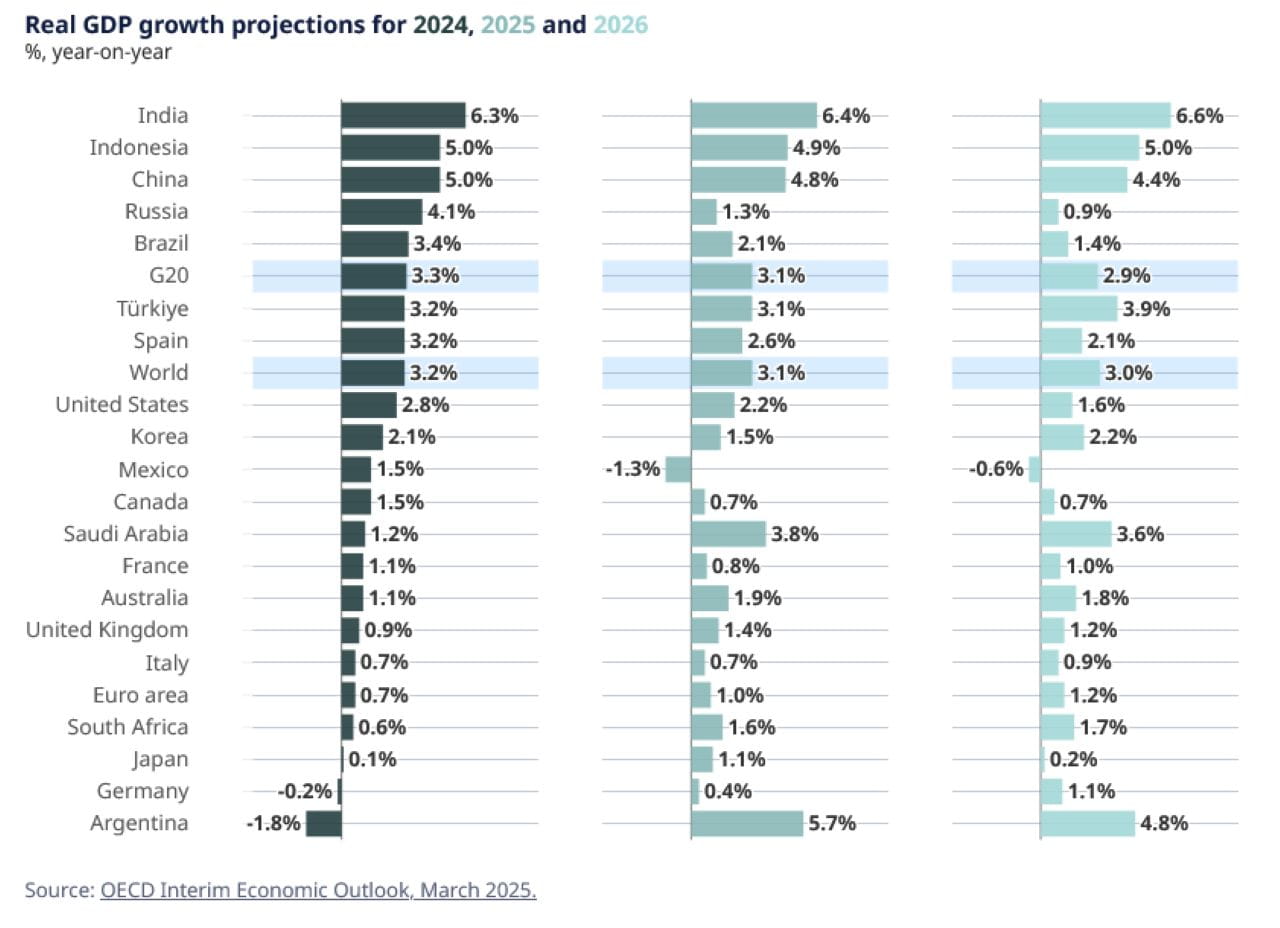
Source: OECD
Uncertainty surrounding the trade war has led to a loss of confidence in Mexico’s economic growth. If this situation persists, concerns could increase bullish pressure on USD/MXN in the long term.
USD/MXN Technical Outlook

Source: StoneX, Tradingview
- Large Sideways Range: Currently, USD/MXN continues to trade within a sideways range, with a ceiling at 20.81 pesos per dollar and a floor around 20 pesos per dollar. Recently, the price has formed a bearish channel, but selling pressure has not been strong enough to break the support of the sideways range. This may indicate that the market is entering a consolidation phase in the short term.
- ADX: The ADX line has begun to decline, showing oscillations below the 20 level. This indicates that the strength of recent movements has weakened, reflecting a neutral sentiment in the short term.
- RSI: The RSI line has been steadily recovering but remains near the oversold level at 30. If the RSI stays in this range, it could signal market pressure imbalances, potentially leading to bullish corrections around the support zone.
Key Levels:
- 20.00 pesos per dollar – Major Support: This level marks the lower boundary of the sideways range. If selling pressure pushes the price below this level, it could reactivate the downtrend, leading to a more pronounced bearish movement.
- 20.40 pesos per dollar – Near-Term Resistance: This level aligns with the barrier formed by the 50- and 200-period moving averages. If bullish momentum pushes the price above this level, the sideways range could continue extending in the short term.
- 20.81 pesos per dollar – Major Resistance: Positioned at the upper boundary of the sideways range. A break above this level could revive the bullish trend, eliminating the recent bearish bias.
Written by Julian Pineda, CFA – Market Analyst