




Why EURUSD is Rallying and What Could Cause it to Stop
The euro is rising on the exact same dynamic that makes the Japanese yen a “safe haven” currency: the reversal of carry trades
Share this:

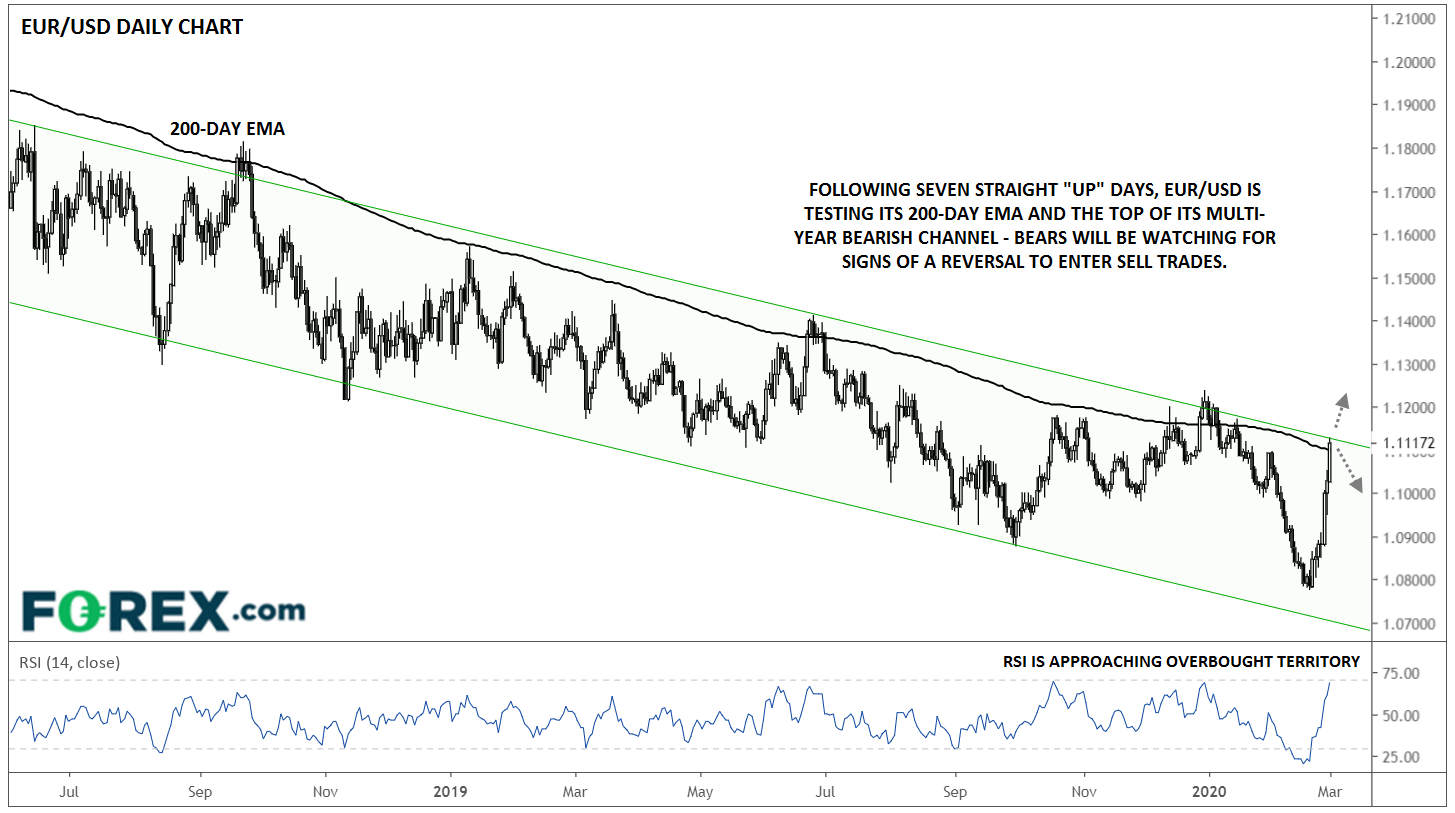
Stop me if you’ve heard this one before, but the euro is the strongest major currency on the day despite the accelerating spread of coronavirus on the continent. Assuming we close anywhere near where we’re currently trading, this would mark the seventh consecutive rally in EUR/USD, which has tacked on more than 300 pips in that time.
So what’s driving the euro higher against its major rivals? It’s certainly not the economy, which remains mired in a slow growth, high unemployment state, despite negative interest rates and aggressive asset purchases.
Instead, the euro is rising on the exact same dynamic that makes the Japanese yen a “safe haven” currency: the reversal of carry trades. In a carry trade, investors buy higher-yielding currencies and sell lower-yielding currencies (like the euro), seeking to benefit from the positive “carry” between the two currencies in addition to any price moves in their favor. Traders typically put these trades on when they’re confident in the prospects for the global economy, which tends to benefit higher-yielding emerging market and commodity-correlated currencies.
Of course, markets are two-way animals, and these dynamics occasionally reverse as we’ve seen in the last couple of weeks. As traders become fearful about the prospects for the global economy, they emphasize the return of their capital over the return on their capital and accordingly “unwind” their carry trades. This means that they must sell the higher-yielding currency and buy back the lower-yielding currency used to fund the trade (commonly the euro of late). It’s this dynamic that has led to the massive rally in the euro, which has counterintuitively become a “safe haven” currency of sorts (see my colleague Joe Perry’s Week Ahead report for more on this phenomenon).
Turning our attention to the chart, there is a technical case for the EUR/USD rally to end soon assuming sentiment around coronavirus can stabilize. The world’s most widely-traded currency pair is currently testing its long-term 200-day EMA, as well was the topside of a multi-year bearish channel. Meanwhile, the RSI oscillator is approaching overbought territory after starting this vicious rally from its most oversold levels in years less than two weeks ago:
Source: TradingView, GAIN Capital
In terms of specifics, bearish traders will want to watch for signs that price action is starting to reverse, perhaps in the form of a reversal candlestick pattern on the 4-hour or 1-hour chart, before considering sell traders against the strong bullish momentum. Positive global economic news, even if it comes in the form of a Fed rate cut, could also help EUR/USD find a near-term top. On the other hand, a break through the current resistance levels would suggest that the buyers remain in control and open the door for a continuation toward the New Year’s Eve highs above 1.1200 next.


The complete CFD trading experience
Award-winning platforms, competitive spreads, low commissions and dedicated support.
We live and breathe the markets and are dedicated to helping traders realise their ambitions as we continue to set the industry bar.
Economic calendar
Web Trader platform
Our sophisticated web-based platform is packed with features.
Related articles
USD/JPY Weekly Outlook: Fed Hikes, AI Volatility and a Sleeping Yen
USD/JPY is tracking the direction of US rates without responding with its usual magnitude. Can Jensen Huang and the payrolls lottery wake the pair from its slumber?

USD/MXN Forecast: Mexican Peso Weakness Persists as Year-End Approaches
These continue to be challenging sessions for the Mexican peso. The currency has remained under pressure in recent weeks, a trend clearly reflected in USD/MXN, which has now posted seven consecutive bullish sessions, gaining more than 7.0% over that period.


USD/JPY Forecast: Is Market Uncertainty Limiting Direction?
One of the developments that has become increasingly evident in recent weeks is the growing neutrality surrounding the Japanese yen. This can be clearly seen in USD/JPY price action, which has moved by barely 0.5% over the last four trading sessions, highlighting that neither the dollar nor the yen has managed to build enough momentum to establish a clear direction for the pair.
StoneX Europe Ltd may make third party material available on this website which may contain information included but not limited to the conditions of financial markets. The material is for information purposes only and does not contain, and should not be construed as containing, investment advice and/or investment recommendation and/or an investment research and/or an offer of or solicitation for any transactions in financial instruments; any decision to enter into a specific transaction shall be made by the client following an assessment by him/her of their situation.
StoneX Europe Ltd makes no representation or warranty and assumes no liability as to the accuracy or completeness of the information provided, nor any loss arising from any investment based on a recommendation, forecast or other information supplied. You should always seek independent advice as to your suitability to speculate in any related markets and your ability to assume the associated risks, if you are at all unsure. We are not under any obligation to update any such material. Any opinion made may be personal to the author and may not reflect the opinion of StoneX Europe Ltd.