






Is it Time for an Emergency Fed Rate Cut Traders Think So
Traders believe the central bank will be cutting interest rates dramatically and rapidly, perhaps as soon as today or later this week.
Share this:

After all the turmoil in markets last week, traders are seemingly taking a pause in early trade this morning. Equity indices across Asia, Europe, and the US are either trading higher or pointing to a higher open, the “safe haven” Japanese yen is the weakest major currency so far today, and oil is rallying by 3%.
While the two-day weekend break from trading certainly helped to “cool off” emotions, the biggest factor stabilizing markets is the belief that central bankers will ride to the rescue once again. At the Asian open, the Bank of Japan issued a brief statement acknowledging that, “Global financial and capital markets have been unstable recently with growing uncertainties about the outlook for economic activity due to the spread of the novel coronavirus” and vowing to “closely monitor future developments, and… strive to provide ample liquidity and ensure stability in financial markets through appropriate market operations and asset purchases.” The central bank subsequently injected ¥500B in two-week funds to support markets.
Looking ahead, the proverbial elephant in the room will be the Federal Reserve. In an unscheduled statement of his own on Friday, Fed Chairman Jerome Powell said that the Fed would “act as appropriate” to support the economy in the face of risks posed by the epidemic. Following last week’s massive selloff in risk assets, traders believe Powell was hinting at an imminent interest rate cut, perhaps even before the Fed’s scheduled meeting in two weeks’ time.
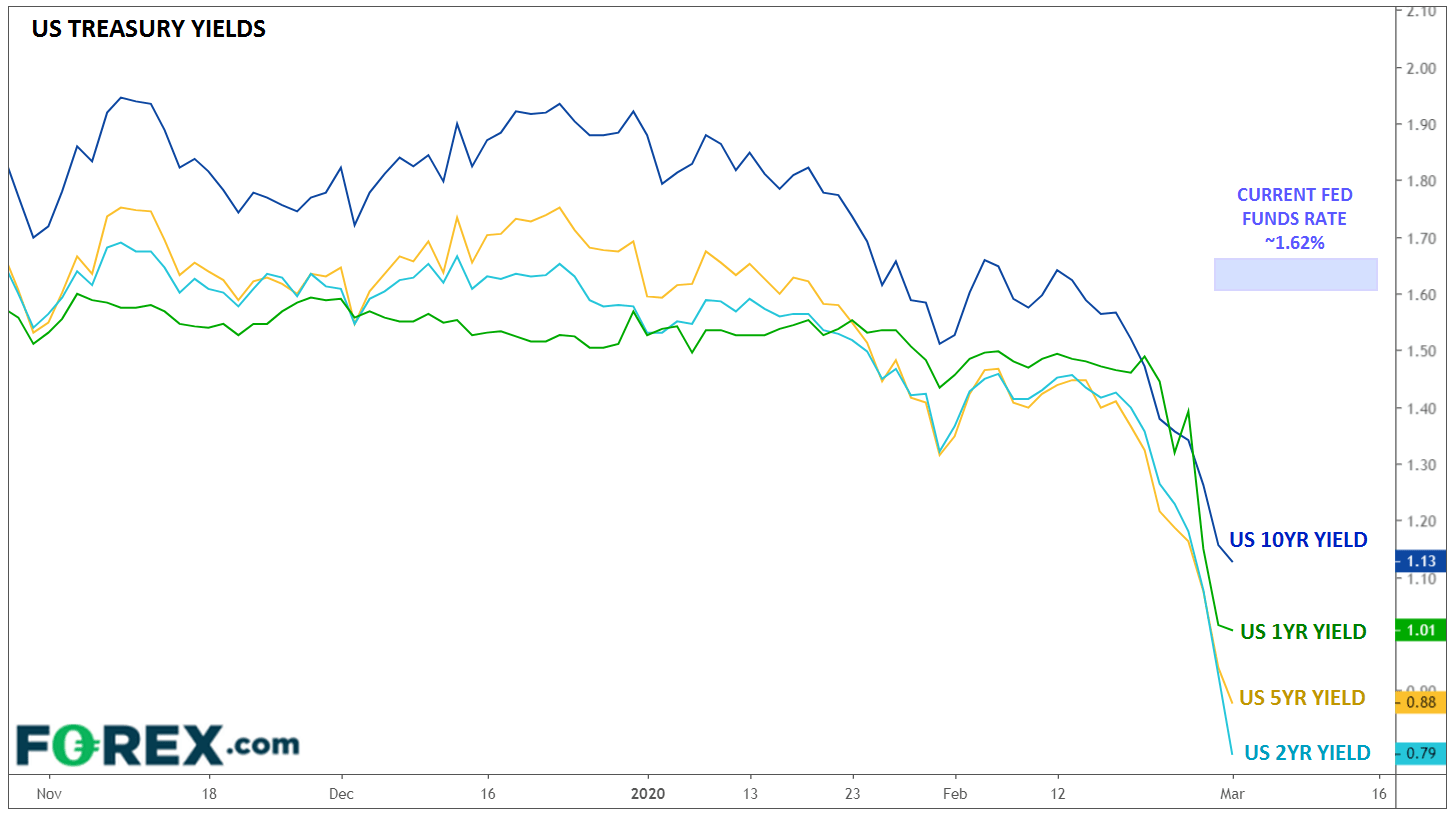
As the chart below shows, US interest rates have fallen off a cliff in recent days, with the 1-year, 2-year, 5-year, and 10-year tenors all shedding at least 40bps over the last two weeks alone.
Source: TradingView, GAIN Capital
For reference, the last time the Fed Funds rate was higher than the entire US yield curve (as we saw briefly last night) was in 2008, in the midst of the Great Financial Crisis. At the moment, the March Fed Funds rate is trading at 1.25%, nearly 40 bps below the current Fed funds rate of 1.62%, signaling that traders believe the central bank will be cutting interest rates dramatically and rapidly, perhaps as soon as today or later this week.
Make no mistake: situations like this are exactly why the Federal Reserve raised interest rates off 0% over the last few years, and the central bank will not be afraid to use the (limited) ammo it has at its disposal. Indeed, the Fed could very well take interest rates below 1.00% this summer in an effort to cushion the blow of coronavirus-related economic disruptions.
For the FX market, this means that the US dollar’s relative yield advantage over its G10 rivals could soon evaporate, and traders have been consistently selling the greenback as a result. After probing 100.00 less than two weeks ago, the US Dollar Index has fallen six of the past seven days to trade back at its 200-day EMA near 97.75.
If the Fed does follow through with a 50bps interest rate cut, either this week or at its regularly-scheduled meeting in two weeks’ time, the dollar could finally bounce in a “sell-the-rumor-buy-the-news” reaction. That said, the near-term momentum has clearly shifted in favor of the bears, and if the dollar index breaks below its 200-day EMA near 97.70, a move toward the bottom of the 1-year range near 96.00 could be next.
Source: GAIN Capital, TradingView
Related tags:




The complete CFD trading experience
Award-winning platforms, competitive spreads, low commissions and dedicated support.
We live and breathe the markets and are dedicated to helping traders realise their ambitions as we continue to set the industry bar.
Economic calendar
Web Trader platform
Our sophisticated web-based platform is packed with features.
Related articles

US dollar outlook: DXY finds fresh support as risk aversion deepens
The dollar is finding fresh support as risk aversion drives investors out of emerging-market and commodity currencies. With tariff threats mounting and today's PCE data in focus, the 104.53 high and 104.60 resistance are back in play.

EUR/USD Forecast: Euro Faces Levels Not Seen Since April 2025
Trading conditions continue to be quite challenging for the euro in the short term. The European currency remains under considerable pressure against the U.S. dollar, a dynamic that can be clearly seen in the behavior of EUR/USD, which has started the week down nearly 0.7%.


Gold Analysis: Why Does XAU/USD Keep Losing Ground?
The past few trading sessions have not been particularly favorable for gold, with the precious metal extending a string of consistent losses. Over the last three trading sessions alone, gold has declined by nearly 4.0%, highlighting that the bearish bias remains firmly in place.
StoneX Europe Ltd may make third party material available on this website which may contain information included but not limited to the conditions of financial markets. The material is for information purposes only and does not contain, and should not be construed as containing, investment advice and/or investment recommendation and/or an investment research and/or an offer of or solicitation for any transactions in financial instruments; any decision to enter into a specific transaction shall be made by the client following an assessment by him/her of their situation.
StoneX Europe Ltd makes no representation or warranty and assumes no liability as to the accuracy or completeness of the information provided, nor any loss arising from any investment based on a recommendation, forecast or other information supplied. You should always seek independent advice as to your suitability to speculate in any related markets and your ability to assume the associated risks, if you are at all unsure. We are not under any obligation to update any such material. Any opinion made may be personal to the author and may not reflect the opinion of StoneX Europe Ltd.