



Australian Dollar Outlook: AUD/USD Eyes Volatility Ahead of Fed, AU CPI
AUD/USD traders brace for volatility as the Fed’s policy decision, Australia’s CPI report, and US–China trade talks dominate the week ahead.
Share this:

The Australian dollar faces a potentially volatile week, with traders preparing for major catalysts including the Federal Reserve’s policy decision, Australia’s quarterly inflation report, and renewed US–China trade discussions. With RBA rate-cut expectations building and global sentiment uncertain, AUD/USD could see sharp moves in both directions.
View related analysis:
AUD/USD Set for Volatile Week Ahead of Fed Decision and Australian CPI
US inflation data on Friday came in slightly softer than expected across the board, paving the way for the Fed to continue cutting rates. Fed funds futures implied a 98.3% chance of a 25bp cut next week and a 91.1% probability of another in December. A third successive cut is currently priced at around 50% for either the January, March, or April meetings.
The US dollar index initially dropped around 1% after the data release but regained ground by the close, ahead of US–China trade talks over the weekend in Kuala Lumpur, Malaysia. How those talks unfold could very much set the tone for the Trump–Xi summit, currently scheduled for 30 October in South Korea. Unless the negotiating wheels fall off and talks get cancelled. Either way, traders will need to factor in headline risks for the US dollar surrounding both the trade talks and the upcoming summit.

Australian Dollar Performance
- The Australian dollar was modestly higher against the Swiss franc, Japanese yen and New Zealand dollar, and marginally higher (but effectively flat) against the US dollar, Canadian dollar and British pound
- AUD/JPY rose for a sixth consecutive day – its best such run in nearly two months – and now sits at a 2-week high with 100 in its sights
- How it trades this week and which way it gaps at the open is likely down to headlines from US-China trade talks, though the Fed meeting and quarterly CPI figures for Australia are the key economic events
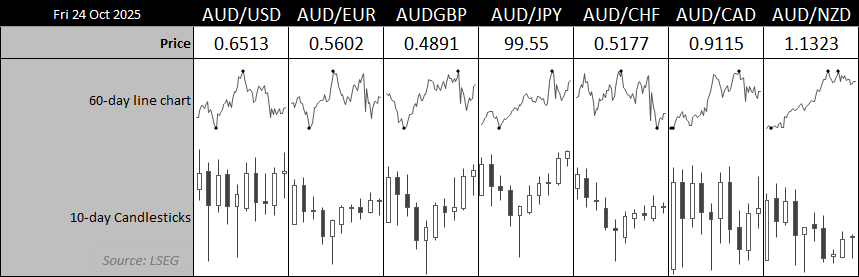
Chart prepared by Matt Simpson - Source: LSEG
Money Markets Favour RBA Cut Next Week
Money markets and economists are increasingly backing a 25bp rate cut by the RBA in November following the latest labour force data. Unemployment rose to a four-year high of 4.5%, while August’s figures for headline and full-time employment were revised further into negative territory. Although participation and employment-to-population rates remain historically high, RBA cash rate futures now imply a 75–80% probability of a cut at the next meeting
Given the hawkish tone of the latest minutes, I place the odds of a cut closer to 60% than 80%. However, the deciding factor will be this week’s quarterly inflation figures.

Chart prepared by Matt Simpson - Source: ABS, LSEG
Australian Quarterly Inflation Report in Focus
As things stand, unemployment has already exceeded the RBA’s end-of-year forecast of 4.3%, with the rate reaching 4.5% by September. The RBA’s Q3 estimates place headline CPI at 2.1% and the trimmed mean at 2.7%. However, monthly gauges of annualised inflation show headline CPI rising to 3.0% and the trimmed mean at 2.6%. It is therefore crucial that the quarterly trimmed mean does not move above 2.7% this week — a print of 2.6% or lower would likely confirm the November rate cut that many already anticipate.
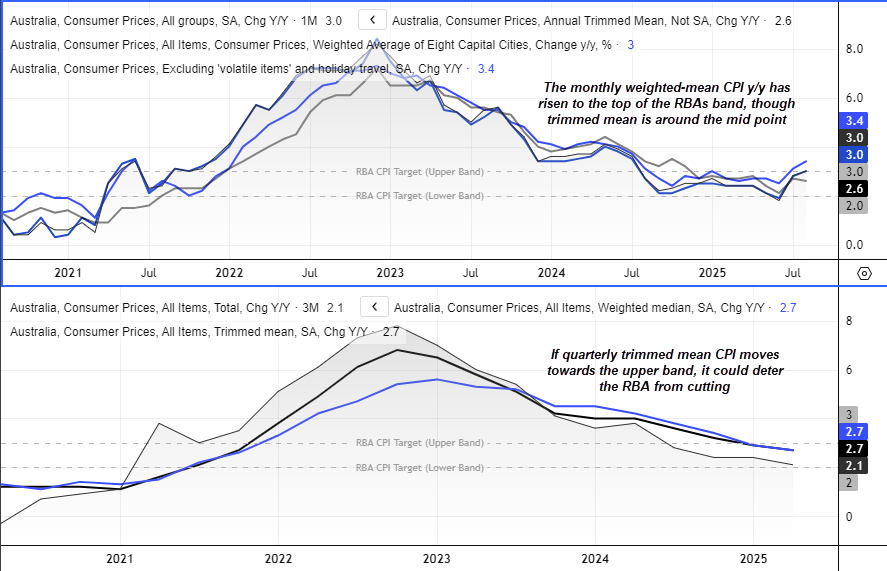
Chart prepared by Matt Simpson - Source: ABS, LSEG
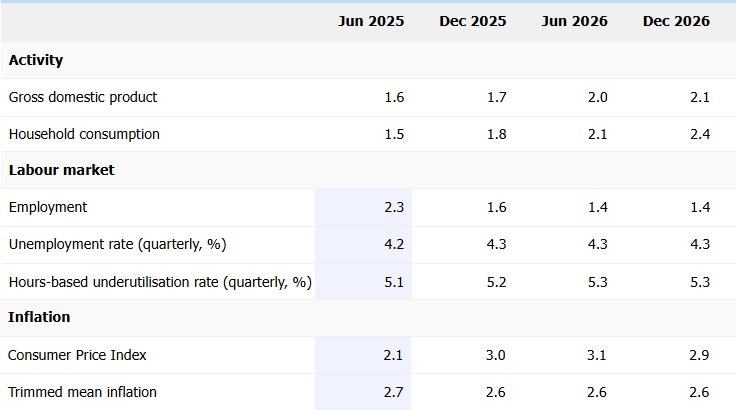
Chart prepared by Matt Simpson - Source: RBA, Statement of Monetary Policy (SOMP)
AUD/USD Correlations
- The usual correlations with the Australian dollar have largely broken down over the 20-day lookback, though the link between AUD/USD and NZD/USD remains strong.
- Even the relationship between the US dollar index and the Australian dollar has weakened to just 0.15 — effectively showing no correlation.
- However, with the 10-day correlation between AUD/USD and copper rising to 0.89 (and the 20-day at 0.68), it suggests the Aussie’s direction could become increasingly influenced by China and developments in trade talks.

 Chart prepared by Matt Simpson - Source: LSEG

AUD/USD Technical Analysis: Australian Dollar vs US Dollar
I don’t often like to adopt a neutral bias, but in this case it’s warranted. The Australian dollar is likely to be caught in the crossfire between risk sentiment driven by US–China trade talks, the Fed meeting, and Australia’s quarterly CPI data.
- The most bearish scenario for AUD/USD would involve deteriorating US–China relations, a less-dovish-than-expected Fed cut, and weak Australian inflation.
- The most bullish outcome would stem from successful trade talks ahead of the Trump–Xi summit, a dovish Fed cut, and an upside surprise in Australia’s CPI report.
- Anything in between could see AUD/USD remain range-bound, with false breakouts and sharp reversals a common theme.
From a technical perspective, traders have clear reference levels to monitor: the 200-day EMA (0.6492), monthly S1 pivot (0.6493), 50-day EMA (0.6538), and the descending trendline resistance.
Purely on a technical basis, I anticipate an initial push higher followed by another leg lower.
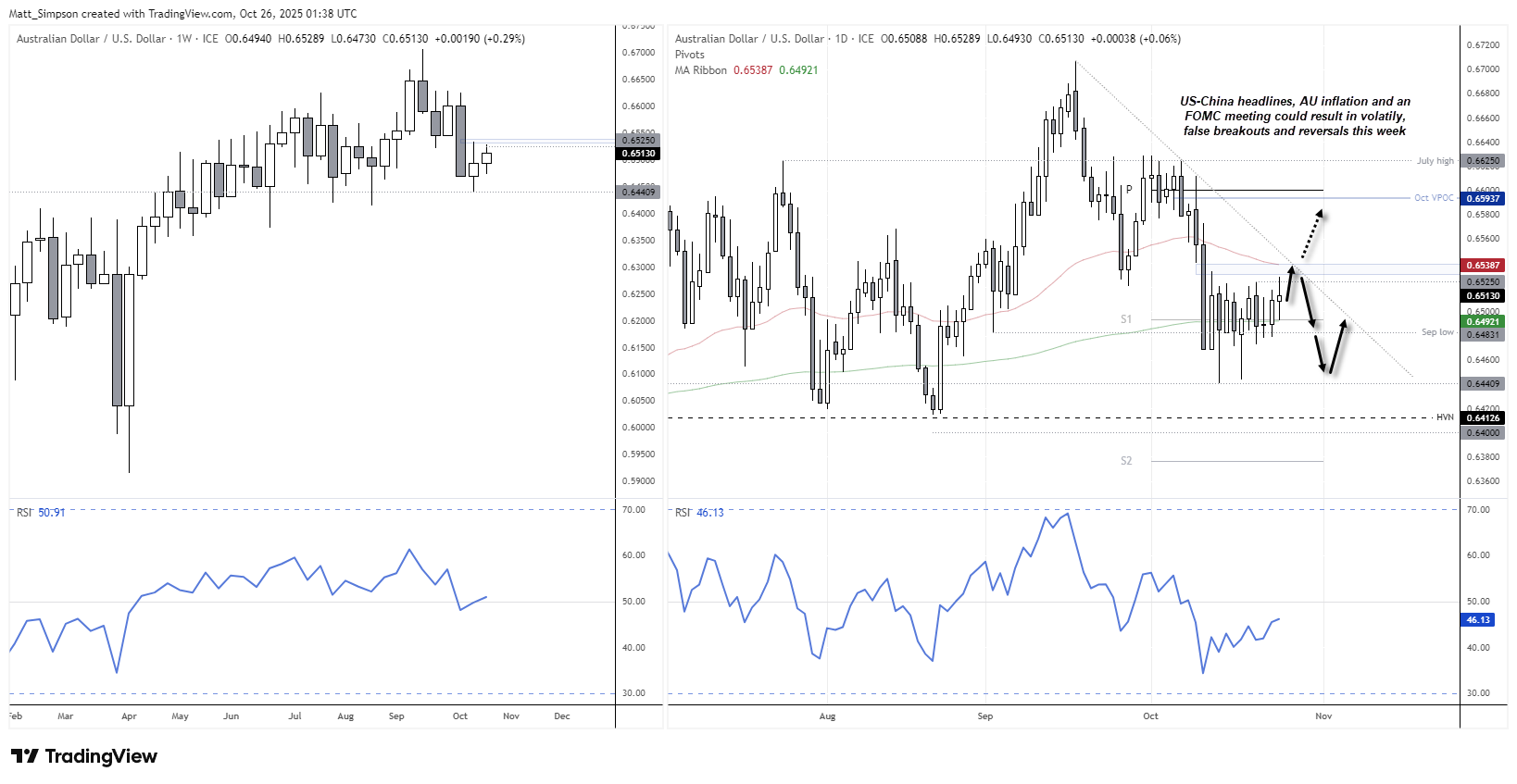
Chart analysis by Matt Simpson - data source: TradingView AUD/USD
View the full economic calendar
-- Written by Matt Simpson
Follow Matt on Twitter @cLeverEdge
Latest market news




The complete CFD trading experience
Award-winning platforms, competitive spreads, low commissions and dedicated support.
We live and breathe the markets and are dedicated to helping traders realise their ambitions as we continue to set the industry bar.
Economic calendar
Web Trader platform
Our sophisticated web-based platform is packed with features.
Related articles
USD/CAD reversal risk builds as central bank showdown looms
USD/CAD has delivered a bullish reversal signal from established support, just as traders prepare for Fed and BoC decisions. Aggressive Canadian rate hike expectations and conflicting momentum signals make the coming session important.
EUR/USD weekly outlook: FOMC and ECB to set the tone
The current backdrop is modestly bearish. On Friday, the EUR/USD closed modestly lower, down for the third consecutive day. The pair also posted a weekly decline after staging a modest recovery attempt in the previous week. Out of the past 8 weeks, the EUR/USD has fallen on 6 occasions. There is not much supporting factors for the single currency right now. So, the upside remains capped.


USD/JPY Forecast: Is Rising Japanese Inflation Supporting the Yen?
As the trading week comes to an end, one of the most relevant developments in the FX market has been the renewed strength of the Japanese yen. This can be seen in the recent performance of USD/JPY, which has fallen nearly 1.0% over the last two trading sessions, highlighting a meaningful recovery in the Japanese currency against the U.S. dollar.

StoneX Europe Ltd may make third party material available on this website which may contain information included but not limited to the conditions of financial markets. The material is for information purposes only and does not contain, and should not be construed as containing, investment advice and/or investment recommendation and/or an investment research and/or an offer of or solicitation for any transactions in financial instruments; any decision to enter into a specific transaction shall be made by the client following an assessment by him/her of their situation.
StoneX Europe Ltd makes no representation or warranty and assumes no liability as to the accuracy or completeness of the information provided, nor any loss arising from any investment based on a recommendation, forecast or other information supplied. You should always seek independent advice as to your suitability to speculate in any related markets and your ability to assume the associated risks, if you are at all unsure. We are not under any obligation to update any such material. Any opinion made may be personal to the author and may not reflect the opinion of StoneX Europe Ltd.