



BOJ split vote fuels yen weakness and Nikkei gains
A divided BOJ hike has left the yen under pressure and Nikkei bid, with Ueda now needing to convince markets that another two-and-a-half hikes by mid-2027 are justified.
Share this:

- BOJ lifts rates to 1.25% in split decision
- Two dissenters favour leaving policy unchanged at September meeting
- Dovish hike sparks yen weakness, Nikkei rally
- Ueda press conference begins at 3:30pm Tokyo time
Split decision gives hike a dovish tinge
As widely anticipated prior to the meeting, the Bank of Japan lifted the overnight call rate by 25 basis points at its September meeting, taking it to 1.25%.
However, the move came with a slightly divisive tinge, with two of the nine board members voting against the increase.
Serial dovish dissenter Toichiro Asada argued that, with CPI excluding fresh food having recently fallen below 2%, it could not necessarily be determined that economic conditions were sufficiently strong to justify another increase, preferring to leave policy rates unchanged.
He was joined by Ayano Sato, who also dissented in favour of leaving policy unchanged, arguing that economic and price developments had not substantially accelerated and, as such, it was inappropriate to tighten policy at this meeting.
The lack of uniformity wasn’t lost on markets, with the yen weakening and the Nikkei rallying following the decision.
Inflation risks remain tilted to the upside
On inflation, the September statement noted that underlying CPI inflation had been approaching 2%. It also retained the view that wage increases are continuing to be passed through to selling prices, with labour shortages remaining acute, helping foster the wage-price cycle further.
Relative to the Bank’s outlook released in late July, there were no other significant changes to its assessment of the economy, inflation or key risks. Risks to the baseline scenario continued to point to geopolitical tensions in the Middle East, the AI build-out and developments in foreign exchange rates that could impact Japan’s economy and inflation.
On underlying inflation, the Bank said there was a risk it could deviate upwards to a level above the 2% price stability target, citing shifting behaviour among firms towards raising wages and prices, which is helping to lift medium- to long-term inflation expectations.
Can Ueda live up to market pricing?
With no updated economic projections released at this meeting, focus will now shift to Governor Ueda’s press conference, scheduled for 3:30pm Tokyo time.
Source: Bloomberg
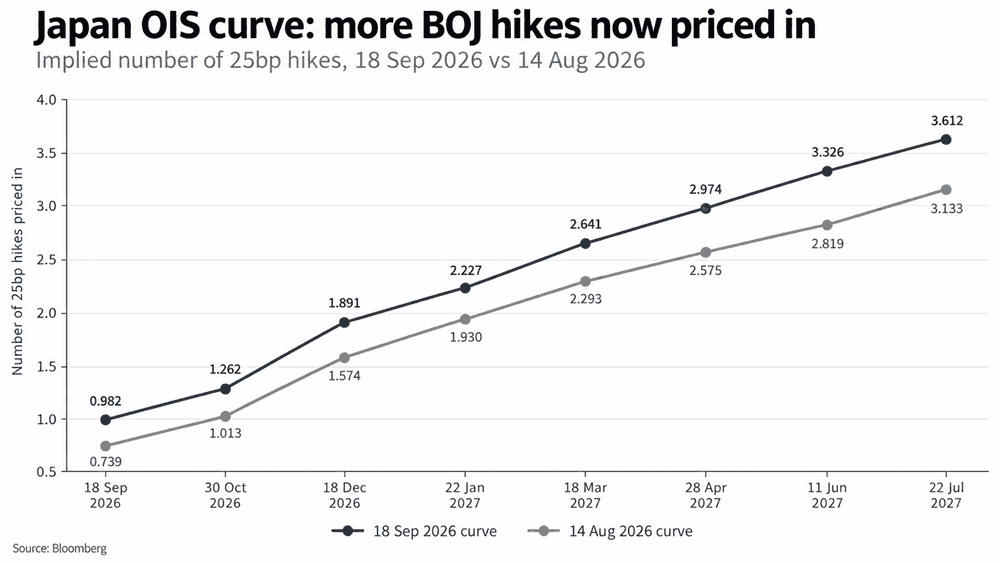
His challenge will be to present a sufficiently hawkish case to justify the tightening path already embedded in the OIS curve, which, following today’s increase, still prices roughly another two-and-a-half 25-basis-point hikes by the middle of next year. Given his past performances, where he has often come across as more cautious than the broader Board message, there is a clear risk that Ueda will struggle to live up to those hawkish expectations.
JGB curve reflects rebuilt BOJ credibility
Source: LSEG
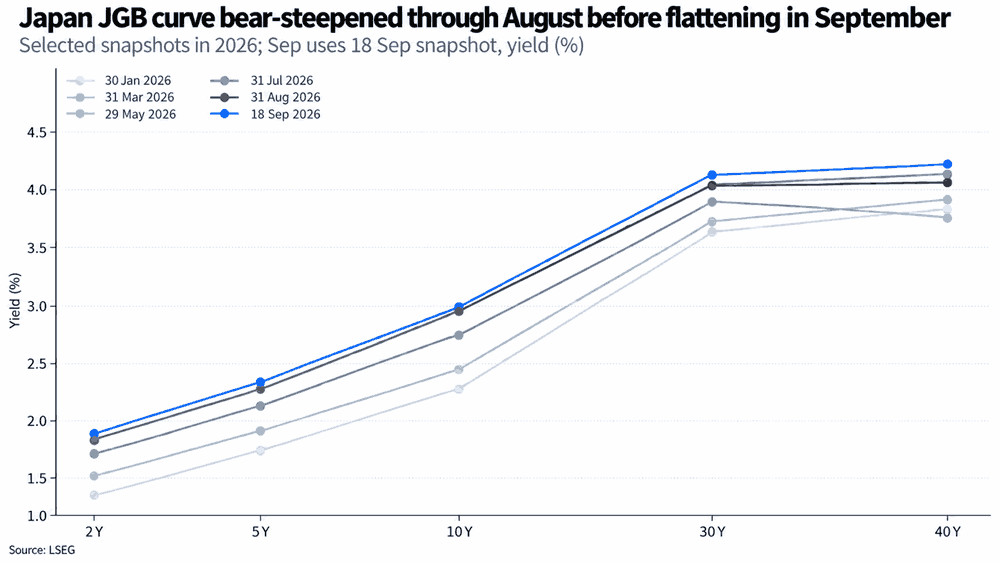
Ueda’s messaging will also be important for the back end of the Japanese government bond curve. After bear-steepening through much of the year, the curve has flattened recently as confidence in the BOJ’s inflation-fighting credentials has rebuilt, alongside increased hawkish pricing at the front end. If Ueda fails to live up to the hawkish pricing embedded at the front end of the curve, it risks seeing long-end yields back up once again.
USD/JPY rebound gathers pace
Source: TradingView
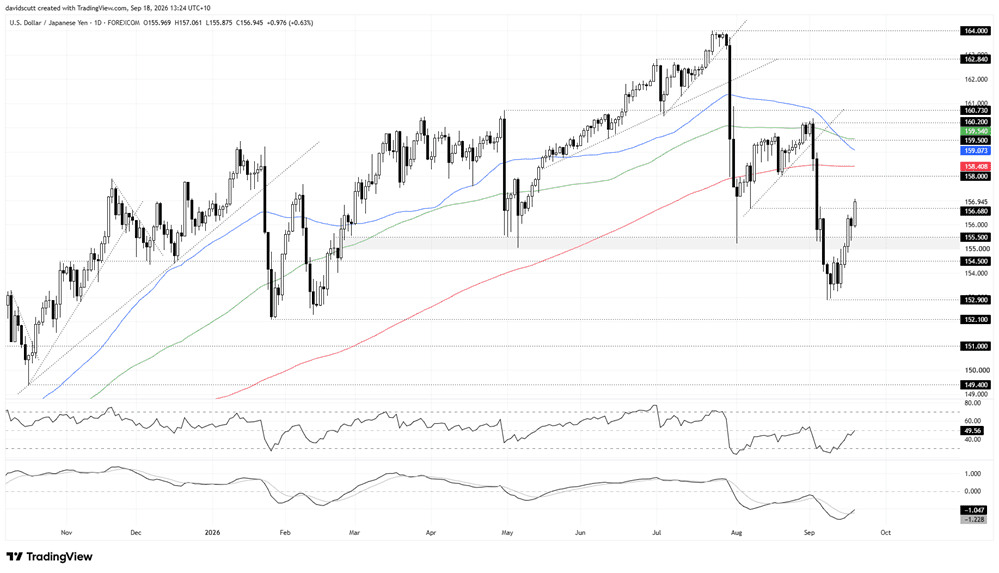
Having bounced strongly from the support zone running from 155.50 down to 155 on Thursday, USD/JPY has extended the rebound following the policy decision, breaking above 156.68, the swing low set on August 7 that then flipped to offer resistance in early September.
That now becomes the key level to watch underneath where the pair trades, with the next topside level of note at 158, marking the breakout zone seen on September 4. The 200-day simple moving average is located just above that.
The oscillators suggest downside momentum is diminishing rapidly and may be on the cusp of shifting towards building upside momentum, hinting that, purely from a technical perspective, the rebound may have further legs. Of course, until the sequence of lower highs is broken, which would require a push through the key medium- and long-term moving averages, the longer-term trend remains bearish.
However, the latest rebound increases the risk of renewed intervention activity from the BOJ on behalf of the Ministry of Finance, which may be enough to limit upside in the near term.
Nikkei rally tests key four-hourly resistance
Source: TradingView
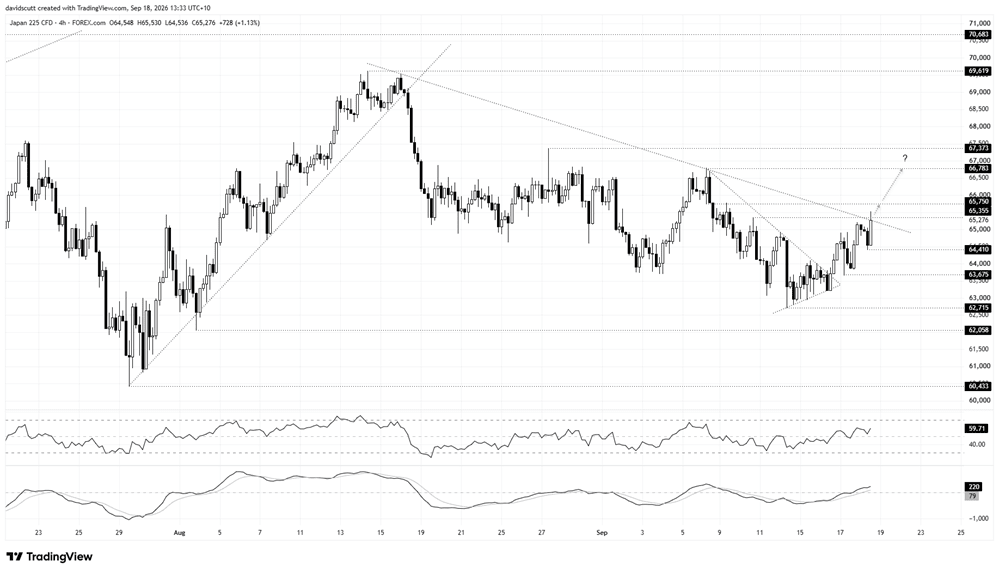
While current shorter-dated rolling correlations between USD/JPY and the Nikkei are not particularly strong right now, there has been a noticeable pick-up in the index following the policy decision, with the price now testing a resistance zone comprising the downtrend from the high set in mid-August and 65,355, the high set on September 10.
If we were to see a breakout of this zone, it would point to the potential for a shift higher towards 65,750, 66,783 or even 67,373. With a string of higher highs and higher lows on the four-hourly, alongside RSI (14) trending higher above 60 and MACD flipping positive after crossing the signal line, both the price action and momentum picture favour buying dips and bullish breakouts near-term.
Of course, confirmation is required. If the price cannot break through this resistance zone, it may result in a reversal back towards 64,410, the low set earlier today, with 63,675 the next level beneath that.
Latest market news




The complete CFD trading experience
Award-winning platforms, competitive spreads, low commissions and dedicated support.
We live and breathe the markets and are dedicated to helping traders realise their ambitions as we continue to set the industry bar.
Economic calendar
Web Trader platform
Our sophisticated web-based platform is packed with features.
Related articles
Canadian Dollar Short-term Outlook: USD/CAD Five-Week Rally Hits a Wall at Major Resistance 10 14 2026
USD/CAD is holding near fresh yearly highs, but bearish divergence and a well-defined October range raise the stakes at major resistance.

EUR/USD Analysis: Euro Loses Ground After a Stronger-Than-Expected U.S. CPI Report
The trading week continues to unfold and weakness around the euro has once again become increasingly evident in the short term. This can be seen in the recent performance of EUR/USD, which has declined roughly 0.3% over the last three trading sessions, highlighting renewed strength in the U.S. dollar.

USD/JPY forecast: hot US CPI lifts the pair above its 200-day average
Hotter-than-expected US inflation has pushed USD/JPY above its 200-day moving average, putting 160 and the risk of Bank of Japan intervention back in focus. The breakout still needs to hold, and a failure could send the pair sharply lower.

StoneX Europe Ltd may make third party material available on this website which may contain information included but not limited to the conditions of financial markets. The material is for information purposes only and does not contain, and should not be construed as containing, investment advice and/or investment recommendation and/or an investment research and/or an offer of or solicitation for any transactions in financial instruments; any decision to enter into a specific transaction shall be made by the client following an assessment by him/her of their situation.
StoneX Europe Ltd makes no representation or warranty and assumes no liability as to the accuracy or completeness of the information provided, nor any loss arising from any investment based on a recommendation, forecast or other information supplied. You should always seek independent advice as to your suitability to speculate in any related markets and your ability to assume the associated risks, if you are at all unsure. We are not under any obligation to update any such material. Any opinion made may be personal to the author and may not reflect the opinion of StoneX Europe Ltd.