


Canadian Dollar Analysis: Can USD/CAD continue to hold its bullish strength?
Recent trading sessions have not been entirely favorable for the Canadian dollar. Over the last five sessions, USD/CAD has gained more than 0.5% in favor of the US dollar, reflecting a buying bias that is now approaching key short-term barrier zones.
Share this:

Recent trading sessions have not been entirely favorable for the Canadian dollar. Over the last five sessions, USD/CAD has gained more than 0.5% in favor of the US dollar, reflecting a buying bias that is now approaching key short-term barrier zones.
For now, buying pressure is mainly supported by the rate differential between the United States and Canada, along with a neutral outlook from the Bank of Canada amid signs of relatively controlled inflation. This environment has not created enough conditions to sustain consistent demand for Canadian dollars, meaning buying pressure in USD/CAD could remain relevant over the medium term.


Central bank dynamics continue to dominate
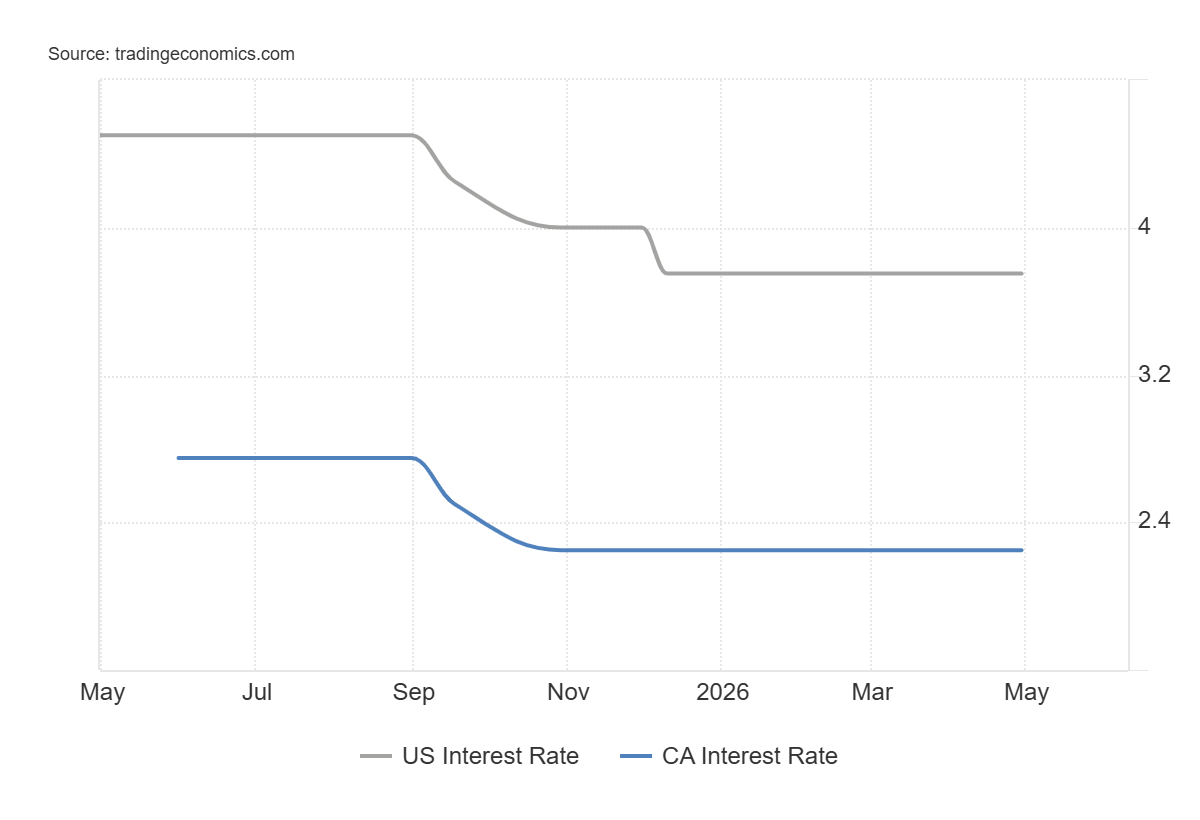
One of the main factors supporting the US dollar in recent weeks has been the rate differential against other regions such as Canada. At the moment, the United States keeps its benchmark rate around 3.75%, well above the Bank of Canada’s rate of 2.25%.
This difference has allowed the US bond market to continue offering more attractive yields. In 10-year bonds, the United States maintains a yield near 4.5%, while Canada’s yield stands around 3.4%. This gap reflects the difference in the monetary policy stance of both central banks and remains an important factor supporting demand for US dollars.
Source: TradingEconomics
This scenario is relevant because higher rates in the United States have kept its bond market attractive compared with other regions. This may continue to drive capital flows into dollar-denominated fixed income instruments, strengthening demand for the US dollar against currencies such as the Canadian dollar. Over time, this effect may limit the CAD’s ability to recover ground consistently.
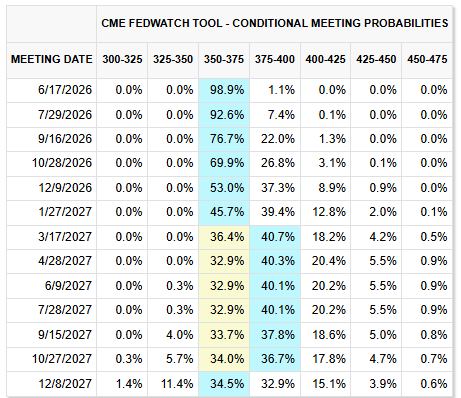
That said, as long as there are no clear signs that this differential could narrow, the Canadian dollar may continue to lose appeal. In the United States, monetary policy remains in a neutral phase, but the CME Group probability table already shows a probability above 40% that rates could rise toward 4.00% in March 2027. This suggests that the Federal Reserve could eventually return to a more aggressive stance, widening the gap with Canada once again.
Source: CMEGROUP
The Bank of Canada’s outlook is similar in terms of expectations for stable rates over the coming months. However, unlike the Federal Reserve, the Canadian central bank has not yet given clear signals of a possible rate hike. Recent inflation data, with April’s reading at 2.8% versus the previous 2.4%, came in below the 3.1% forecast and was mainly driven by higher gasoline prices, a factor that the central bank had already anticipated.
For now, there does not appear to be a strong enough catalyst for the Bank of Canada to shift toward a higher-rate scenario in the short term. This contrasts with the United States, where recent inflation data has exceeded expectations and could lead the Federal Reserve to adopt a more aggressive tone.
Overall, this difference between both central banks remains a concern for demand in Canadian dollars. As long as there is no confirmation that the Bank of Canada could become more aggressive, the rate differential may continue to favor the US dollar over the CAD. Therefore, if this gap remains relevant, buying pressure around USD/CAD could continue over the coming weeks.
Technical outlook for USD/CAD

Source: StoneX, Tradingview
- Major bearish trendline enters a risk zone: Since the first days of March 2025, USD/CAD had maintained a relevant bearish dynamic, forming a major bearish trendline that acted as the dominant pattern over the past several months. However, the pair’s recent recovery has started to challenge this long-term structure again. If buying pressure manages to hold, this recovery could begin to invalidate the bearish structure and open the door to a more relevant buying bias over the coming sessions.
- RSI: The RSI continues to move consistently above the neutral 50 area, indicating that average bullish momentum over the last 14 sessions remains dominant. As long as this behavior holds, the buying bias could remain relevant in the short term.
- MACD: A similar scenario can be seen in the MACD, as the histogram remains above the neutral 0 level. This suggests that the average strength of short-term moving averages continues to show bullish bias, which could remain relevant in USD/CAD price action over the coming sessions.
Key levels:
- 1.39215 – Relevant resistance: An important high level located above the 50- and 200-period moving averages. Price movements toward this level would begin to reflect a more consistent buying bias and could generate a full breakout of the long-term bearish trendline, opening the door to a more relevant bullish structure over the coming weeks.
- 1.38129 – Near-term barrier: A neutral zone that coincides with the 200-period simple moving average. Price action that remains close to this level could continue to highlight a phase of consistent indecision and potentially generate a relevant sideways range on the daily chart over the coming sessions.
- 1.37503 – Crucial support: A nearby support level that corresponds to the area marked by the 50-period moving average. Price action that manages to break below this level could reactivate a selling bias and give continuity to the bearish trendline in the short term.
Written by Julian Pineda, CFA, CMT – Market Analyst
Follow him on: @julianpineda25
Latest market news




The complete CFD trading experience
Award-winning platforms, competitive spreads, low commissions and dedicated support.
We live and breathe the markets and are dedicated to helping traders realise their ambitions as we continue to set the industry bar.
Economic calendar
Web Trader platform
Our sophisticated web-based platform is packed with features.
Related articles
Canadian Dollar Short-term Outlook: USD/CAD Five-Week Rally Hits a Wall at Major Resistance 10 14 2026
USD/CAD is holding near fresh yearly highs, but bearish divergence and a well-defined October range raise the stakes at major resistance.

EUR/USD Analysis: Euro Loses Ground After a Stronger-Than-Expected U.S. CPI Report
The trading week continues to unfold and weakness around the euro has once again become increasingly evident in the short term. This can be seen in the recent performance of EUR/USD, which has declined roughly 0.3% over the last three trading sessions, highlighting renewed strength in the U.S. dollar.

USD/JPY forecast: hot US CPI lifts the pair above its 200-day average
Hotter-than-expected US inflation has pushed USD/JPY above its 200-day moving average, putting 160 and the risk of Bank of Japan intervention back in focus. The breakout still needs to hold, and a failure could send the pair sharply lower.

StoneX Europe Ltd may make third party material available on this website which may contain information included but not limited to the conditions of financial markets. The material is for information purposes only and does not contain, and should not be construed as containing, investment advice and/or investment recommendation and/or an investment research and/or an offer of or solicitation for any transactions in financial instruments; any decision to enter into a specific transaction shall be made by the client following an assessment by him/her of their situation.
StoneX Europe Ltd makes no representation or warranty and assumes no liability as to the accuracy or completeness of the information provided, nor any loss arising from any investment based on a recommendation, forecast or other information supplied. You should always seek independent advice as to your suitability to speculate in any related markets and your ability to assume the associated risks, if you are at all unsure. We are not under any obligation to update any such material. Any opinion made may be personal to the author and may not reflect the opinion of StoneX Europe Ltd.