



China set to reopen; Good news for the Yuan?
China is back and looking to move forward. With some help from the government, the trough in the PMI data may be behind us.
Share this:

China released its official Manufacturing and Non-Manufacturing PMI data for May. The NBS Manufacturing PMI was 49.6 vs an expectation of 48.9 and an April reading of 47.4. The NBS Non-Manufacturing PMI for May was 47.8 vs an expectation of 45 and an April reading of only 41.9! Although both prints are under the expansion/contraction level of 50, both are moving in the right direction and suggest that a bottom may be in as China’s economy begins to reopen. Look for the Caixin Manufacturing and Non-Manufacturing PMIs to confirm later this week.
In addition, with workers returning to work in low-risk areas and with high-risk areas, such as malls and gyms, looking to reopening at 75% capacity, data should begin to show signs of life once again. This is particularly true in Shanghai, which has been on lockdown for nearly 2 months. To help the economy restart, the government has announced a number of policies to help the recovery. According to documents obtained by Reuters, China’s cabinet announced a package of 33 measures covering fiscal, financial, investment, and industrial policies. Some of these measures include increasing quotas for car ownership, halving the purchase tax for small-engine cars, supporting domestic firms to list in Hong Kong, and reduce borrowing costs for infrastructure and major projects. China will also provide tax credit rebates to more industries hard hit by the coronavirus and allow them to defer social security payments.
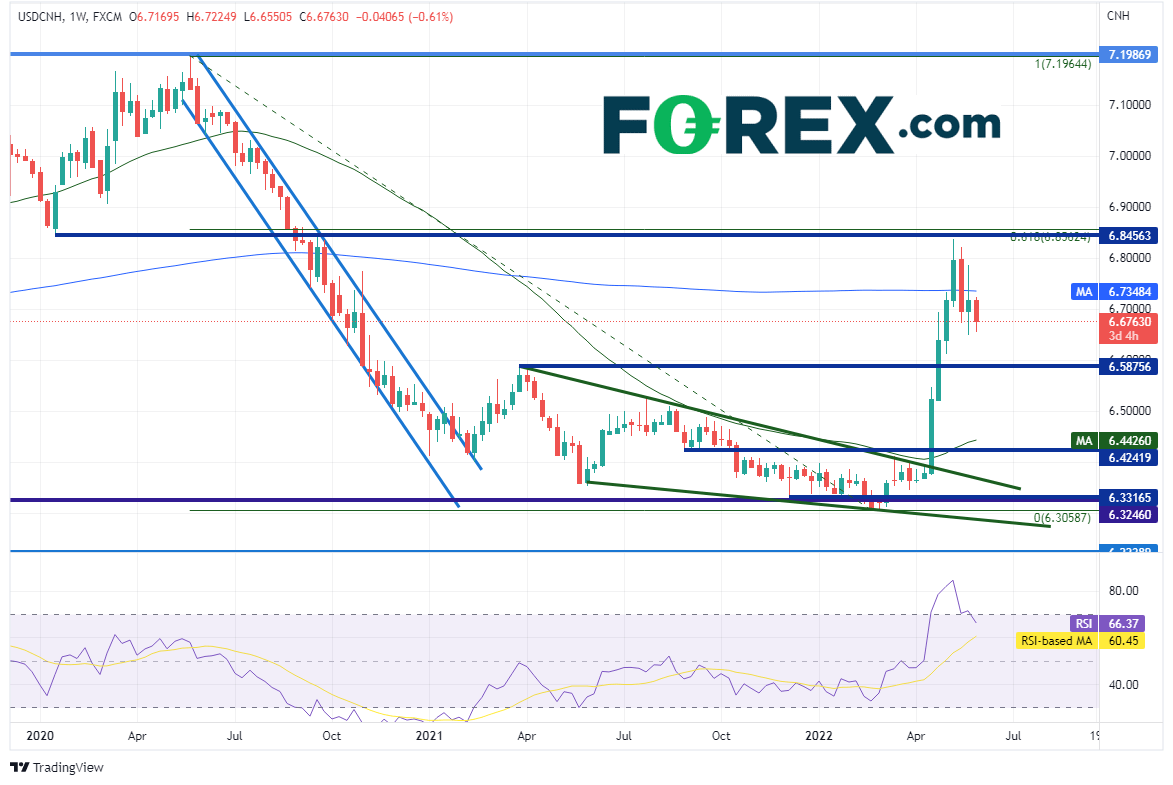
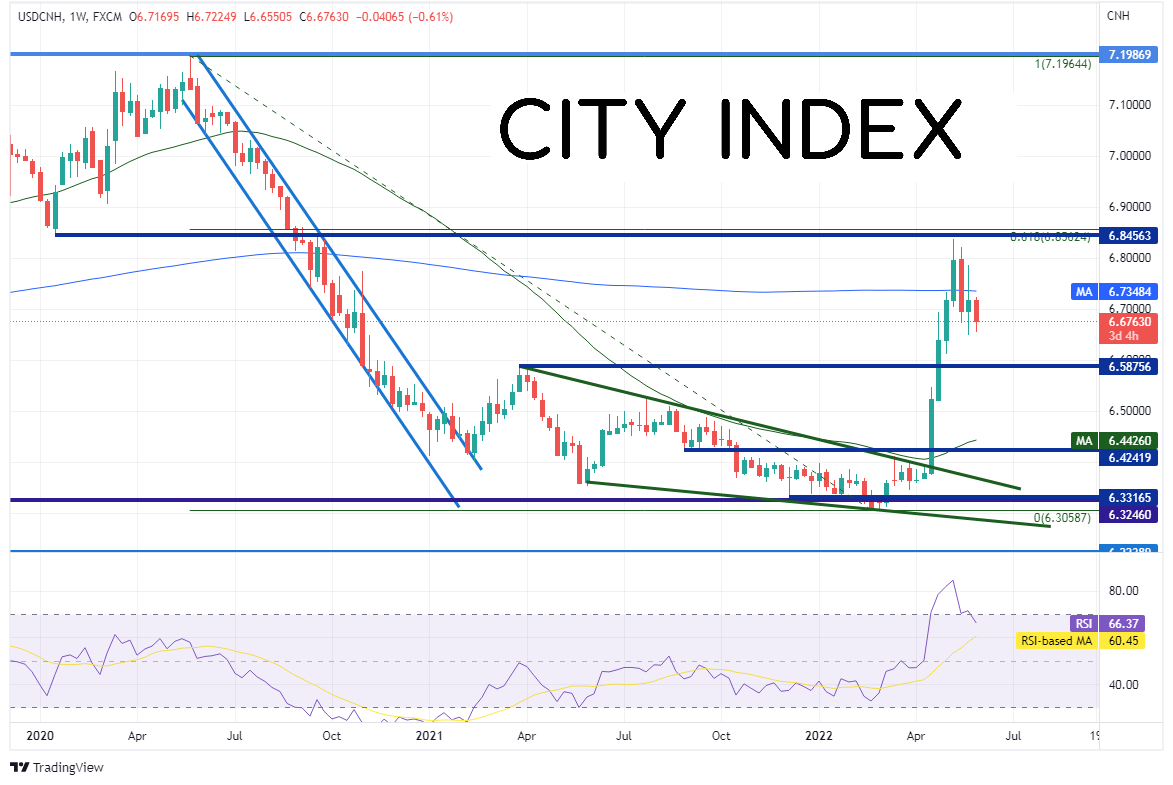
On a weekly timeframe, USD/CNH had moved in a downward sloping channel from the high in May 2020 to low during the week of February 18th, 2021. As the pair moved sideways out of the channel, if formed a descending wedge between 6.5876 and 6.3059 from March 2021 to April 2022. USD/CNH then broke aggressively higher as China moved into restrictions and lockdowns in Shanghai. The pair broke above the wedge near 6.3958 and over the course of only 4 weeks, moved aggressively to just under the 61.8% Fibonacci retracement level from the highs of May 2020 to the lows of February 2022, near 6.8375. Horizontal resistance dating to January 2020 also crosses just above the highs.
Source: Tradingview, Stone X
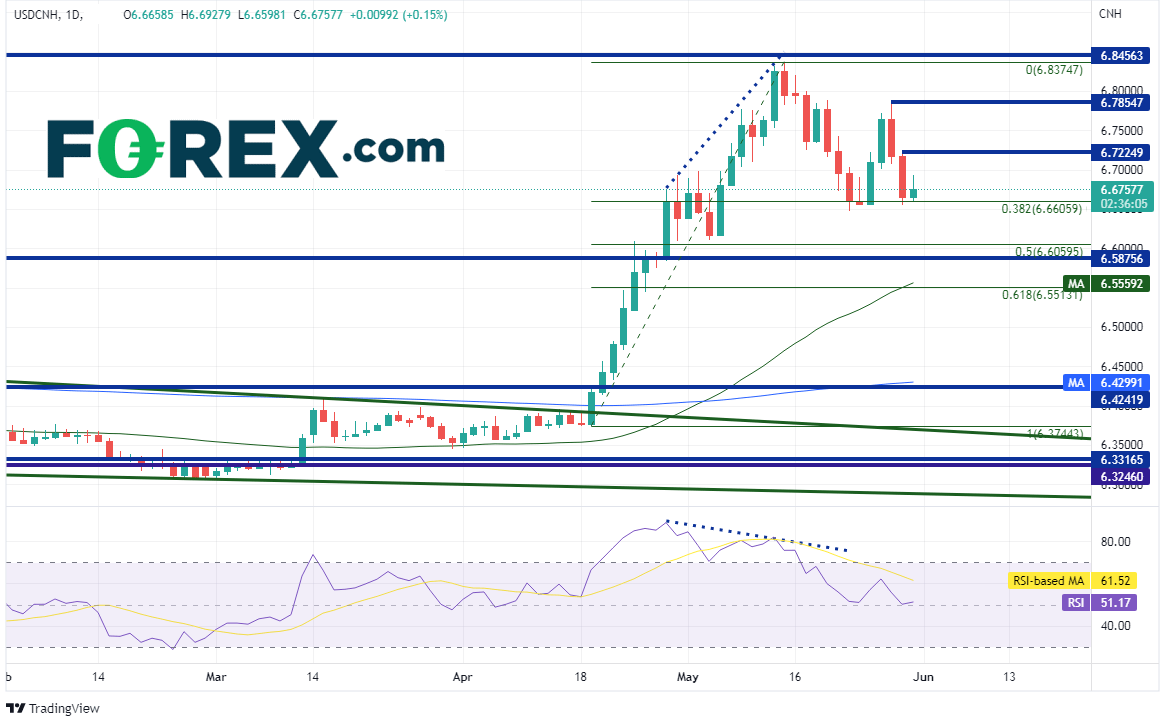
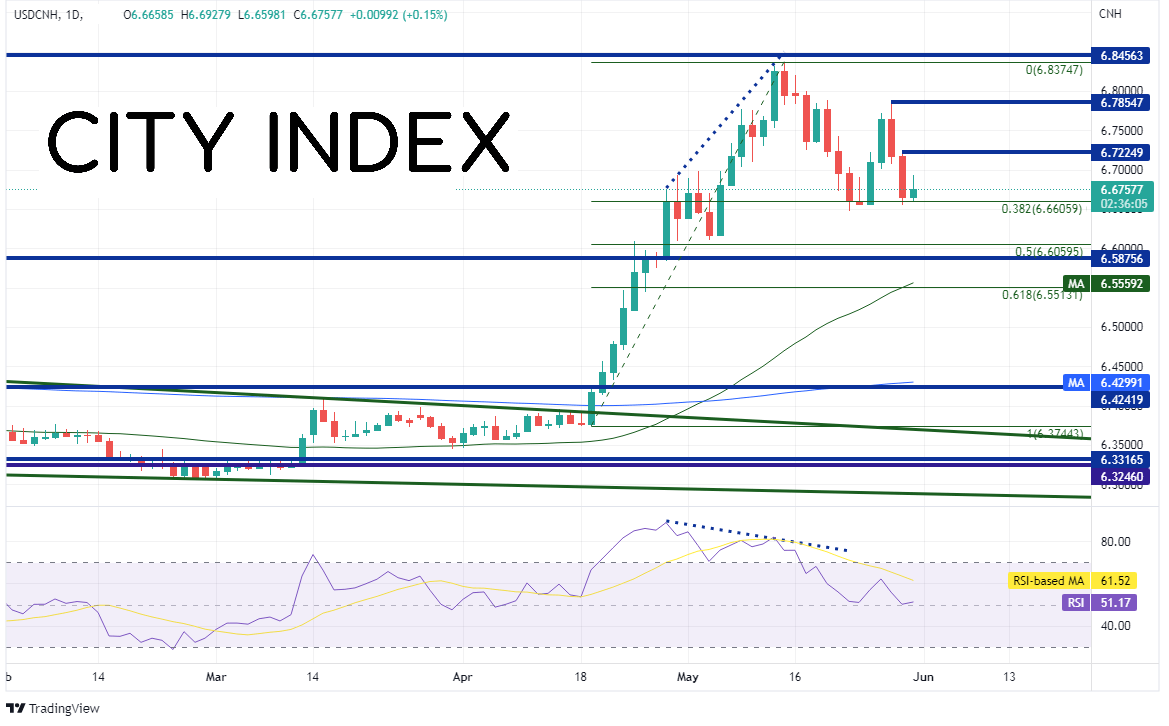
On a daily timeframe, USD/CNH has since pulled back from the May 13th highs and has found support at the 38.2% Fibonacci retracement level from the lows of April 19th (the day of the breakout of the wedge) to the highs on May 13th, near 6.6606. Notice how the RSI was diverging from price in overbought territory near the highs, an indication that price may have been ready to pull back. If price continues to move lower, the next support level is at the 50% retracement level from the same timeframe near 6.6506, then horizontal support dating back to the top of the wedge at 6.5876. Below there, price can fall to the 50 Day Moving Average at 6.5560. If the 38.2% Fibonacci retracement level holds, first resistance is at yesterday’s high of 6.7225, then May 27th high at 6.7855. If price breaks above, the next resistance level is the highs from May 13th at 6.8375.
Source: Tradingview, Stone X
China is back and looking to move forward. With some help from the government, the trough in the PMI data may be behind us. Watch to see if economic activity and picks up over the next month. If so, USD/CNH may be ready to move lower. However, if stimulus continues and growth doesn’t pick up, USD/CNH many continue to move higher.
China released its official Manufacturing and Non-Manufacturing PMI data for May. The NBS Manufacturing PMI was 49.6 vs an expectation of 48.9 and an April reading of 47.4. The NBS Non-Manufacturing PMI for May was 47.8 vs an expectation of 45 and an April reading of only 41.9! Although both prints are under the expansion/contraction level of 50, both are moving in the right direction and suggest that a bottom may be in as China’s economy begins to reopen. Look for the Caixin Manufacturing and Non-Manufacturing PMIs to confirm later this week.
In addition, with workers returning to work in low-risk areas and with high-risk areas, such as malls and gyms, looking to reopening at 75% capacity, data should begin to show signs of life once again. This is particularly true in Shanghai, which has been on lockdown for nearly 2 months. To help the economy restart, the government has announced a number of policies to help the recovery. According to documents obtained by Reuters, China’s cabinet announced a package of 33 measures covering fiscal, financial, investment, and industrial policies. Some of these measures include increasing quotas for car ownership, halving the purchase tax for small-engine cars, supporting domestic firms to list in Hong Kong, and reduce borrowing costs for infrastructure and major projects. China will also provide tax credit rebates to more industries hard hit by the coronavirus and allow them to defer social security payments.
On a weekly timeframe, USD/CNH had moved in a downward sloping channel from the high in May 2020 to low during the week of February 18th, 2021. As the pair moved sideways out of the channel, if formed a descending wedge between 6.5876 and 6.3059 from March 2021 to April 2022. USD/CNH then broke aggressively higher as China moved into restrictions and lockdowns in Shanghai. The pair broke above the wedge near 6.3958 and over the course of only 4 weeks, moved aggressively to just under the 61.8% Fibonacci retracement level from the highs of May 2020 to the lows of February 2022, near 6.8375. Horizontal resistance dating to January 2020 also crosses just above the highs.
Source: Tradingview, Stone X
Trade USD/CNH now: Login or Open a new account!
• Open an account in the UK
• Open an account in Australia
• Open an account in Singapore
On a daily timeframe, USD/CNH has since pulled back from the May 13th highs and has found support at the 38.2% Fibonacci retracement level from the lows of April 19th (the day of the breakout of the wedge) to the highs on May 13th, near 6.6606. Notice how the RSI was diverging from price in overbought territory near the highs, an indication that price may have been ready to pull back. If price continues to move lower, the next support level is at the 50% retracement level from the same timeframe near 6.6506, then horizontal support dating back to the top of the wedge at 6.5876. Below there, price can fall to the 50 Day Moving Average at 6.5560. If the 38.2% Fibonacci retracement level holds, first resistance is at yesterday’s high of 6.7225, then May 27th high at 6.7855. If price breaks above, the next resistance level is the highs from May 13th at 6.8375.
Source: Tradingview, Stone X
China is back and looking to move forward. With some help from the government, the trough in the PMI data may be behind us. Watch to see if economic activity and picks up over the next month. If so, USD/CNH may be ready to move lower. However, if stimulus continues and growth doesn’t pick up, USD/CNH many continue to move higher.
Learn more about forex trading opportunities.
Related tags:
Latest market news




The complete CFD trading experience
Award-winning platforms, competitive spreads, low commissions and dedicated support.
We live and breathe the markets and are dedicated to helping traders realise their ambitions as we continue to set the industry bar.
Economic calendar
Web Trader platform
Our sophisticated web-based platform is packed with features.
Related articles
Silver's bullish breakout case builds as bond yields retreat
The Democratic blue wave has sent crude and Treasury yields sharply lower, improving the outlook for precious metals. With gold already breaking higher, could silver be next?
Swiss Franc Short-term Outlook: USD/CHF Selloff Nears Critical Support Ahead of NFP 11 4 2026
USD/CHF bears are closing in on critical trend support, with the next reaction likely to determine whether the October decline has further to run.

USD/CAD Forecast: Canadian Dollar Gains Ground After U.S. Midterm Elections
The trading week continues to unfold and the recovery in the Canadian dollar has once again become a relevant theme in the short term. This can be clearly seen in the recent performance of USD/CAD, which is down nearly 0.4% during the session, reflecting a consistent recovery in the CAD against the U.S. dollar.

StoneX Europe Ltd may make third party material available on this website which may contain information included but not limited to the conditions of financial markets. The material is for information purposes only and does not contain, and should not be construed as containing, investment advice and/or investment recommendation and/or an investment research and/or an offer of or solicitation for any transactions in financial instruments; any decision to enter into a specific transaction shall be made by the client following an assessment by him/her of their situation.
StoneX Europe Ltd makes no representation or warranty and assumes no liability as to the accuracy or completeness of the information provided, nor any loss arising from any investment based on a recommendation, forecast or other information supplied. You should always seek independent advice as to your suitability to speculate in any related markets and your ability to assume the associated risks, if you are at all unsure. We are not under any obligation to update any such material. Any opinion made may be personal to the author and may not reflect the opinion of StoneX Europe Ltd.