



Dollar forecast: DXY and NZD/USD analysis – Technical Tuesday
The US dollar forecast remains tilted slightly lower, as investors look forward to the Fed’s rate decision next week. Among the pairs that could benefit the most from the potential dollar weakness is the likes of the NZD/USD. Let’s break it down in this edition of Technical Tuesday.
Share this:

The US dollar forecast remains tilted slightly lower, as investors look forward to the Fed’s rate decision next week. Among the pairs that could benefit the most from the potential dollar weakness is the likes of the NZD/USD. Let’s break it down in this edition of Technical Tuesday.
Risk appetite improves slightly
There was a sense of calm across markets today, with European indices rising and cryptos finding some love after what has been a brutal last couple of weeks. The lack of any major news certainly played a part in the calmer tone. Investors are realising that not much data that you’d consider potential gamer changers are left to be released until the Fed’s meeting next week. As a result, the yield-differential trade is back on, where investors are favouring currencies where the central bank is turning neutral such as the New Zealand dollar and the euro and selling currencies where the central bank is seen cutting rates further such as the US dollar.
Dollar forecast: USD could resume slide ahead of FOMC
The dollar has come under a bit of pressure in recent trade, potentially resuming the slide we saw earlier this year. During yesterday’s afternoon trade it managed to claw back some ground, likely helped by safe-haven flows pulling away from the high-beta currencies. A touch more stability in broader risk sentiment is probably needed before the dollar can meaningfully soften — which remains my base case for the rest of the year.
Indeed, the flow of US data continues to remain bearish as exemplified by yesterday’s ISM manufacturing print which came in weaker. But even if it had beaten expectations, I don’t think it would have shifted expectations for a December rate cut anyway.
The more significant US data like the jobs report won’t arrive until after the December rate decision next week, which drastically dilutes this week’s ability to spring any material surprises in as far as rate cut expectations are concerned.
Thus, I reckon that the rest of this week’s data should broadly reinforce the market’s dovish stance.
NZD/USD may have turned the corner as RBNZ turns neutral
The Reserve Bank of New Zealand delivered what was effectively a hawkish cut last week — a 25bp reduction paired with updated rate projections that signal no further easing, and one member even voting to keep rates unchanged. Forward guidance suggests rates will remain steady right through 2026, although the Committee is sensibly keeping some dovish conditionality in reserve.
With markets having now priced out the probability of further easing, we’ve seen a notable recovery in the NZD/USD, and this move could extend significantly if the US dollar continues to weaken broadly.
Technically, the NZD/USD has broken above several resistance levels, including 0.5690, the previous swing high. This is now the most important support level, although price has not yet retested it after breaking above it cleanly.
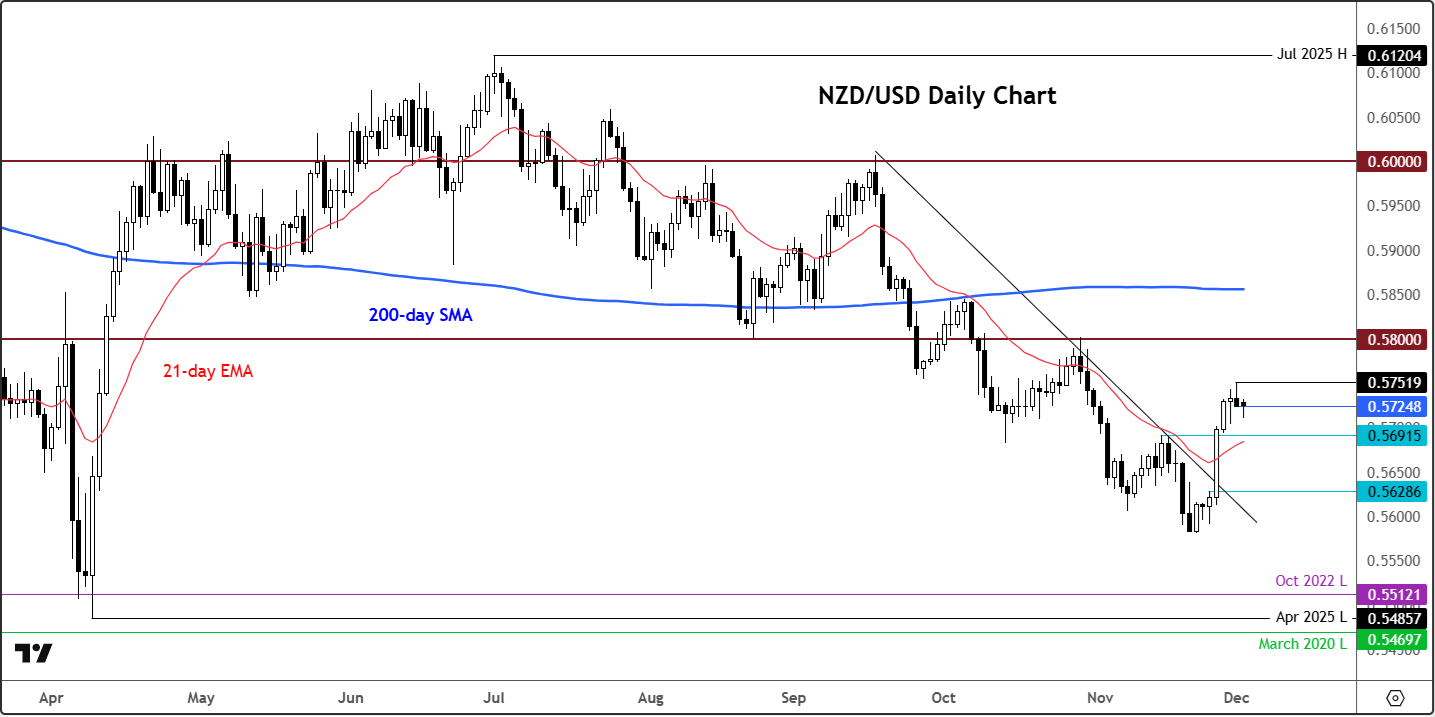
From here, we may see a period of consolidation near the recent highs, followed by a push toward 0.5800, the next key resistance zone. Above that, the 200-day moving average near 0.5860 comes into play, followed by 0.5950 and ultimately the major 0.6000 psychological level.
Overall, risks are tilted to the upside for the New Zealand dollar, making it a very interesting currency pair to watch—especially with the RBNZ now appearing less dovish than markets had expected.
Technical dollar forecast turns bearish DXY breaks trend line
The dollar index has broken below the bullish trend line that had been in place since September. This is a short-term bearish development, putting the dollar forecast on a negative watch. This is especially the case considering that price failed several times this year to break above the psychologically important 100.00 level.

The dollar index has also fallen back below the 21-day moving average, which now carries a negative slope. This adds to the bearish tone. With that in mind, former support levels must now hold as resistance.
The first level to watch is 99.50, a key price support level in the past and the underside of the broken trend line. If this level holds as resistance today, it will keep the bearish bias intact and open the door for a decline towards 99.00, a major support zone tested yesterday and again in mid-November. This area is critical and could be the next downside target for sellers.
Below 99.00, there are no significant support levels nearby. Traders should monitor round numbers like 98.00, 97.00, and so on. The year-to-date low at 96.20 could become the ultimate downside target, though reaching it would likely require a dovish Fed. Still, it’s not out of the question that the dollar index could revisit that area in the weeks ahead—it remains a medium-term target for now.
In the near term, however, the path of least resistance clearly remains to the downside, so we will continue to look for supports to break and resistances to hold.
If resistance at 99.50 gives way, the index could squeeze back toward 100.00. A break above that would bring the 100.25 resistance area into play. If that zone were to break - perhaps on the back of a hawkish Fed next week - the bias would shift decisively back in favour of the bulls.
Source for all charts used in this article: TradingView.com

-- Written by Fawad Razaqzada, Market Analyst
Follow Fawad on Twitter @Trader_F_R
Latest market news




The complete CFD trading experience
Award-winning platforms, competitive spreads, low commissions and dedicated support.
We live and breathe the markets and are dedicated to helping traders realise their ambitions as we continue to set the industry bar.
Economic calendar
Web Trader platform
Our sophisticated web-based platform is packed with features.
Related articles
Canadian Dollar Short-term Outlook: USD/CAD Five-Week Rally Hits a Wall at Major Resistance 10 14 2026
USD/CAD is holding near fresh yearly highs, but bearish divergence and a well-defined October range raise the stakes at major resistance.
EUR/USD Analysis: Euro Loses Ground After a Stronger-Than-Expected U.S. CPI Report
The trading week continues to unfold and weakness around the euro has once again become increasingly evident in the short term. This can be seen in the recent performance of EUR/USD, which has declined roughly 0.3% over the last three trading sessions, highlighting renewed strength in the U.S. dollar.

USD/JPY forecast: hot US CPI lifts the pair above its 200-day average
Hotter-than-expected US inflation has pushed USD/JPY above its 200-day moving average, putting 160 and the risk of Bank of Japan intervention back in focus. The breakout still needs to hold, and a failure could send the pair sharply lower.
StoneX Europe Ltd may make third party material available on this website which may contain information included but not limited to the conditions of financial markets. The material is for information purposes only and does not contain, and should not be construed as containing, investment advice and/or investment recommendation and/or an investment research and/or an offer of or solicitation for any transactions in financial instruments; any decision to enter into a specific transaction shall be made by the client following an assessment by him/her of their situation.
StoneX Europe Ltd makes no representation or warranty and assumes no liability as to the accuracy or completeness of the information provided, nor any loss arising from any investment based on a recommendation, forecast or other information supplied. You should always seek independent advice as to your suitability to speculate in any related markets and your ability to assume the associated risks, if you are at all unsure. We are not under any obligation to update any such material. Any opinion made may be personal to the author and may not reflect the opinion of StoneX Europe Ltd.