


EUR/USD pops, gold sinks as telegraphed trade deal confirmed
The U.S. and EU confirmed a long-anticipated trade pact, halving threatened tariffs and pledging major investment and energy deals. The euro firmed, gold extended losses, and broader markets barely blinked.
Share this:
- U.S.–E.U. confirm trade deal with 15% tariff on most goods
- E.U. pledges $600bn in U.S. investment during Trump’s term
- EUR/USD extends gains, gold falls through key support
- Market reaction muted, deal widely expected after Japan pact
EUR/USD, Gold Summary
A trade agreement has been reached between the United States and European Union, confirming what traders had been anticipating following the announcement of a similar agreement between the U.S. and Japan last week. The muted reaction suggests as much, with EUR/USD trading modestly higher on the news. While moves in the FX universe have been contained, gold is a market worth watching, breaking some critical technical levels late last week before going on with the move on Monday.
Surprise!?! U.S.-E.U. Trade Deal Inked
The U.S. and EU finalised a framework trade deal Sunday, confirming widespread expectations for a de-escalation in tensions after last week’s agreement with Japan. Announced by President Donald Trump and European Commission President Ursula von der Leyen in Scotland, the deal imposes a flat 15% tariff on most EU goods—half the threatened rate—and includes a pledge from the EU to invest $600 billion in the U.S. during Trump’s current presidential term. The EU also committed to sharply increasing purchases of U.S. energy and defence equipment.
The key details:
• 15% tariff applied broadly to E.U. goods including autos, semis and pharmaceuticals
• Exemptions include aircraft and parts, critical raw materials, generic drugs, some ag and chemicals
• $600bn in E.U. investment in the U.S. flagged during Trump’s term
• $750bn in future E.U. energy imports, hundreds of billions in arms
• 50% U.S. steel and aluminium tariff remains, with quota system under discussion
• Trump retains discretion to lift tariffs if E.U. doesn’t meet commitments
The reaction has been muted, reflecting that markets moved to price in such an outcome following the U.S.-Japan trade deal agreed last week. The euro and U.S. index futures have nudged higher, while safe havens such as gold have come under renewed pressure.
EUR/USD: Buying Dips Favoured
Source: TradingView
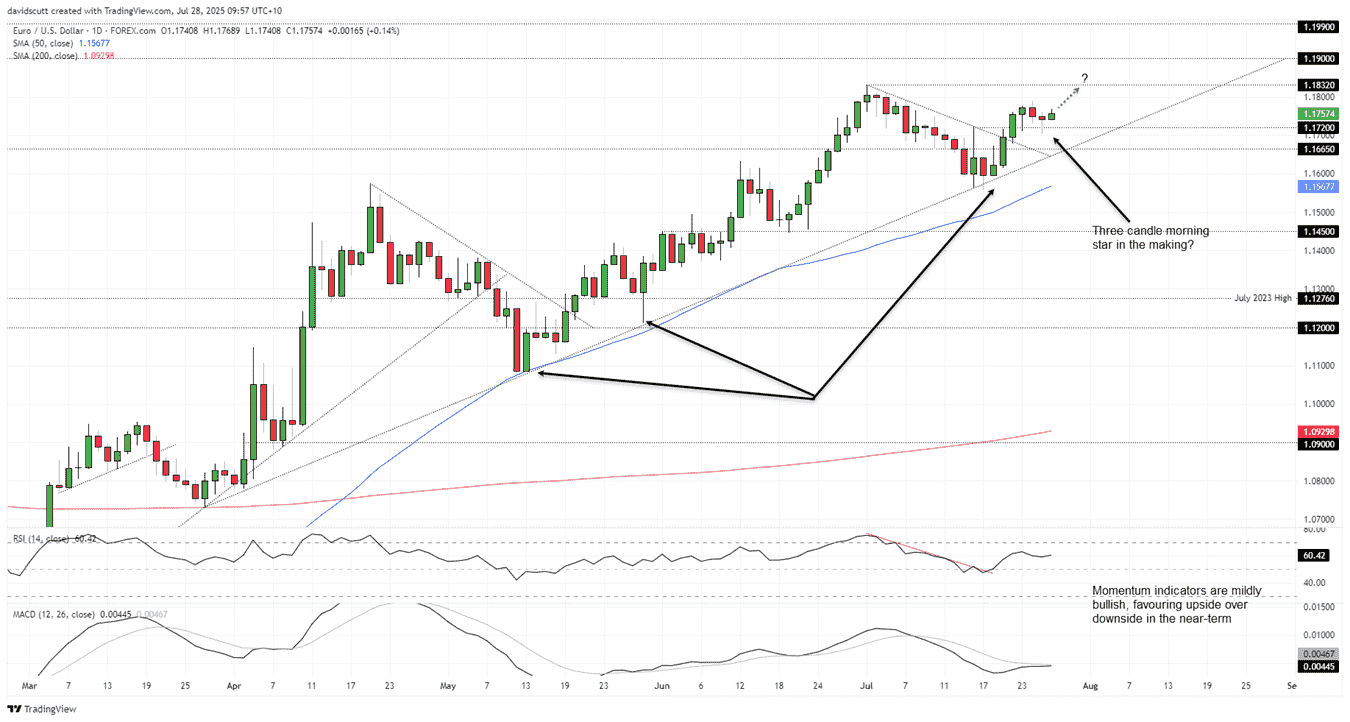
EUR/USD was looking good for the bulls even before the trade agreement, continuing to grind higher within a broader uptrend established in March. After testing the uptrend midway through July, the price bounced hard last Monday, breaking above the minor downtrend it had been sitting in since July 1 before consolidating over the remainder of the week.
Momentum indicators are also mildly bullish, with RSI (14) trending higher above 50 while MACD is on the cusp of crossing the signal line from below in positive territory, favouring upside over downside.
In the near-term, $1.1720 has acted as support and resistance recently, putting it on the radar for those contemplating bullish setups. Above, Thursday’s high of 1.1790 and July 1 peak of $1.1832 screen as possible targets. The session still has a long way to run, but as things stand the three-candle pattern on the daily resembles a morning star reversal pattern—hitting it could encourage additional longs off the sidelines should it close around these levels or higher.
On the downside, a break and close beneath 1.1720 would put the intersection of uptrend and horizontal support around 1.1650 in focus.
Gold Breaks Key Uptrend
Source: TradingView
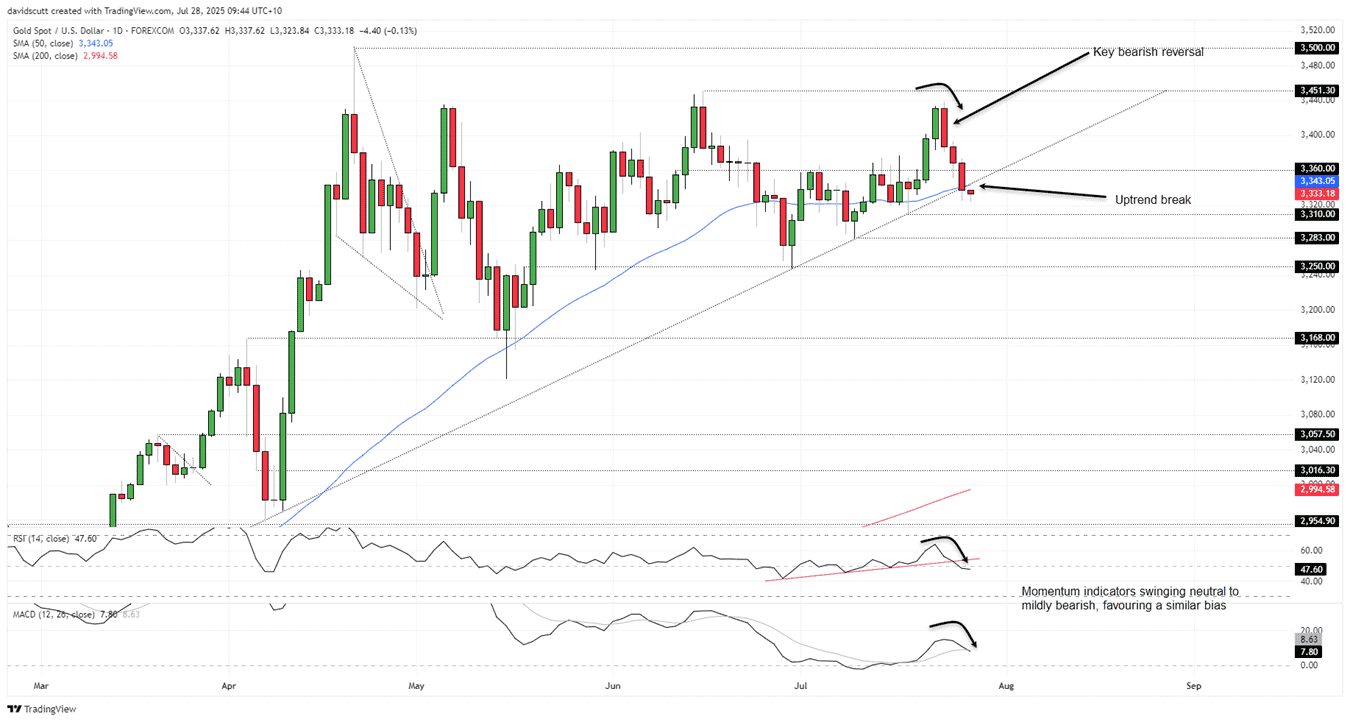
The key bearish candle on the daily chart last Wednesday proved to be a reliable signal on how gold closed out last week, with the price slicing through uptrend support for the first time since being established in late February, taking out the important 50-day moving average along the way.
With RSI (14) breaking its uptrend and sliding below 50, the momentum picture is quickly shifting to neutral-to-slightly-bearish—a view confirmed by MACD, which has just crossed over the signal line from above while remaining in positive territory for now.
Combined, the price and momentum signals warn of growing downside risk unless the price can reclaim the uptrend in the near-term.
On the downside, dips towards $3320 down to $3310 have been bought over the past fortnight, putting the latter level on the radar for traders considering selling the break. If it were to give way, $3283 was the low struck on July 9 before a more pronounced support level is found at $3250. To contemplate additional downside beyond those levels in a week laden with major risk events comes across as unlikely in the near-term.
If gold were to bounce back above the uptrend and hold there, the 50-day moving average and $3360 are the immediate levels to watch. The latter helped soak up bids for much of July before being overrun on July 21, so it may revert to its previous role in the current risk-on environment. If gold were to stage a dramatic reversal higher, last Wednesday’s high just shy of $3400 will likely be targeted by bulls.


The complete CFD trading experience
Award-winning platforms, competitive spreads, low commissions and dedicated support.
We live and breathe the markets and are dedicated to helping traders realise their ambitions as we continue to set the industry bar.
Economic calendar
Web Trader platform
Our sophisticated web-based platform is packed with features.
Related articles
USD/CAD shooting star puts September surge on notice
USD/CAD has printed a clear bearish reversal pattern after an extraordinary September surge, but confirmation may depend heavily on how US Treasury yields react to Friday’s payrolls report.

USD/MXN Analysis: Is Super Peso Starting to Fade?
Over recent trading sessions, the Mexican peso has continued to show signs of weakness against the U.S. dollar. This can already be seen in USD/MXN, which has gained more than 1.7% over the last three sessions, highlighting sustained buying pressure in favor of the dollar in the short term.


Canadian Dollar Analysis: USD/CAD Returns to July Highs Ahead of NFP
The Canadian dollar continues to face one of its most challenging environments in recent months when it comes to maintaining strength against the U.S. dollar. The weakness of the Canadian currency is clearly reflected in USD/CAD, which has now recorded nine consecutive bullish sessions and gained more than 1.7% during that period.
StoneX Europe Ltd may make third party material available on this website which may contain information included but not limited to the conditions of financial markets. The material is for information purposes only and does not contain, and should not be construed as containing, investment advice and/or investment recommendation and/or an investment research and/or an offer of or solicitation for any transactions in financial instruments; any decision to enter into a specific transaction shall be made by the client following an assessment by him/her of their situation.
StoneX Europe Ltd makes no representation or warranty and assumes no liability as to the accuracy or completeness of the information provided, nor any loss arising from any investment based on a recommendation, forecast or other information supplied. You should always seek independent advice as to your suitability to speculate in any related markets and your ability to assume the associated risks, if you are at all unsure. We are not under any obligation to update any such material. Any opinion made may be personal to the author and may not reflect the opinion of StoneX Europe Ltd.