




NFP Preview What to Expect from the Final PreElection Jobs Report
Like everything else these days, this month’s jobs report will be viewed primarily through a political lens as we finally enter the home stretch of the multi-year US Presidential campaign season.
Share this:

Background
Like everything else these days, this month’s jobs report will be viewed primarily through a political lens as we finally enter the home stretch of the multi-year US Presidential campaign season. Academic studies have repeatedly shown that the state of the economy can have a major influence on voting intentions, and with another round of fiscal stimulus unlikely to hit consumers’ wallets before the election (if ever!), this final pre-election jobs report will be perhaps the single most important economic release heading into November 3rd.
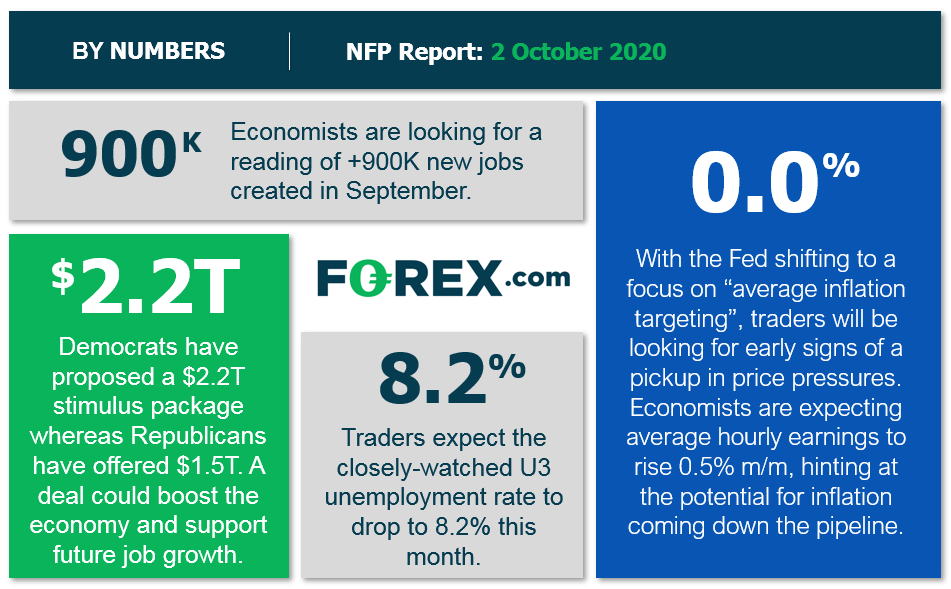
As it stands, economists expect that this month’s NFP report will show roughly 900K net new jobs, which would be the first figure below 1M jobs since the catastrophic -21M jobs reading in April. Meanwhile, The Street’s consensus expectations are for average hourly earnings to rise 0.5% m/m and the unemployment rate to dip to 8.2%.
Source: GAIN Capital
NFP Forecast
As regular readers know, there are four historically reliable leading indicators that we watch to help handicap each month’s NFP report, but due to a calendar quirk, the ISM Non-Manufacturing PMI report won’t be released until Monday. That leaves us with the following indicators to watch:
- The ISM Manufacturing PMI Employment component rose to 49.6, a 3-point improvement from last month’s 46.4 reading.
- The ADP Employment report printed at 749k, an improvement over last month’s upwardly revised 481k reading and above the 650k print that economists were expecting.
- The 4-week moving average of initial unemployment claims dipped to 867k, down from last month’s 992k reading, indicating fewer new unemployed Americans.
As we’ve noted repeatedly over the last few months, traders should take any forward-looking economic estimates with a massive grain of salt given the truly unparalleled global economic disruption as a result of COVID-19’s spread. That said, weighing the data and our internal models, the leading indicators point to a potentially worse-than-expected reading from the September NFP report, with headline job growth potentially rising by “just” 600k-800k jobs, though with a bigger band of uncertainty than ever given the current state of affairs.
Regardless, the month-to-month fluctuations in this report are notoriously difficult to predict, so we wouldn’t put too much stock into any forecasts (including ours). As always, the other aspects of the release, prominently including the closely-watched average hourly earnings figure, will likely be just as important as the headline figure itself.
Potential Market Reaction
See wage and job growth scenarios, along with the potential bias for the U.S. dollar below:
| Earnings < 0.4% m/m | Earnings 0.4-0.6% m/m | Earnings > 0.6% m/m | |
| < 800k jobs | Bearish USD | Slightly Bearish USD | Neutral USD |
| 800k-1M jobs | Slightly Bearish USD | Neutral USD | Slightly Bullish USD |
| >1M jobs | Neutral USD | Slightly Bullish USD | Bullish USD |
When it comes to the FX market, the elephant in the room is still the US dollar. The greenback has generally stabilized against its major rivals over the past couple months after a big swoon through the summer, and with this month’s jobs report and the final stretch of the campaign on tap, the next month or so will be critical to “set the tone” for the rest of the year.
For this month’s report, if we see stronger than expected jobs growth and wage figures, readers may want to consider sell opportunities in EUR/USD, which has retraced back to previous-support-turned-resistance in the 1.1750 area after rolling over last month. Meanwhile, with USD/JPY unable to break above it’s downward-trending 50-day EMA, a weaker-than-anticipated NFP reading could be the catalyst for the general downtrend in that pair to resume.
Background
Like everything else these days, this month’s jobs report will be viewed primarily through a political lens as we finally enter the home stretch of the multi-year US Presidential campaign season. Academic studies have repeatedly shown that the state of the economy can have a major influence on voting intentions, and with another round of fiscal stimulus unlikely to hit consumers’ wallets before the election (if ever!), this final pre-election jobs report will be perhaps the single most important economic release heading into November 3rd.
As it stands, economists expect that this month’s NFP report will show roughly 900K net new jobs, which would be the first figure below 1M jobs since the catastrophic -21M jobs reading in April. Meanwhile, The Street’s consensus expectations are for average hourly earnings to rise 0.5% m/m and the unemployment rate to dip to 8.2%.
Source: GAIN Capital
NFP Forecast
As regular readers know, there are four historically reliable leading indicators that we watch to help handicap each month’s NFP report, but due to a calendar quirk, the ISM Non-Manufacturing PMI report won’t be released until Monday. That leaves us with the following indicators to watch:
- The ISM Manufacturing PMI Employment component rose to 49.6, a 3-point improvement from last month’s 46.4 reading.
- The ADP Employment report printed at 749k, an improvement over last month’s upwardly revised 481k reading and above the 650k print that economists were expecting.
- The 4-week moving average of initial unemployment claims dipped to 867k, down from last month’s 992k reading, indicating fewer new unemployed Americans.
As we’ve noted repeatedly over the last few months, traders should take any forward-looking economic estimates with a massive grain of salt given the truly unparalleled global economic disruption as a result of COVID-19’s spread. That said, weighing the data and our internal models, the leading indicators point to a potentially worse-than-expected reading from the September NFP report, with headline job growth potentially rising by “just” 600k-800k jobs, though with a bigger band of uncertainty than ever given the current state of affairs.
Regardless, the month-to-month fluctuations in this report are notoriously difficult to predict, so we wouldn’t put too much stock into any forecasts (including ours). As always, the other aspects of the release, prominently including the closely-watched average hourly earnings figure, will likely be just as important as the headline figure itself.
Potential Market Reaction
See wage and job growth scenarios, along with the potential bias for the U.S. dollar below:
| Earnings < 0.4% m/m | Earnings 0.4-0.6% m/m | Earnings > 0.6% m/m | |
| < 800k jobs | Bearish USD | Slightly Bearish USD | Neutral USD |
| 800k-1M jobs | Slightly Bearish USD | Neutral USD | Slightly Bullish USD |
| >1M jobs | Neutral USD | Slightly Bullish USD | Bullish USD |
When it comes to the FX market, the elephant in the room is still the US dollar. The greenback has generally stabilized against its major rivals over the past couple months after a big swoon through the summer, and with this month’s jobs report and the final stretch of the campaign on tap, the next month or so will be critical to “set the tone” for the rest of the year.
For this month’s report, if we see stronger than expected jobs growth and wage figures, readers may want to consider sell opportunities in EUR/USD, which has retraced back to previous-support-turned-resistance in the 1.1750 area after rolling over last month. Meanwhile, with USD/JPY unable to break above it’s downward-trending 50-day EMA, a weaker-than-anticipated NFP reading could be the catalyst for the general downtrend in that pair to resume.
Related tags:


The complete CFD trading experience
Award-winning platforms, competitive spreads, low commissions and dedicated support.
We live and breathe the markets and are dedicated to helping traders realise their ambitions as we continue to set the industry bar.
Economic calendar
Web Trader platform
Our sophisticated web-based platform is packed with features.
Related articles

AUD/USD hammered by US yields and fading RBA hike bets
US yields, dollar strength and fading RBA hike bets have combined to drive AUD/USD to fresh multi-month lows. The macro and technical bias remains bearish, although history suggests parts of the move are now reaching unusually stretched levels.

EUR/USD Forecast: Euro Struggles to Find Support Even After U.S. PCE Data
The euro continues to face a challenging environment in the short term. The currency has struggled to regain ground against a U.S. dollar that remains firmly supported, a dynamic reflected in EUR/USD, which has now recorded three consecutive losing sessions and a decline of roughly 0.6%.


Canadian Dollar Forecast: USD/CAD Four-Week Rally Eyes Yearly Highs 9 30 2026
USD/CAD has advanced in 14 of the past 15 sessions, but stretched momentum raises the stakes as major resistance and NFP come into focus.

StoneX Europe Ltd may make third party material available on this website which may contain information included but not limited to the conditions of financial markets. The material is for information purposes only and does not contain, and should not be construed as containing, investment advice and/or investment recommendation and/or an investment research and/or an offer of or solicitation for any transactions in financial instruments; any decision to enter into a specific transaction shall be made by the client following an assessment by him/her of their situation.
StoneX Europe Ltd makes no representation or warranty and assumes no liability as to the accuracy or completeness of the information provided, nor any loss arising from any investment based on a recommendation, forecast or other information supplied. You should always seek independent advice as to your suitability to speculate in any related markets and your ability to assume the associated risks, if you are at all unsure. We are not under any obligation to update any such material. Any opinion made may be personal to the author and may not reflect the opinion of StoneX Europe Ltd.