










NZD/USD: Split decision at RBNZ clouds path for further easing
Markets got their cut, but not the dovish consensus they were expecting. A firmer inflation tone and a lone dissenting vote hint the RBNZ may not be fully aligned on what comes next.
Share this:

- RBNZ cut OCR by 25bp to 3.25%, as expected
- One member voted to hold, adding hawkish tone
- Rising inflation expectations noted
- More rate cuts likely, downside risks seen abroad
- NZD reversed lower before rebounding on split vote
Summary
The Reserve Bank of New Zealand (RBNZ) cut interest rates and signalled a need for additional policy easing compared to three months ago. However, the decision was not unanimous, and its language on inflation was noticeably firmer, putting a hawkish tinge on the move.
Cash Rate Cut, Not Unanimous
The RBNZ delivered a 25bp cut in the cash rate to 3.25%, as was fully priced by markets. The surprise came from the meeting discussion, with the final decision coming down to a choice between holding the cash rate steady or cutting by 25bp—ruling out a supersized 50bp move.
“The case for lowering the OCR [cash rate] to 3.25% highlighted that CPI inflation is in the target range and there is significant spare capacity in the economy,” the minutes said.
“In considering the merits of holding the OCR unchanged at 3.50%... some members noted that this would allow the Committee to better assess whether increased economic policy uncertainty was having a noticeable impact on household and firm behaviour.
“An unchanged OCR could also further consolidate inflation expectations around the target mid-point, and guard against the risk of higher-than-expected inflation from the supply-side effects of increased tariffs.”
Adding a hawkish twist to the decision, only five members voted to cut, with one opting to keep the cash rate unchanged at 3.5%.
The unexpected split vote saw the New Zealand dollar and short-dated interest rates reverse initial kneejerk declines, overriding what was otherwise a more aggressive rate cut profile than three months earlier.
RBNZ Rate Track Forecast Lowered
Source: RBNZ
The RBNZ lowered its rate track forecast, indicating further cuts are likely beyond the move in May. The cash rate is now seen bottoming at an average of 2.85% in Q1 2026—some 25bp lower than projected in February. It implies policy may need to move into mildly stimulatory territory this cycle.
Hinting that U.S. trade policy will be a key swing factor for the cash rate, the Committee discussed two scenarios for the domestic economy, labelled “negative” and “more negative”. Despite the framing, the “negative” scenario suggested a higher cash rate would be needed from December to return inflation to the 2% mid-point. Under the “more negative” scenario, the opposite applies—a lower rate would be necessary.
Source: RBNZ
Inflation Tone Firmer
Reflecting uncertainty stemming from shifting U.S. trade policy, the RBNZ struck a more dovish tone on the global outlook, although it was firmer on inflation and the domestic economy.
While it acknowledged core inflation is falling and spare capacity remains, it noted inflation expectations among firms and households have “risen”. On the local economy, it said it is “recovering after a period of contraction”, with “high commodity prices and lower interest rates” supporting overall activity.
Markets Trim Rate Cut Bets
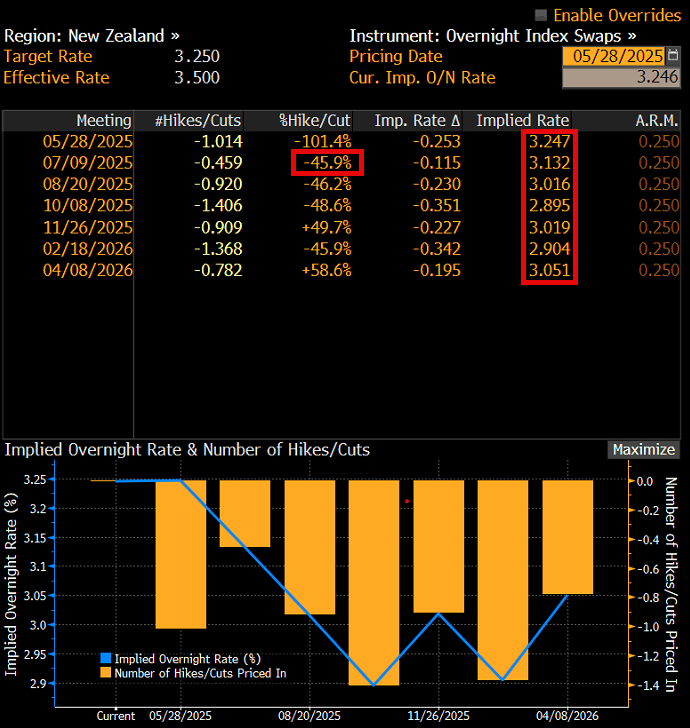
Following the statement and updated forecasts, swaps markets trimmed the odds of the cash rate falling below 3%, with rates now expected to remain on hold at the RBNZ’s July meeting—though pricing suggests it will be a close call. While the risk of a move to 2.75% is still partially priced following quarterly inflation prints, markets have tilted towards 3% being the likely floor this cycle.
Source: Bloomberg
Still, with so much excess slack in the labour market, it’s debatable whether conditions are conducive for domestic price pressures to rebuild, leaving the door open for the cash rate to move closer to 2.5% to spur private sector activity. We retain that view, and that’s before factoring in risks from offshore.
NZD/USD: Buying Dips Favoured
Source: TradingView
NZD/USD reversed course and pushed higher following the rate decision before running into resistance at .5968. Sitting above the 50 and 200-day moving averages, and with both price and momentum indicators trending higher, buying dips remains the preferred near-term strategy. Below trend support from mid-May, buyers may emerge around the 50DMA, 200DMA, and .5850. Above .5968, .6030 stands as key resistance.
-- Written by David Scutt
Follow David on Twitter @scutty
How to trade with City Index
You can trade with City Index by following these four easy steps:
- Open an account, or log in if you’re already a customer
• Open an account in the UK
• Open an account in Australia
• Open an account in Singapore
- Search for the market you want to trade in our award-winning platform
- Choose your position and size, and your stop and limit levels
- Place the trade
Related tags:
Latest market news




The complete CFD trading experience
Award-winning platforms, competitive spreads, low commissions and dedicated support.
We live and breathe the markets and are dedicated to helping traders realise their ambitions as we continue to set the industry bar.
Economic calendar
Web Trader platform
Our sophisticated web-based platform is packed with features.
Related articles
USD/MXN Analysis: Is Super Peso Starting to Fade?
Over recent trading sessions, the Mexican peso has continued to show signs of weakness against the U.S. dollar. This can already be seen in USD/MXN, which has gained more than 1.7% over the last three sessions, highlighting sustained buying pressure in favor of the dollar in the short term.
Canadian Dollar Analysis: USD/CAD Returns to July Highs Ahead of NFP
The Canadian dollar continues to face one of its most challenging environments in recent months when it comes to maintaining strength against the U.S. dollar. The weakness of the Canadian currency is clearly reflected in USD/CAD, which has now recorded nine consecutive bullish sessions and gained more than 1.7% during that period.

US Dollar Technical Outlook: DXY Bulls Meet Resistance at Yearly Highs 10 1 2026
The U.S. Dollar has held firm despite fading Fed hike bets, but Friday’s payrolls could test the rally’s staying power.

StoneX Europe Ltd may make third party material available on this website which may contain information included but not limited to the conditions of financial markets. The material is for information purposes only and does not contain, and should not be construed as containing, investment advice and/or investment recommendation and/or an investment research and/or an offer of or solicitation for any transactions in financial instruments; any decision to enter into a specific transaction shall be made by the client following an assessment by him/her of their situation.
StoneX Europe Ltd makes no representation or warranty and assumes no liability as to the accuracy or completeness of the information provided, nor any loss arising from any investment based on a recommendation, forecast or other information supplied. You should always seek independent advice as to your suitability to speculate in any related markets and your ability to assume the associated risks, if you are at all unsure. We are not under any obligation to update any such material. Any opinion made may be personal to the author and may not reflect the opinion of StoneX Europe Ltd.