




Powell puts a 50bps March hike firmly on the radar, GBP/USD tests 2023 lows
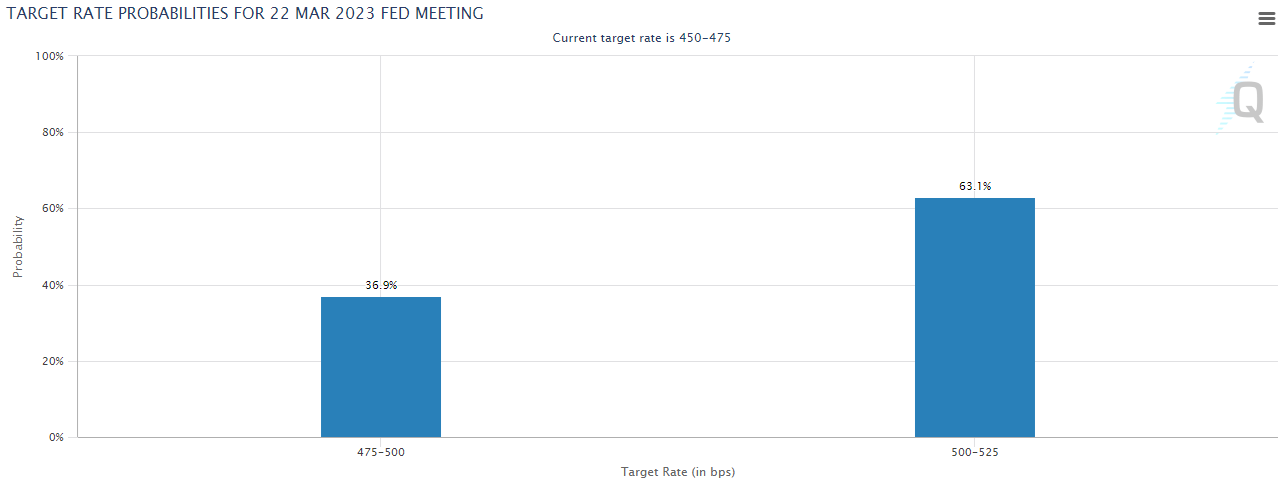
According to the CME’s FedWatch tool, investors are now pricing in a 60/40 shot of a 50bps rate hike in two weeks’ time and that rates could peak above 5.5%.
Share this:

Key takeaways
- Fed Chair Jerome Powell acknowledged that the pace of quarter-point interest-rate increases is not set in stone, and a faster tightening of rates may be warranted if economic data indicates it is necessary.
- Powell's follow-up testimony tomorrow will be his last scheduled public remarks on interest-rate policy before the Fed's next meeting, March 21-22.
- Strong economic data have shifted investors' rate expectations, with the rate now expected to rise to around 5.5% by midyear and remain there through the end of 2023.
This morning, Federal Reserve Chair Jerome Powell acknowledged during his Capitol Hill hearings that the recent 25bps pace of interest rate increases is not set in stone. Powell expressed his belief that strong and sustained economic activity this year could prompt the central bank officials to accelerate interest rate increases. He further stated that this could lead to more rate increases than initially expected to combat high inflation.
Powell’s comments were prepared for delivery before the Senate Banking Committee. He highlighted that the recent economic data had come in stronger than expected, which means that the ultimate level of interest rates is likely to be higher than anticipated. In the same vein, Powell explained that the Fed would be prepared to increase the pace of rate hikes if the data indicate that a faster tightening is warranted.
Powell further revealed that the process of getting inflation back down to 2% has a long way to go and is likely to be bumpy. Although inflation has been moderating in recent months, Powell revealed that the Fed would continue to make its decisions meeting by meeting.
Economic data running hot
Since the Fed’s last meeting in February, several economic reports have revealed that hiring, spending, and inflation were hotter than anticipated. Data revisions also revealed that inflation and demand for labor did not slow as much as initially reported. Powell explained that the breadth of the reversal, along with revisions to the previous quarter, suggests that inflationary pressures are higher than initially expected.
Powell stated that the Fed has been trying to curb investment, spending, and hiring by raising rates. This makes it more expensive to borrow and can push down the price of risk assets such as stocks and real estate.
Powell’s testimony this week is his last scheduled public remarks on interest-rate policy. As such, it presents his final chance to shape market expectations before the Fed’s next meeting on March 21-22. The officials will begin their pre-meeting quiet period on Saturday.
Notably, Powell could face limits in guiding markets beyond this week because two widely watched economic reports that could influence officials’ deliberations, Friday’s NFP report and next week’s CPI release, are set to be released after he testifies and before the next Fed meeting.
50bps on the table?
Several Fed officials have indicated in recent weeks that they could raise rates this year more than initially projected. Three regional Fed bank presidents have said they could have backed a larger half-point increase last month or would do so at the coming meeting.
The recent strong economic data shifted investors’ rate expectations. When the Fed last met, investors in interest-rate futures markets anticipated officials would raise the fed-funds rate just once more this year, to a peak of 4.9%, and begin cutting it this fall.
According to the CME’s FedWatch tool, investors are now pricing in a 60/40 shot of a 50bps rate hike in two weeks’ time and that rates could peak above 5.5%.
Source: CME FedWatch
British pound technical analysis – GBP/USD testing 2023 lows
Not surprisingly, the US dollar has been the big winner of the market’s “higher interest rates for longer” interpretation of Powell’s comments. GBP/USD in particular is on the back foot today, with the pair breaking below previous support in the 1.1900 area to test its lowest level of the year.
A close below the January 6 low around 1.1840 would open the door for more weakness toward the 38.2% rally off the all-time low around 1.1640 next. At this point, only a close back above 1.1900 would eliminate the near-term bearish bias.
Source: StoneX, TradingView
-- Written by Matt Weller, Global Head of Research
Follow Matt on Twitter @MWellerFX
Key takeaways
- Fed Chair Jerome Powell acknowledged that the pace of quarter-point interest-rate increases is not set in stone, and a faster tightening of rates may be warranted if economic data indicates it is necessary.
- Powell's follow-up testimony tomorrow will be his last scheduled public remarks on interest-rate policy before the Fed's next meeting, March 21-22.
- Strong economic data have shifted investors' rate expectations, with the rate now expected to rise to around 5.5% by midyear and remain there through the end of 2023.
This morning, Federal Reserve Chair Jerome Powell acknowledged during his Capitol Hill hearings that the recent 25bps pace of interest rate increases is not set in stone. Powell expressed his belief that strong and sustained economic activity this year could prompt the central bank officials to accelerate interest rate increases. He further stated that this could lead to more rate increases than initially expected to combat high inflation.
Powell’s comments were prepared for delivery before the Senate Banking Committee. He highlighted that the recent economic data had come in stronger than expected, which means that the ultimate level of interest rates is likely to be higher than anticipated. In the same vein, Powell explained that the Fed would be prepared to increase the pace of rate hikes if the data indicate that a faster tightening is warranted.
Powell further revealed that the process of getting inflation back down to 2% has a long way to go and is likely to be bumpy. Although inflation has been moderating in recent months, Powell revealed that the Fed would continue to make its decisions meeting by meeting.
Economic data running hot
Since the Fed’s last meeting in February, several economic reports have revealed that hiring, spending, and inflation were hotter than anticipated. Data revisions also revealed that inflation and demand for labor did not slow as much as initially reported. Powell explained that the breadth of the reversal, along with revisions to the previous quarter, suggests that inflationary pressures are higher than initially expected.
Powell stated that the Fed has been trying to curb investment, spending, and hiring by raising rates. This makes it more expensive to borrow and can push down the price of risk assets such as stocks and real estate.
Powell’s testimony this week is his last scheduled public remarks on interest-rate policy. As such, it presents his final chance to shape market expectations before the Fed’s next meeting on March 21-22. The officials will begin their pre-meeting quiet period on Saturday.
Notably, Powell could face limits in guiding markets beyond this week because two widely watched economic reports that could influence officials’ deliberations, Friday’s NFP report and next week’s CPI release, are set to be released after he testifies and before the next Fed meeting.
50bps on the table?
Several Fed officials have indicated in recent weeks that they could raise rates this year more than initially projected. Three regional Fed bank presidents have said they could have backed a larger half-point increase last month or would do so at the coming meeting.
The recent strong economic data shifted investors’ rate expectations. When the Fed last met, investors in interest-rate futures markets anticipated officials would raise the fed-funds rate just once more this year, to a peak of 4.9%, and begin cutting it this fall.
According to the CME’s FedWatch tool, investors are now pricing in a 60/40 shot of a 50bps rate hike in two weeks’ time and that rates could peak above 5.5%.
Source: CME FedWatch
British pound technical analysis – GBP/USD testing 2023 lows
Not surprisingly, the US dollar has been the big winner of the market’s “higher interest rates for longer” interpretation of Powell’s comments. GBP/USD in particular is on the back foot today, with the pair breaking below previous support in the 1.1900 area to test its lowest level of the year.
A close below the January 6 low around 1.1840 would open the door for more weakness toward the 38.2% rally off the all-time low around 1.1640 next. At this point, only a close back above 1.1900 would eliminate the near-term bearish bias.
Source: StoneX, TradingView
-- Written by Matt Weller, Global Head of Research
Follow Matt on Twitter @MWellerFX
How to trade with City Index
You can trade with City Index by following these four easy steps:
- Open an account, or log in if you’re already a customer
• Open an account in the UK
• Open an account in Australia
• Open an account in Singapore
- Search for the market you want to trade in our award-winning platform
- Choose your position and size, and your stop and limit levels
- Place the trade


The complete CFD trading experience
Award-winning platforms, competitive spreads, low commissions and dedicated support.
We live and breathe the markets and are dedicated to helping traders realise their ambitions as we continue to set the industry bar.
Economic calendar
Web Trader platform
Our sophisticated web-based platform is packed with features.
Related articles

AUD/USD hammered by US yields and fading RBA hike bets
US yields, dollar strength and fading RBA hike bets have combined to drive AUD/USD to fresh multi-month lows. The macro and technical bias remains bearish, although history suggests parts of the move are now reaching unusually stretched levels.
EUR/USD Forecast: Euro Struggles to Find Support Even After U.S. PCE Data
The euro continues to face a challenging environment in the short term. The currency has struggled to regain ground against a U.S. dollar that remains firmly supported, a dynamic reflected in EUR/USD, which has now recorded three consecutive losing sessions and a decline of roughly 0.6%.


Canadian Dollar Forecast: USD/CAD Four-Week Rally Eyes Yearly Highs 9 30 2026
USD/CAD has advanced in 14 of the past 15 sessions, but stretched momentum raises the stakes as major resistance and NFP come into focus.

StoneX Europe Ltd may make third party material available on this website which may contain information included but not limited to the conditions of financial markets. The material is for information purposes only and does not contain, and should not be construed as containing, investment advice and/or investment recommendation and/or an investment research and/or an offer of or solicitation for any transactions in financial instruments; any decision to enter into a specific transaction shall be made by the client following an assessment by him/her of their situation.
StoneX Europe Ltd makes no representation or warranty and assumes no liability as to the accuracy or completeness of the information provided, nor any loss arising from any investment based on a recommendation, forecast or other information supplied. You should always seek independent advice as to your suitability to speculate in any related markets and your ability to assume the associated risks, if you are at all unsure. We are not under any obligation to update any such material. Any opinion made may be personal to the author and may not reflect the opinion of StoneX Europe Ltd.