




RBA Minutes Confirm They Are More Likely To Ease Further
The RBA’s minutes revealed what many had expected, by stating it’s ‘more than likely’ they’ll have to ease further in the period ahead.
Share this:

The RBA’s minutes revealed what many had expected, by stating it’s ‘more than likely’ they’ll have to ease further in the period ahead.
Summary From RBA Minutes on Monetary Policy
- Members judged that a decline in interest rates was unlikely to encourage a material pick-up in borrowing by households that would add to medium-term risks in the economy
- Risks to the forecasts for growth and inflation in both directions
- It was more likely than not that a further easing in monetary policy would be appropriate in the period ahead.
- Lower interest rates were not the only policy option available to assist in lowering the rate of unemployment".
- In assessing whether further monetary easing was appropriate, developments in the labour market would be particularly important.
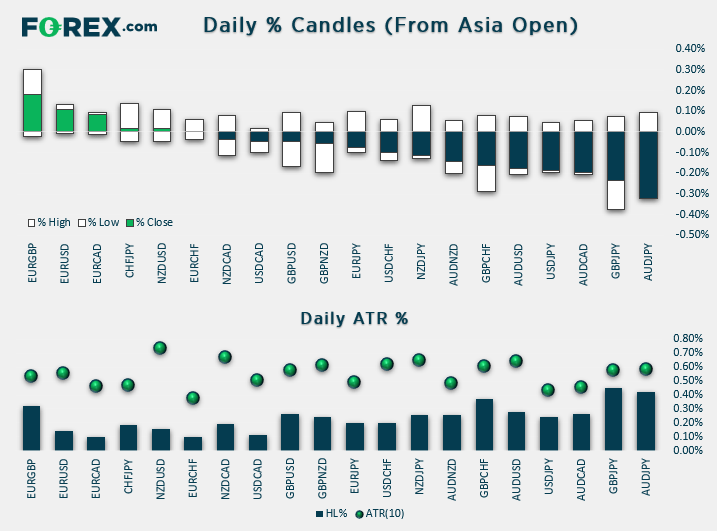
The biggest mover of the session so far is AUD/JPY, which dropped 0.4% after the release and is currently today’s biggest mover among FX majors and crosses. Currently at its lowest point since January’s flash-crash, bears remain keen to sell into any pullbacks in line with its bearish trend structure. Over the near-term, it’s arguable that prices are a little stretched (as really, nothing major and new was revealed in the minutes), although the Japanese yen is the strongest major Trump is sending 1,000 troops to the Middle East.
GBP/AUD has shown its ability to provide wild swings, although the recent rally from the June low appears to be running out of steam. Resistance has been found at the 50 and 100-day MA, where a bearish hammer and pinbar formed ahead of yesterday’s bearish engulfing candle yesterday. Furthermore, this potential swing high has failed to test the 38.2% Fibonacci level to further highlight how the dynamics appears to have changed on the cross. From here, we remain bearish whilst it trades below the 1.8390 – 1.8410 area.
AUD/NZD has managed to hold above a 50% retracement level, although price action has essentially remain in a choppy sideways correction. Furthermore, prices are trapped between the 50 and 100-day MA’s, with the 200-day MA also providing resistance. However, a potential bullish flag could be forming which, if successful, projects a target around 1.0900. Yet we’d need to see bullish momentum break the 200-day MA or prior swing high before assuming a bull flag is playing out. Keep an eye on NZ GDP data tomorrow as this could prove a bullish catalyst for AUD/NZD if it misses the mark by a wide enough margin.
The RBA’s minutes revealed what many had expected, by stating it’s ‘more than likely’ they’ll have to ease further in the period ahead.
Summary From RBA Minutes on Monetary Policy
- Members judged that a decline in interest rates was unlikely to encourage a material pick-up in borrowing by households that would add to medium-term risks in the economy
- Risks to the forecasts for growth and inflation in both directions
- It was more likely than not that a further easing in monetary policy would be appropriate in the period ahead.
- Lower interest rates were not the only policy option available to assist in lowering the rate of unemployment".
- In assessing whether further monetary easing was appropriate, developments in the labour market would be particularly important.
The biggest mover of the session so far is AUD/JPY, which dropped 0.4% after the release and is currently today’s biggest mover among FX majors and crosses. Currently at its lowest point since January’s flash-crash, bears remain keen to sell into any pullbacks in line with its bearish trend structure. Over the near-term, it’s arguable that prices are a little stretched (as really, nothing major and new was revealed in the minutes), although the Japanese yen is the strongest major Trump is sending 1,000 troops to the Middle East.
GBP/AUD has shown its ability to provide wild swings, although the recent rally from the June low appears to be running out of steam. Resistance has been found at the 50 and 100-day MA, where a bearish hammer and pinbar formed ahead of yesterday’s bearish engulfing candle yesterday. Furthermore, this potential swing high has failed to test the 38.2% Fibonacci level to further highlight how the dynamics appears to have changed on the cross. From here, we remain bearish whilst it trades below the 1.8390 – 1.8410 area.
AUD/NZD has managed to hold above a 50% retracement level, although price action has essentially remain in a choppy sideways correction. Furthermore, prices are trapped between the 50 and 100-day MA’s, with the 200-day MA also providing resistance. However, a potential bullish flag could be forming which, if successful, projects a target around 1.0900. Yet we’d need to see bullish momentum break the 200-day MA or prior swing high before assuming a bull flag is playing out. Keep an eye on NZ GDP data tomorrow as this could prove a bullish catalyst for AUD/NZD if it misses the mark by a wide enough margin.
Related tags:


The complete CFD trading experience
Award-winning platforms, competitive spreads, low commissions and dedicated support.
We live and breathe the markets and are dedicated to helping traders realise their ambitions as we continue to set the industry bar.
Economic calendar
Web Trader platform
Our sophisticated web-based platform is packed with features.
Related articles
USD/CAD shooting star puts September surge on notice
USD/CAD has printed a clear bearish reversal pattern after an extraordinary September surge, but confirmation may depend heavily on how US Treasury yields react to Friday’s payrolls report.

USD/MXN Analysis: Is Super Peso Starting to Fade?
Over recent trading sessions, the Mexican peso has continued to show signs of weakness against the U.S. dollar. This can already be seen in USD/MXN, which has gained more than 1.7% over the last three sessions, highlighting sustained buying pressure in favor of the dollar in the short term.


Canadian Dollar Analysis: USD/CAD Returns to July Highs Ahead of NFP
The Canadian dollar continues to face one of its most challenging environments in recent months when it comes to maintaining strength against the U.S. dollar. The weakness of the Canadian currency is clearly reflected in USD/CAD, which has now recorded nine consecutive bullish sessions and gained more than 1.7% during that period.
StoneX Europe Ltd may make third party material available on this website which may contain information included but not limited to the conditions of financial markets. The material is for information purposes only and does not contain, and should not be construed as containing, investment advice and/or investment recommendation and/or an investment research and/or an offer of or solicitation for any transactions in financial instruments; any decision to enter into a specific transaction shall be made by the client following an assessment by him/her of their situation.
StoneX Europe Ltd makes no representation or warranty and assumes no liability as to the accuracy or completeness of the information provided, nor any loss arising from any investment based on a recommendation, forecast or other information supplied. You should always seek independent advice as to your suitability to speculate in any related markets and your ability to assume the associated risks, if you are at all unsure. We are not under any obligation to update any such material. Any opinion made may be personal to the author and may not reflect the opinion of StoneX Europe Ltd.