



Trump’s Tariffs are in, Trade War Fears linger
Trump’s global tariffs shock markets, triggering a steep selloff and igniting fears of a new trade war. A universal 10% import tariff and targeted reciprocal duties are set to take effect in early April. Equities plunged worldwide, with U.S. tech stocks leading losses. Germany and the EU brace for retaliation, while gold holds steady and the dollar weakens.
Share this:

Trump’s Global Tariffs Ignite Fears of a Trade War and Market Shock
In a highly anticipated announcement dubbed "Liberation Day," U.S. President Donald Trump has unleashed a sweeping wave of global import tariffs, marking the most aggressive trade policy move of his presidency. Speaking in a Rose Garden ceremony on Wednesday, Trump confirmed the introduction of a universal 10% import tariff on all goods entering the United States, effective April 5. Additionally, a system of reciprocal tariffs—with higher duties on countries the U.S. deems “trade offenders”—will follow from April 9. The decision sent shockwaves through global markets and raised concerns of an impending trade war and recession.
A Historic Policy Shift
Trump framed the move as a long-overdue correction to decades of what he described as unfair trade practices. “For years, hardworking Americans watched other nations grow rich at our expense. That ends today,” he declared. Calling the new measures the start of a “golden age” for American manufacturing, Trump portrayed the tariffs as both an economic necessity and a patriotic duty.
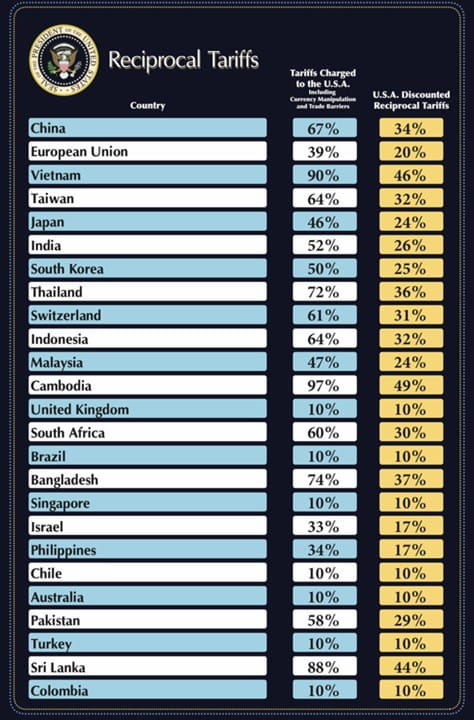
Under the new regime, China faces the steepest penalty, with a total tariff rate of 54%, including a new 34% duty on top of the existing 20%. The European Union will be hit with a 20% tariff, while other nations like Vietnam (46%), India (26%), Japan (24%), and South Korea (25%) are also targeted. Trump also revived 25% auto import tariffs, effective immediately, and extended them to auto parts from May 3. Products from Canada and Mexico under the USMCA are temporarily exempt from the baseline tariffs, although some specific goods are still subject to duties.
Source: The White House on X - Table with Tariffs charged for the US and US Reciprocal Tariffs implemented.
Economic Justification and Political Messaging
Trump declared a national emergency related to the $918 billion trade deficit the U.S. ran in 2024. Using powers granted by the International Emergency Economic Powers Act (IEEPA), the president asserted unilateral authority to implement tariffs. The administration projects the new duties will generate hundreds of billions of dollars in revenue, potentially helping fund the president’s campaign promise of broad-based tax cuts.
In addition to standard customs duties, Trump’s calculation of trade inequities includes non-tariff barriers such as value-added taxes (VAT), import restrictions, subsidies, and currency manipulation. “We’re not just talking about tariffs anymore,” a White House official said. “We’re talking about hidden taxes and unfair policies that hurt American jobs.”
Market Reaction: Immediate and Brutal
Financial markets responded with panic. U.S. stock futures plummeted after-hours:
- S&P 500 futures: -2.7%
- Nasdaq futures: -3.2%
- Dow Jones futures: -2%
- Russell 2000: -4%
The “Magnificent 7” tech stocks saw sharp losses in after-hours trading, led by Tesla (-8%), Apple (-7%), Amazon (-6%), and Nvidia (-5.7%). Global equity markets also suffered:
- Nikkei 225 (Japan): -3.3%
- HSCEI (Hong Kong): -1.7%
- Kospi (South Korea): -1.15%
- ASX 200 (Australia): -0.95%
Safe-haven demand surged, although gold prices retreated slightly to $3,129/oz after reaching historic highs earlier in the week. Oil and gas prices tumbled, with Brent and WTI futures down 2.5%. Trump’s tariffs also triggered volatility in forex markets, with the dollar weakening across the board. The yen and Swiss franc strengthened, and the euro broke above 1.09 (+0.85%).
In cryptocurrencies, the pain was equally pronounced. Bitcoin dropped 2.6% to $83,440, while Ethereum and Solana posted similar losses. The Trump-themed token collapsed 7.5%.
The European Response: Retaliation in the Works
European Commission President Ursula von der Leyen criticized the decision but expressed willingness to negotiate. However, she also confirmed that the EU is finalizing a retaliatory package, targeting U.S. goods and possibly imposing digital service taxes on U.S. tech firms like Google, Amazon, Netflix, and Elon Musk’s X platform.
Brussels has already signaled the reintroduction of retaliatory tariffs on jeans, motorcycles, bourbon whiskey, and peanut butter—originally a response to previous U.S. steel and aluminum tariffs. The EU is also considering energy trade leverage, including potential LNG deals with the U.S. as part of broader negotiations.
Risks for Germany and the Broader EU
Germany, as Europe’s largest exporter, will be especially affected. Although not named directly in the tariff list, Germany falls under the EU category and will be subject to the 20% tariff. The automotive sector and industrial exports, key drivers of the German economy, are vulnerable to the U.S. tariff shock. With production costs likely rising, German consumers could also face higher prices and the risk of recession if retaliatory tariffs emerge.
Economic experts warn that the consequences could be felt deeply and quickly. UBS estimates that inflation in the U.S. could spike to 5%, while Barclays projects a GDP hit of -1.9% for Europe and -1.5% for the UK if tariffs escalate and provoke full retaliation.
The Long-Term play
Trump’s tariff strategy hinges on the idea that short-term economic pain will be offset by a long-term reshoring of U.S. manufacturing and a rebalancing of global trade. However, many analysts see this as a high-stakes gamble, especially in an election year.
While importers and consumers may bear the brunt of higher prices, retaliation from major trade partners could reduce demand for U.S. exports, shrink global supply chains, and undermine business confidence. Ultimately, the administration’s hope for a revival of American industry may come at a steep cost—one that risks tipping the global economy into recession.
Conclusion
Trump’s aggressive new tariffs mark a historic inflection point in U.S. trade policy, unleashing broad-based uncertainty across global markets. With retaliation looming and economic risks mounting, the coming weeks will be critical. Investors, businesses, and governments around the world are now watching closely to see whether diplomacy can prevent a full-blown trade war—or whether the “golden age” Trump promised will be ushered in on the back of global economic turmoil.
Related tags:



The complete CFD trading experience
Award-winning platforms, competitive spreads, low commissions and dedicated support.
We live and breathe the markets and are dedicated to helping traders realise their ambitions as we continue to set the industry bar.
Economic calendar
Web Trader platform
Our sophisticated web-based platform is packed with features.
Related articles

Gold outlook: Metal rebounds but downside risks persist
For now, at least, my near-term gold outlook remains modestly bearish, even if I have a strong long-term bullish bias towards gold and especially silver.


Nasdaq 100 forecast: US tech stocks extend decline as AI concerns intensify
Following the CPI-related drop yesterday, Nasdaq 100 futures have fallen further following a weak handover from Asian markets overnight. US stocks came under intense pressure after a hotter-than-expected inflation report revived bets on further Federal Reserve rate hikes and sent Treasury yields and the dollar higher. While both the dollar and yields subsequently dropped back to pre-CPI levels and more in the case of yields, the Nasdaq has failed to respond positively as concerns over AI trade remained.

GBP/USD, Gold Forecasts: Two trades to watch
GBP/USD rises after UK GDP boost and amid a weaker USD. Gold rises as Treasury yields and USD ease lower. PPI and retail sales data are up next.

StoneX Europe Ltd may make third party material available on this website which may contain information included but not limited to the conditions of financial markets. The material is for information purposes only and does not contain, and should not be construed as containing, investment advice and/or investment recommendation and/or an investment research and/or an offer of or solicitation for any transactions in financial instruments; any decision to enter into a specific transaction shall be made by the client following an assessment by him/her of their situation.
StoneX Europe Ltd makes no representation or warranty and assumes no liability as to the accuracy or completeness of the information provided, nor any loss arising from any investment based on a recommendation, forecast or other information supplied. You should always seek independent advice as to your suitability to speculate in any related markets and your ability to assume the associated risks, if you are at all unsure. We are not under any obligation to update any such material. Any opinion made may be personal to the author and may not reflect the opinion of StoneX Europe Ltd.