






Will USChina relations continue to deteriorate in 2021
Perhaps the biggest factor impacting trade volume between the two nations will be the USD/CNH exchange rate itself.
Share this:

Be sure to check out the rest of our “big picture” 2021 Outlook pieces, including a look at the market implications of the COVID-19 vaccine, whether anything can derail the “Big 5” US technology stocks, the fallout from Joe Biden’s Presidential victory, the outlook for UK and EU markets following Brexit, and a look at the long-term fallout of rampant government deficits and debt.
There are no two ways about it: relations between the US and China, the world’s two largest economies, deteriorated dramatically under outgoing President Donald Trump’s watch.
As a brief summary, Trump cast doubt on the sacred “One China” policy before even taking up residence in the White House, followed that afront with a series of tit-for-tat tariffs that eventually erupted into a full ‘trade war’ impacting over $300B in Chinese exports, and completed his Presidency by repeatedly blaming the country for its handling of the COVID-19 (“China Virus”) pandemic. As he leaves office, some political observers believe that a new ‘Cold War’ is emerging between the two nations.
So now that Trump is on his way out, surely the US and China will be able to repair their strained relationship, right? Unfortunately, it’s not that simple.
While the Trump administration was particularly aggressive and bellicose toward the Middle Kingdom, his actions were reflective of a populace with generally unfavourable views of China. According to a recent Pew Research Center poll, nearly three-quarters of US adults (73%) had an unfavourable view of China, a figure that has risen dramatically since 2018.
Source: Pew Research Center
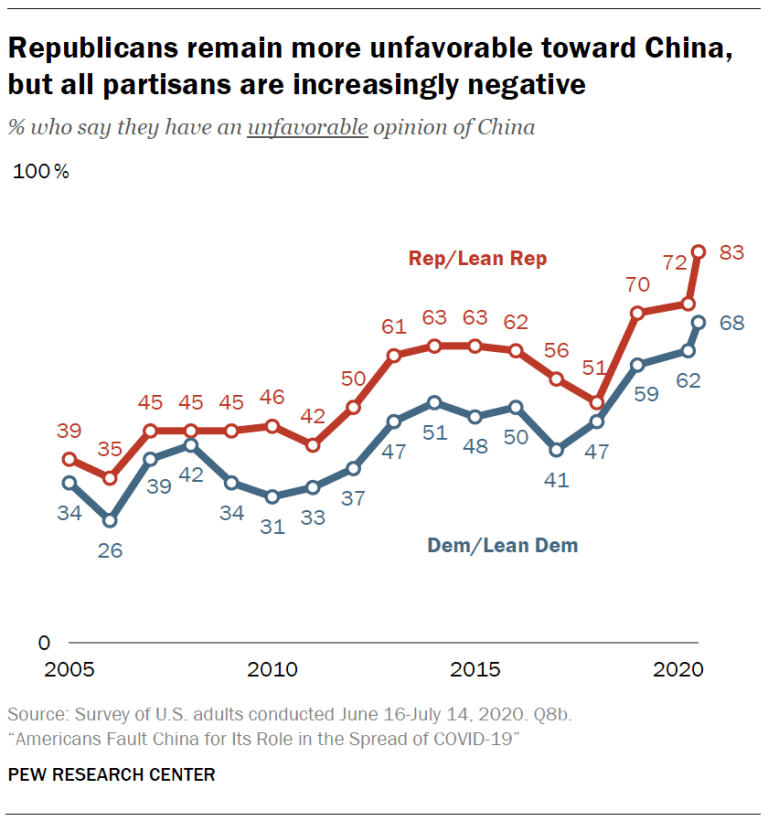
Crucially, this skeptical view toward China was shared by both parties, suggesting that a Biden presidency may not usher in a golden age of cooperation between the two countries.
Source: Pew Research Center
In the words of Jin Canrong, associate dean of the School of International Studies at the Renmin University of China in Beijing, ‘to contain and confront China is a strategic consensus between the two parties of the US.’
So, what can we expect from the planet’s most important economic relationship in 2021 and beyond?
Reading the tea leaves, it appears that US policy may shift more toward multi-lateral containment of China, rather than direct economic conflict. For example, Biden’s team is more likely to reach out to traditional democratic allies in the region, appealing to the importance of shared values around human rights, democratic principles and market economies in an attempt to limit China’s expansion. The campaign could even use the removal of Trump’s tariffs as a possible ‘bargaining chip’ in negotiations moving forward.
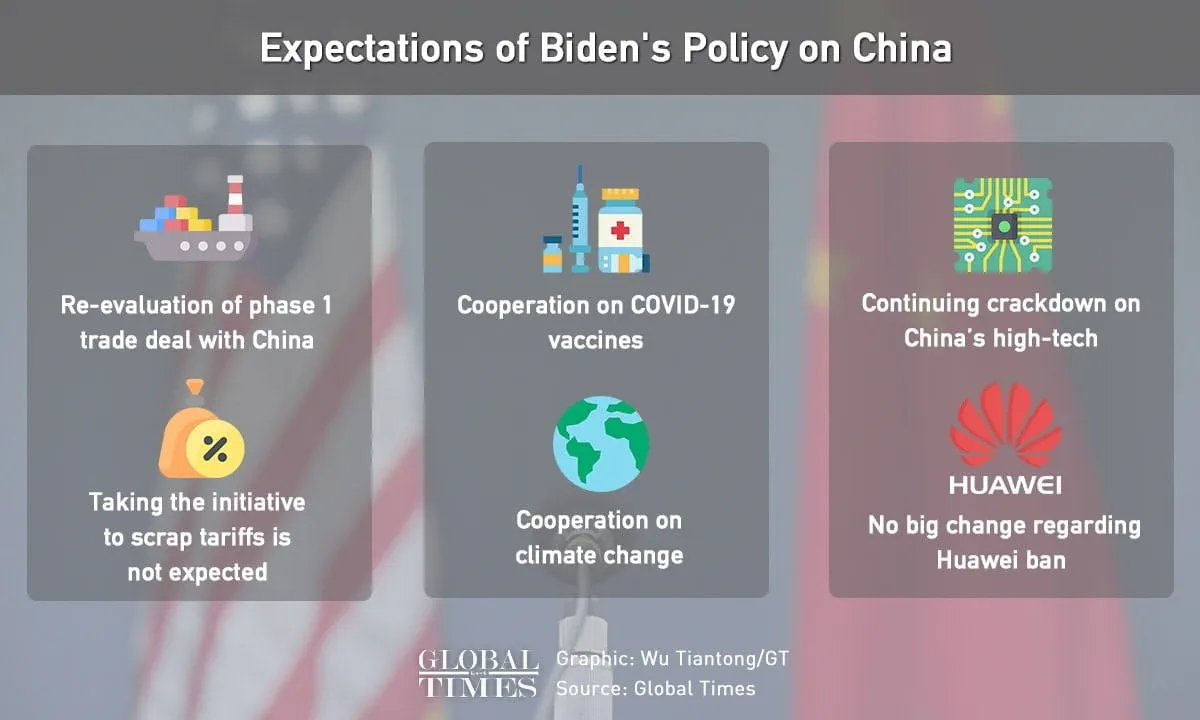
Of course, China will likely view any such policies as interference into its domestic affairs, so we wouldn’t expect a sudden shift toward a close alliance any time soon. That said, there may still be limited opportunities for the two powers to cooperate on global issues such as vaccine distribution and climate change. The graphic below highlights the expectations for some of the high-profile conflicts between the two nations.
Source: Global Times
Potential market impact
While these geopolitical narratives will certainly have a major impact on relations and trade between the US and China in years to come, perhaps the biggest factor impacting trade volume between the two nations will be the exchange rate itself.
From a purely mechanical perspective, a decrease in the value of one currency relative to another makes that country’s exports more affordable and appealing. Since mid-2020, the US dollar has depreciated in general and fallen sharply against the Chinese yuan in particular. After averaging around 7.05 over the previous year, USD/CNH has consistently traded lower in the second half of 2020 to trade down around 6.55 as of writing in mid-November.
Source: TradingView, GAIN Capital
All else equal, this ~10% depreciation in the value of the US dollar (if maintained) could boost US exports to China by more than the four-year-and-counting trade war. So far, there’s been no sign that Chinese policymakers are uncomfortable with the strength of the yuan, noting that the strong currency reflects the country’s world-leading COVID-19 containment and the relatively high interest rates offered on government debt. The signing of the massive Regional Comprehensive Economic Partnership (RCEP) trade deal spanning 15 countries, 2.2 billion people, and $26 trillion of economic output has also helped boost asset prices in China and the broader Asia-Pacific region.
Moving forward, Chinese authorities may still look to slow the renminbi’s appreciation as one of many international negotiating levers, but as long as China’s currency remains relatively strong, it may reduce the urgency for US authorities to increase economic pressure on the Middle Kingdom.
As we’ve seen over the past four years, the US-China exchange rate can serve as a real-time indicator of the international tensions between the US and China, so USD/CNH will be one of the most important markets to watch into 2021 and beyond.
Be sure to check out the rest of our “big picture” 2021 Outlook pieces, including a look at the market implications of the COVID-19 vaccine, whether anything can derail the “Big 5” US technology stocks, the fallout from Joe Biden’s Presidential victory, the outlook for UK and EU markets following Brexit, and a look at the long-term fallout of rampant government deficits and debt.
Be sure to check out the rest of our “big picture” 2021 Outlook pieces, including a look at the market implications of the COVID-19 vaccine, whether anything can derail the “Big 5” US technology stocks, the fallout from Joe Biden’s Presidential victory, the outlook for UK and EU markets following Brexit, and a look at the long-term fallout of rampant government deficits and debt.
There are no two ways about it: relations between the US and China, the world’s two largest economies, deteriorated dramatically under outgoing President Donald Trump’s watch.
As a brief summary, Trump cast doubt on the sacred “One China” policy before even taking up residence in the White House, followed that afront with a series of tit-for-tat tariffs that eventually erupted into a full ‘trade war’ impacting over $300B in Chinese exports, and completed his Presidency by repeatedly blaming the country for its handling of the COVID-19 (“China Virus”) pandemic. As he leaves office, some political observers believe that a new ‘Cold War’ is emerging between the two nations.
So now that Trump is on his way out, surely the US and China will be able to repair their strained relationship, right? Unfortunately, it’s not that simple.
While the Trump administration was particularly aggressive and bellicose toward the Middle Kingdom, his actions were reflective of a populace with generally unfavourable views of China. According to a recent Pew Research Center poll, nearly three-quarters of US adults (73%) had an unfavourable view of China, a figure that has risen dramatically since 2018.
Source: Pew Research Center
Crucially, this skeptical view toward China was shared by both parties, suggesting that a Biden presidency may not usher in a golden age of cooperation between the two countries.
Source: Pew Research Center
In the words of Jin Canrong, associate dean of the School of International Studies at the Renmin University of China in Beijing, ‘to contain and confront China is a strategic consensus between the two parties of the US.’
So, what can we expect from the planet’s most important economic relationship in 2021 and beyond?
Reading the tea leaves, it appears that US policy may shift more toward multi-lateral containment of China, rather than direct economic conflict. For example, Biden’s team is more likely to reach out to traditional democratic allies in the region, appealing to the importance of shared values around human rights, democratic principles and market economies in an attempt to limit China’s expansion. The campaign could even use the removal of Trump’s tariffs as a possible ‘bargaining chip’ in negotiations moving forward.
Of course, China will likely view any such policies as interference into its domestic affairs, so we wouldn’t expect a sudden shift toward a close alliance any time soon. That said, there may still be limited opportunities for the two powers to cooperate on global issues such as vaccine distribution and climate change. The graphic below highlights the expectations for some of the high-profile conflicts between the two nations.
Source: Global Times
Potential market impact
While these geopolitical narratives will certainly have a major impact on relations and trade between the US and China in years to come, perhaps the biggest factor impacting trade volume between the two nations will be the exchange rate itself.
From a purely mechanical perspective, a decrease in the value of one currency relative to another makes that country’s exports more affordable and appealing. Since mid-2020, the US dollar has depreciated in general and fallen sharply against the Chinese yuan in particular. After averaging around 7.05 over the previous year, USD/CNH has consistently traded lower in the second half of 2020 to trade down around 6.55 as of writing in mid-November.
Source: TradingView, GAIN Capital
All else equal, this ~10% depreciation in the value of the US dollar (if maintained) could boost US exports to China by more than the four-year-and-counting trade war. So far, there’s been no sign that Chinese policymakers are uncomfortable with the strength of the yuan, noting that the strong currency reflects the country’s world-leading COVID-19 containment and the relatively high interest rates offered on government debt. The signing of the massive Regional Comprehensive Economic Partnership (RCEP) trade deal spanning 15 countries, 2.2 billion people, and $26 trillion of economic output has also helped boost asset prices in China and the broader Asia-Pacific region.
Moving forward, Chinese authorities may still look to slow the renminbi’s appreciation as one of many international negotiating levers, but as long as China’s currency remains relatively strong, it may reduce the urgency for US authorities to increase economic pressure on the Middle Kingdom.
As we’ve seen over the past four years, the US-China exchange rate can serve as a real-time indicator of the international tensions between the US and China, so USD/CNH will be one of the most important markets to watch into 2021 and beyond.
Be sure to check out the rest of our “big picture” 2021 Outlook pieces, including a look at the market implications of the COVID-19 vaccine, whether anything can derail the “Big 5” US technology stocks, the fallout from Joe Biden’s Presidential victory, the outlook for UK and EU markets following Brexit, and a look at the long-term fallout of rampant government deficits and debt.
Related tags:




The complete CFD trading experience
Award-winning platforms, competitive spreads, low commissions and dedicated support.
We live and breathe the markets and are dedicated to helping traders realise their ambitions as we continue to set the industry bar.
Economic calendar
Web Trader platform
Our sophisticated web-based platform is packed with features.
Related articles

Silver Analysis Can XAGUSD hold above the 85 level
Recent price action in silver has been particularly relevant, as over the last five trading sessions XAG/USD has posted a significant gain, accumulating an increase of more than 18% over this period.


USD/CNH Forecast: New Year, Same Yu-an Strength
USD/CNH has been trending consistently lower within a bearish channel since the start of November, falling 2500 pips from near 7.14 to closer to 6.88 now – what are the levels to watch next?

US Dollar Forecast: USD Falls, USD/CNH Nears 1-Year Highs on US-China Optimism
After US and Chinese lieutenants agreed to a “preliminary framework deal” over the weekend, USD/CNH bears have the upper hand for the moment, with a break below bullish trend line support potentially exposing the pair’s one-year low near 7.09 next.
StoneX Europe Ltd may make third party material available on this website which may contain information included but not limited to the conditions of financial markets. The material is for information purposes only and does not contain, and should not be construed as containing, investment advice and/or investment recommendation and/or an investment research and/or an offer of or solicitation for any transactions in financial instruments; any decision to enter into a specific transaction shall be made by the client following an assessment by him/her of their situation.
StoneX Europe Ltd makes no representation or warranty and assumes no liability as to the accuracy or completeness of the information provided, nor any loss arising from any investment based on a recommendation, forecast or other information supplied. You should always seek independent advice as to your suitability to speculate in any related markets and your ability to assume the associated risks, if you are at all unsure. We are not under any obligation to update any such material. Any opinion made may be personal to the author and may not reflect the opinion of StoneX Europe Ltd.