


Australian Dollar Outlook: RBA Rate Decision and AUD/USD Pullback Risks
The RBA decision, rising oil prices and shifting sentiment could test the Australian dollar, with AUD/USD showing signs of a potential pullback.
Share this:

The Australian dollar faces a pivotal week as traders weigh the Reserve Bank of Australia’s rate decision alongside rising geopolitical risks and surging oil prices. While the Aussie has held up relatively well despite risk-off flows, technical signals and positioning data suggest momentum may be turning. With several major central banks also meeting this week, volatility across FX markets could rise as traders reassess the outlook for interest rates and global growth.
View related analysis:
View related analysis:
Australian Dollar Performance
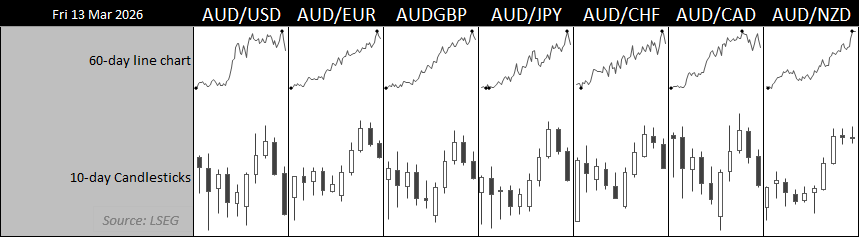
- The US dollar remained supreme in the face of geopolitical uncertainty last week and was the only major currency the Australian dollar did not rise against
- AUD/USD fell 0.7%, closing below 70c for the first time in six weeks, with all of the week’s losses arriving on Thursday and Friday
- AUD/NZD rose to a fresh 13-year high, closing the week just shy of 1.21
- AUD/CAD formed a volatile shooting star week and marked another failed break above 0.97
- AUD/JPY formed a shooting star week near 114, warning of potential near-term weakness within its otherwise strong trend
- EUR/AUD fell for a twelfth consecutive week, its most bearish run on record
- GBP/AUD formed a bullish outside week, hinting at potential weakness in the broader bearish trend ahead of this week’s RBA and BOE meetings
Source: LSEG
Australia This Week: Economic Data and Events for AUD/USD Traders
RBA Decision Looms as Oil Shock Complicates Rate Outlook
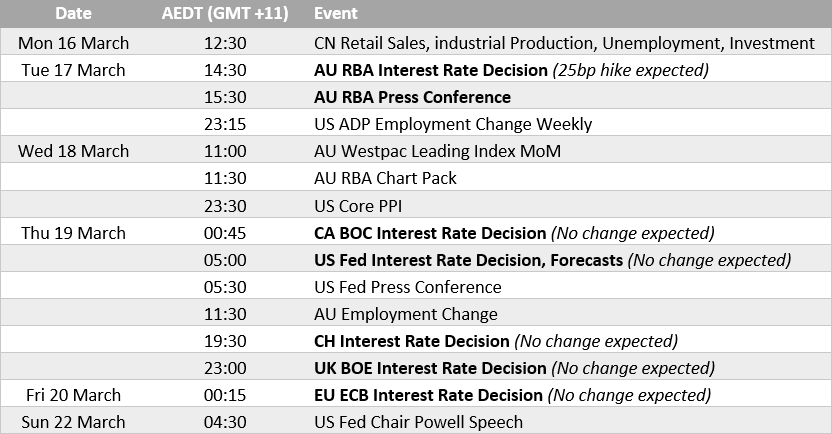
The Reserve Bank of Australia meets on Tuesday with markets debating whether policymakers will follow February’s hawkish pivot with another rate hike. The balance of risks suggests a hike is more likely — though not guaranteed.
Inflation remains above the RBA’s target band, underlying measures are proving sticky, and the labour market continues to show resilience. Growth also surprised slightly to the upside in late 2025, reinforcing the view that demand has not slowed enough to comfortably bring inflation back to target.
However, the wildcard is the Middle East conflict and its impact on global energy prices. The sharp surge in crude oil raises the risk of renewed inflation pressure through higher fuel and transport costs. At the same time, an energy shock can act as a tax on growth, potentially weakening consumer demand.
This leaves the RBA facing a delicate balance. Policymakers may prefer to tighten sooner if they believe higher oil prices could reignite inflation expectations. But if the Board views the shock as temporary, it may opt to wait for greater clarity before moving again.
For now, a 25bp hike seems likely, though I doubt the RBA will want to commit top another hike at this meeting. And that could help prompt a deeper pullback on the Australian dollar.
Central Bank Meeting Galore, Though Holds Seem Likely
While several major central banks meet this week, most are expected to leave policy unchanged. That said, the meetings remain worth watching in case one of them surprises.
As mentioned, the RBA is the main exception and is expected to hike on Tuesday, while the SNB and ECB are both likely to hold on Wednesday. However, the SNB may reiterate that it remains willing to intervene in currency markets if necessary.
The BOC appears to have ended its easing cycle, although it may still be too soon for policymakers to signal any shift towards tightening. The Bank of Japan is also expected to stand pat on Thursday, though a surprise hike could trigger volatility.
If the BOE were to surprise, it would more likely be with a cut — but for now, a hold remains the most probable outcome.
A Fed hold is practically a given, though traders will keep a close eye on updated SEP (staff economic projections). But the FOMC dot plot is likely to be less dovish, if there is any change at all.
Australia This Week: Economic Data and Events for AUD/USD Traders


AUD/USD Futures Positioning | COT Report
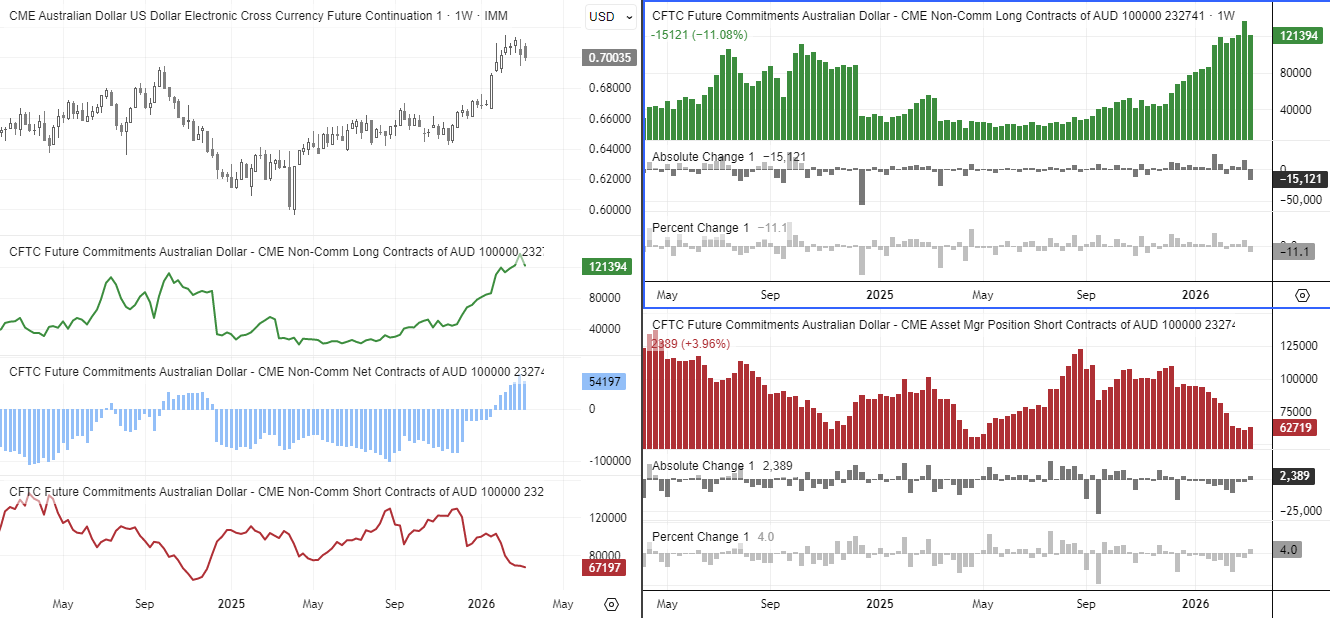
Net-long exposure finally tapered off last week on AUD/USD futures, primarily due to a closure of longs. Large speculators reduced longs by 15.1k contracts (-11%), seeing net-long exposure fall for the first time since flipping to bullish exposure six weeks ago.
Asset managers only trimmed longs by 3.1k contracts (-3.5%), although they also increased shorts by 2.4k contracts (+4%). While this hardly paints a compellingly bearish picture for the Australian dollar, it does reinforce growing calls for a pullback.
The Aussie has remained resilient despite the risk-off flows of the past two weeks, supported by rising commodities and expectations of a hawkish RBA, while risk appetite remains pressured by developments in the Middle East.
Source: CFTC, CME, LSEG
AUD/USD Correlations
The Aussie’s correlation with the Chinese yuan and copper has returned over the past two weeks, likely as an indirect consequence of Middle East tensions. While AUD/USD has also maintained a strong inverse correlation with crude oil, it could be argued the pair has held up relatively well despite the surge in oil prices.
With the US dollar becoming the safe-haven currency of choice for traders amid the Iran war, AUD/USD has retained its strong inverse correlation with the US dollar index overall.
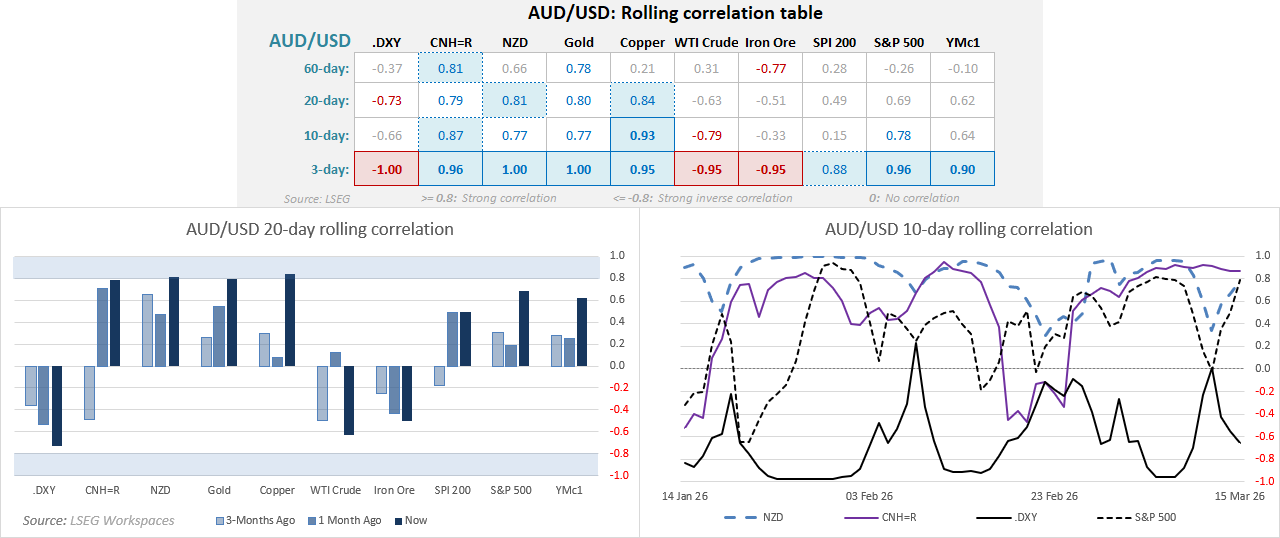
Chart prepared by Matt Simpson - Source: LSEG
AUD/USD Technical Analysis: Australian Dollar vs US Dollar
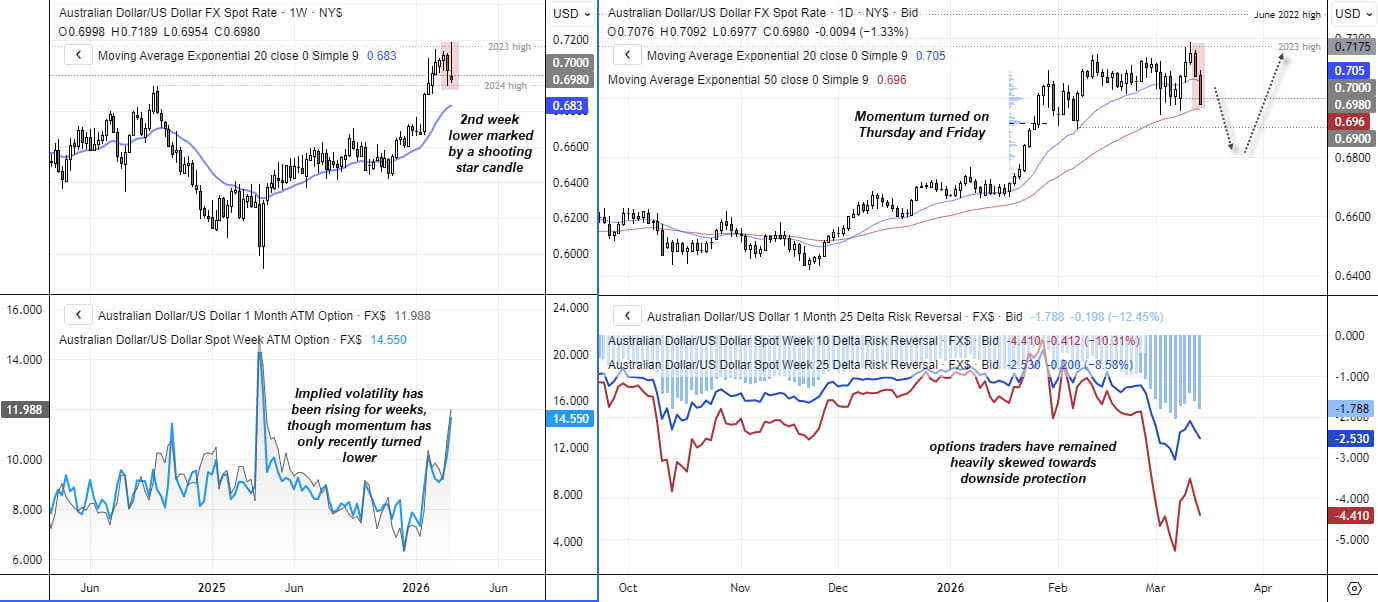
Implied volatility has risen to its highest level since April, yet the Aussie has remained above 69c regardless. Still, hints of a reversal have continued to build. A shooting star week saw AUD/USD close below 70c following a false break of its 2023 high, marking its second consecutive week lower.
Note that bearish momentum has noticeably picked up over the past two days, which to me suggests a top may now be in place. Risk reversals are also showing a renewed preference for puts over calls, and options traders have been heavily skewed towards downside protection for several weeks despite the Aussie’s ability to remain stubbornly high.
With price action now hinting at a top and the potential for the RBA to deliver a lukewarm hike, AUD/USD could come under pressure this week. The recent pickup in bearish momentum suggests traders may already be positioning for a pullback — particularly if oil prices remain elevated amid geopolitically driven headlines from the Middle East.
Source: ICE, TradingView
View the full economic calendar
View the full economic calendar
-- Written by Matt Simpson
Follow Matt on Twitter @cLeverEdge
How to trade with City Index
You can trade with City Index by following these four easy steps:
- Open an account, or log in if you’re already a customer
• Open an account in the UK
• Open an account in Australia
• Open an account in Singapore
- Search for the market you want to trade in our award-winning platform
- Choose your position and size, and your stop and limit levels
- Place the trade




Open an account in minutes
Experience award-winning platforms with fast and secure execution, and enjoy tight spreads from 0.5 pts on FX and 0.3 pts on indices.
Economic calendar
Web Trader platform
Our sophisticated web-based platform is packed with features.
Related articles
Australian Dollar Outlook: AUD/USD Screams Sentiment Extreme Into Fed, CPI
AUD/USD rebounds despite record bearish futures positioning, with Australian Q3 CPI and the Fed meeting threatening to trigger another short squeeze.
Australian Dollar Forecast: AUD/USD Support Reversal Sparks Monthly Range Breakout 10 23 2026
A sharp reversal off key support has fueled the AUD/USD recovery, with resistance now in focus ahead of next week’s Fed decision and Australian CPI.


Japanese Yen Surges Across FX Majors as Risk Aversion Intensifies
Safe-haven demand sent the Japanese yen higher across FX majors, while USD/JPY broke lower ahead of Japan's CPI release and next week's BOJ meeting.
This report is intended for general circulation only. It should not be construed as a recommendation, or an offer (or solicitation of an offer) to buy or sell any financial products. The information provided does not take into account your specific investment objectives, financial situation or particular needs. Before you act on any recommendation that may be contained in this report, independent advice ought to be sought from a financial adviser regarding the suitability of the investment product, taking into account your specific investment objectives, financial situation or particular needs.
StoneX Financial Pte. Ltd., may distribute reports produced by its respective foreign entities or affiliates within the StoneX group of companies or third parties pursuant to an arrangement under Regulation 32C of the Financial Advisers Regulations. Where the report is distributed to a person in Singapore who is not an accredited investor, expert investor or an institutional investor (as defined in the Securities Futures Act), StoneX Financial Pte. Ltd. accepts legal responsibility to such persons for the contents of the report only to the extent required by law. Singapore recipients should contact StoneX Financial Pte. Ltd. at 6826 9988 for matters arising from, or in connection with the report.
In the case of all other recipients of this report, to the extent permitted by applicable laws and regulations neither StoneX Financial Pte. Ltd. nor its associated companies will be responsible or liable for any loss or damage incurred arising out of, or in connection with, any use of the information contained in this report and all such liability is hereby expressly disclaimed. No representation or warranty is made, express or implied, that the content of this report is complete or accurate.
StoneX Financial Pte. Ltd. is not under any obligation to update this report.
Trading CFDs carries a high level of risk that may not be suitable for some investors. Consider your investment objectives, level of experience, financial resources, risk appetite and other relevant circumstances carefully. The possibility exists that you could lose some or all of your investments, including your initial deposits. If in doubt, please seek independent expert advice. Visit www.forex.com/en-sg/terms-and-policies for the complete Risk Disclosure Statement.