



EUR/USD Forecast: Euro starts the week with strength
The trading week begins with EUR/USD showing signs of short-term strength, posting a gain of more than 0.4% during the first session. This move has started to suggest a new short-term bullish bias, mainly driven by progress in Middle East negotiations and the decline in US bond yields.
Share this:

The trading week begins with EUR/USD showing signs of short-term strength, posting a gain of more than 0.4% during the first session. This move has started to suggest a new short-term bullish bias, mainly driven by progress in Middle East negotiations and the decline in US bond yields.
These factors have started to weaken the US dollar, supporting the euro’s advance. If this dynamic continues, more relevant buying pressure could remain part of EUR/USD price action over the coming trading sessions.


Potential peace agreement?
The weekend was relevant for potential peace negotiations in the Middle East, after President Trump said on Saturday that progress had been made on a memorandum of understanding for a possible agreement. Although Iran still has pending conditions, such as the release of billions of dollars in frozen funds held in foreign banks, the country is believed to be willing, at least initially, to support a significant opening of the Strait of Hormuz, through which more than 20% of global oil trade passes.
This event has triggered strong corrections in oil prices. Brent fell below the $100 area, marking its lowest level in two weeks, which has reduced part of the global inflation uncertainty and geopolitical premium. As a result, demand for the US dollar as a safe-haven currency has also started to moderate.
In fact, DXY, which measures the strength of the dollar against its main rivals, opened the week with a decline of -0.24%, moving back below the 99-point area and showing a short-term downward slope. This suggests that demand for US dollars has started to moderate.
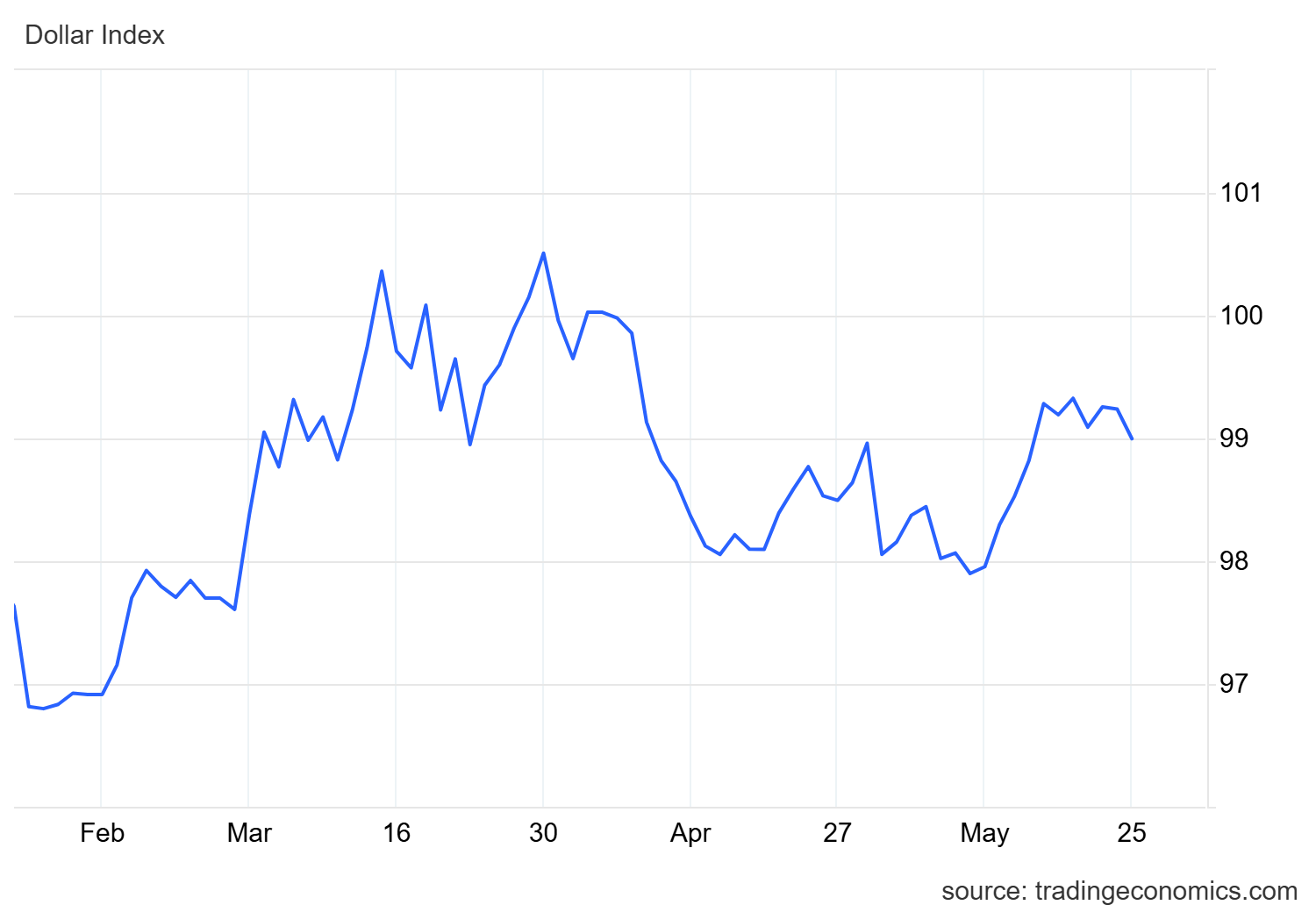
Source: TradingEconomics
This scenario is positive for the euro, as renewed hopes for a peace agreement have reduced demand for its main rival, the US dollar. This has allowed the euro to gain ground more consistently in the short term. If this confidence environment holds and the dollar continues to weaken, EUR/USD could continue to show important buying pressure in the coming sessions.
Is the central bank dynamic changing?
Another important factor is that the potential reduction in global uncertainty has also started to shift expectations around the Federal Reserve, one of the main drivers supporting the dollar in recent weeks. Now, the CME Group probability table points to a calmer central bank throughout the year, as markets now expect rates to remain unchanged until December.
A potential rate hike is now being priced for March 2027, with a probability above 40%. This is relevant because, just a few weeks ago, that same probability was being assigned to December of the current year, showing that the market no longer expects a rate increase as soon as before.
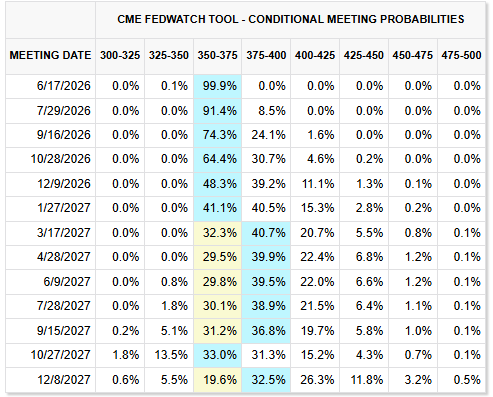
Source: CMEGROUP
This dynamic has started to weaken US 10-year bond yields, which have now fallen below the 4.6% area. The loss of momentum in yields reduces the global appeal of these instruments and may also be affecting demand for US dollars in recent sessions.
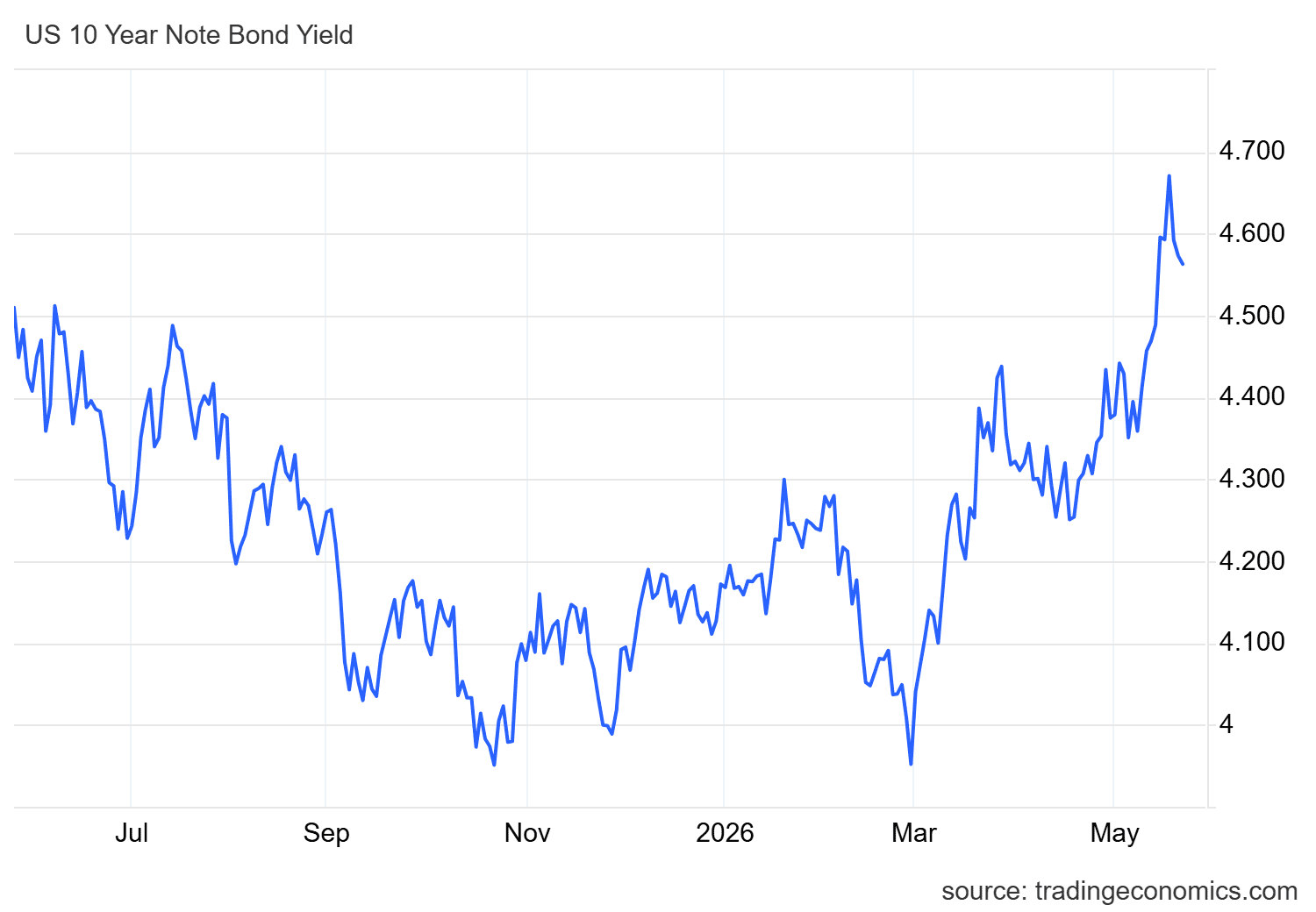
Fuente: TradingEconomics
With this in mind, the loss of demand for the dollar is not only linked to greater confidence around the Middle East, but also to the shift in expectations around the Federal Reserve. If the US central bank maintains a no-change rate stance over the coming months, the dollar could continue to show consistent neutrality, which could favor buying pressure in EUR/USD over the medium term.
Technical outlook for EUR/USD
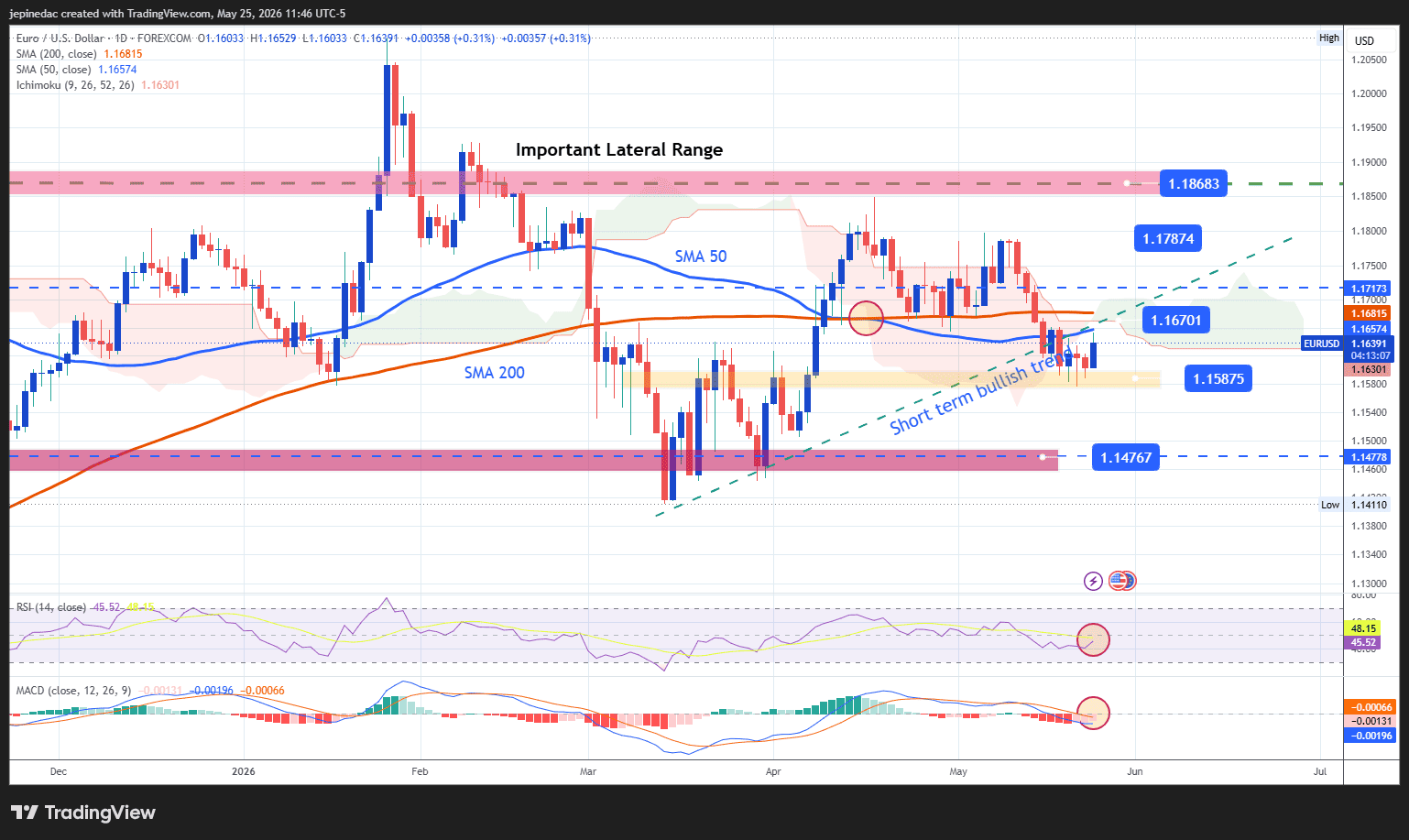
Source: StoneX, Tradingview
- Broad sideways range remains dominant: Despite EUR/USD’s attempts to form more consistent trends in recent weeks, prices have not been able to maintain a clear direction. For now, a broad sideways range continues to dominate between resistance at 1.18683 and support at 1.14767. If prices fail to break out of this area, it will be difficult to see the formation of a stronger medium-term trendline.
- RSI: Now, the RSI line has attempted to return toward the neutral 50 area, suggesting a balance between buying and selling momentum. This behavior indicates that a phase of neutrality could remain present in the short term if current buying pressure fails to stabilize.
- MACD: A similar scenario can be seen in the MACD, as the histogram remains close to the 0 line. This suggests a balance in the strength of short-term moving averages and also highlights the relevance of the indecision phase that has started to form in the market.
Key levels:
- 1.17874 – Relevant resistance: This level corresponds to current highs and stands as the most important upside barrier to watch. Price movements toward this zone could highlight a new buying bias and bring back relevance to the bullish trendline that attempted to form weeks ago, once again challenging the sideways range.
- 1.16701 – Near-term barrier: A neutral level that coincides with the 50- and 200-period moving averages, making it one of the most relevant areas to monitor in the short term. Price movements too close to this level could extend the neutrality phase and keep the broad sideways range that has dominated for months in place.
- 1.15875 – Definitive support: A nearby support level that acts as an important retracement zone for price action. Moves below this level could open the door to a more dominant selling bias, capable of challenging the lower part of the broad sideways range in the coming sessions.
Written by Julian Pineda, CFA, CMT – Market Analyst
Follow him on: @julianpineda25


Open an account in minutes
Experience award-winning platforms with fast and secure execution, and enjoy tight spreads from 0.5 pts on FX and 0.3 pts on indices.
Economic calendar
Web Trader platform
Our sophisticated web-based platform is packed with features.
Related articles
USD/JPY weekly outlook: Quarter turn scrambles rates regime
USD/JPY’s tight relationship with front-end US rates broke down sharply last week, but quarter-turn flows and positioning suggest the disconnect may prove temporary.

USD/CAD forecast: rally could accelerate above June highs at 1.4250
USD/CAD recovered quickly after weaker US jobs data, keeping the bullish trend in focus. A move above the June highs could accelerate the rally as inflation keeps the Fed under pressure.


USD Sets Fresh Yearly High as EUR/USD Drops Dramatically, USD/JPY Stable
Well, it was a week of USD strength that wasn’t entirely pushed by USD/JPY, as a strong sell-off in EUR/USD has pushed the major pair to its most oversold state in a decade.

This report is intended for general circulation only. It should not be construed as a recommendation, or an offer (or solicitation of an offer) to buy or sell any financial products. The information provided does not take into account your specific investment objectives, financial situation or particular needs. Before you act on any recommendation that may be contained in this report, independent advice ought to be sought from a financial adviser regarding the suitability of the investment product, taking into account your specific investment objectives, financial situation or particular needs.
StoneX Financial Pte. Ltd., may distribute reports produced by its respective foreign entities or affiliates within the StoneX group of companies or third parties pursuant to an arrangement under Regulation 32C of the Financial Advisers Regulations. Where the report is distributed to a person in Singapore who is not an accredited investor, expert investor or an institutional investor (as defined in the Securities Futures Act), StoneX Financial Pte. Ltd. accepts legal responsibility to such persons for the contents of the report only to the extent required by law. Singapore recipients should contact StoneX Financial Pte. Ltd. at 6826 9988 for matters arising from, or in connection with the report.
In the case of all other recipients of this report, to the extent permitted by applicable laws and regulations neither StoneX Financial Pte. Ltd. nor its associated companies will be responsible or liable for any loss or damage incurred arising out of, or in connection with, any use of the information contained in this report and all such liability is hereby expressly disclaimed. No representation or warranty is made, express or implied, that the content of this report is complete or accurate.
StoneX Financial Pte. Ltd. is not under any obligation to update this report.
Trading CFDs carries a high level of risk that may not be suitable for some investors. Consider your investment objectives, level of experience, financial resources, risk appetite and other relevant circumstances carefully. The possibility exists that you could lose some or all of your investments, including your initial deposits. If in doubt, please seek independent expert advice. Visit www.forex.com/en-sg/terms-and-policies for the complete Risk Disclosure Statement.