


Senate Moves to End Longest U.S. Government Shutdown in History
On its 41st day, the Senate appears on the brink of reopening the US government this week
Share this:

Key Takeaways: Longest-Ever U.S. Government Shutdown Nears Its End
- The U.S. government shutdown began on October 1 and is now in its 41st day — the longest in U.S. history.
- The Senate’s bipartisan funding bill could be passed early this week, followed by a House vote by Wednesday.
- If President Trump signs the bill, agencies could begin reopening by Friday U.S. time (Saturday AEST).
- Economic data flow won’t normalise immediately — expect a two-to-three-week lag for major reports such as NFP, GDP, and CPI.
- Traders will focus on the first major data releases for clues on the Federal Reserve’s next move.
On October 1, the U.S. government began what has become its longest shutdown in history. As always, it didn’t come without warning, which helps explain why the market impact has been muted. That said, many had assumed it would reopen quickly — an assumption that’s now clearly been tested.
Since 1976, the U.S. government has shut down 22 times (including the current episode), with past closures ranging from one day to 35 days and averaging about eight days. If the Senate’s new funding bill passes and President Trump signs it in the coming days, this shutdown will have lasted at least 43 days, easily eclipsing the 35-day record from 2018–19.
The key question for traders now is when economic data will return.


View related analysis:
View related analysis:
When Could the U.S. Government Reopen?
The Senate has already advanced the funding bill, setting up a final vote. Assuming there are no last-minute amendments, the final Senate vote could take place late Monday or Tuesday (U.S. time).
If it passes with bipartisan support, the bill then heads to the House of Representatives. While the House is Republican-controlled, that doesn’t guarantee immediate passage — but the political pressure after a 40-day shutdown makes a swift vote likely. The House could pass it by Wednesday, clearing the way for the bill to reach the White House.
Once it lands on President Trump’s desk, he could sign it within hours, officially ending the shutdown. Federal agencies would then begin reopening the following business day — realistically by Friday U.S. time (Saturday AEST).
When Could Traders Expect Economic Data to Resume?
While a few high-priority data points — such as CPI — have trickled out through alternate sources or partial releases, most federal statistics remain on hold. Agencies including the Bureau of Labor Statistics (BLS), Census Bureau, and Bureau of Economic Analysis (BEA) have suspended normal data collection.
Once funding is restored, these agencies will need two to three weeks to restart operations, validate delayed inputs, and backfill major reports such as Nonfarm Payrolls, GDP, and JOLTS.
That means traders may not see a fully normalised U.S. data calendar until late November or early December — even if the government reopens this week. However, those data points will remain vulnerable to later revisions as agencies work through the backlog.
Still, after a six-week blackout, traders are likely to trade on whatever data they can get, even if it comes with caveats.


Which Economic Data Points Will Traders Priorities?
Traders will zero in on the big three: Nonfarm Payrolls, PCE inflation, and GDP. These are the cornerstone indicators that shape Federal Reserve expectations and drive volatility across currencies, bonds, and equities. With no fresh labour or inflation data for weeks, markets have been trading largely on sentiment and positioning — so the first full releases are likely to trigger outsized reactions. A stronger-than-expected payrolls rebound, for example, could quickly unwind Fed rate-cut bets that built up during the shutdown.
Beyond those headline prints, attention will shift to retail sales and JOLTS job openings to gauge underlying demand and wage pressure. But after a six-week data vacuum, traders will treat almost any high-impact release as a catalyst. Even typically second-tier reports like industrial production or housing starts could move markets more than usual until the economic calendar normalises.
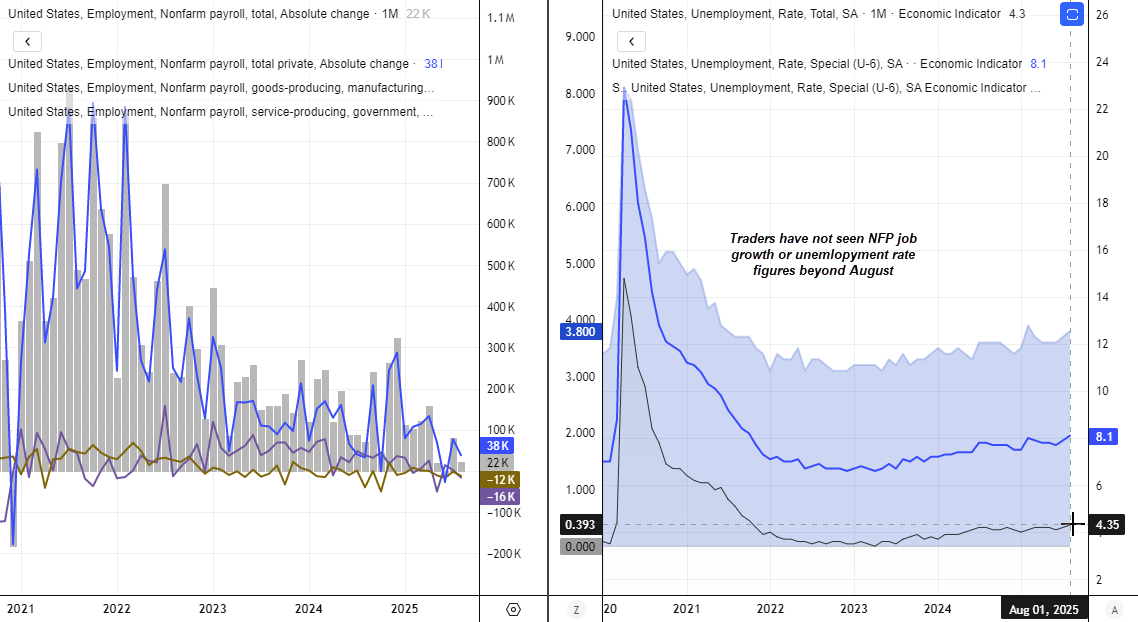
Chart prepared by Matt Simpson - data source:
Commitment of Traders (COT) Reports To Finally Return
A data set I’ve personally missed are the Commitment of Traders (COT) reports from the Commodity Futures Trading Commission (CFTC). Knowing the net long or short exposure helps traders monitor the strength of an underlying trend, identify divergences between price action and sentiment, and flag potential reversal zones when positioning reaches extremes.
The U.S. dollar index has climbed over the past six weeks during the COT data blackout, so it will be interesting to see whether net-short exposure has narrowed. If the upcoming data show that gross longs are rising, it could suggest there’s more to the dollar rally than just short covering.
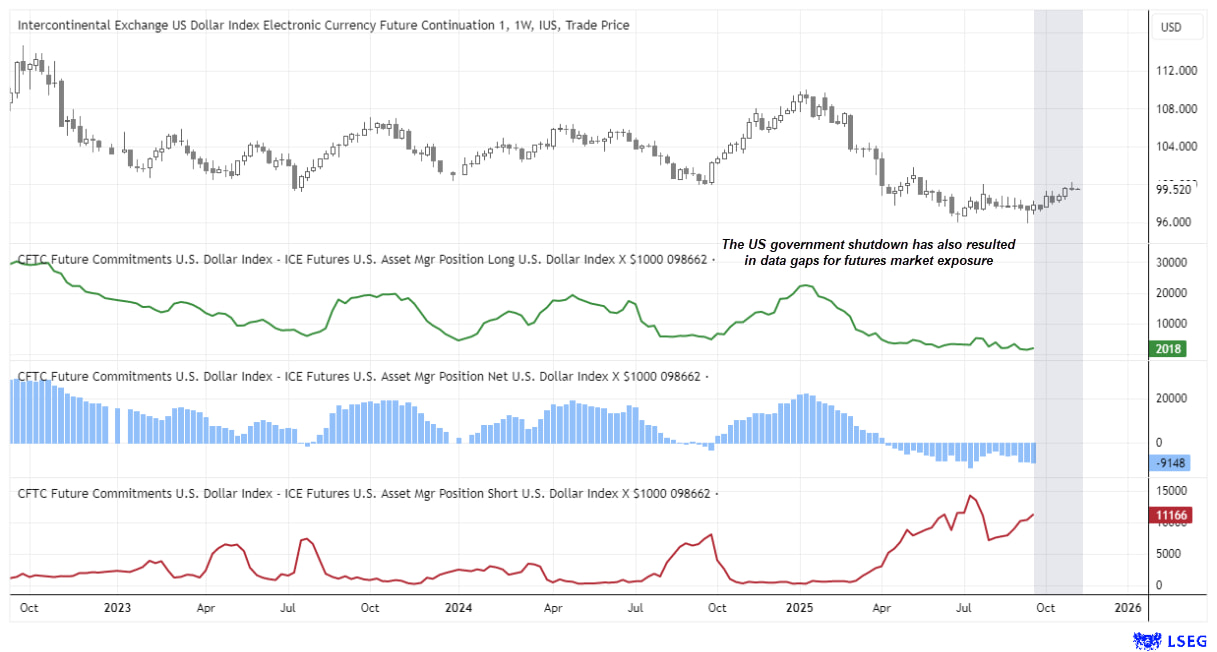
Chart prepared by Matt Simpson - data source: CFTC, LSEG
View the full economic calendar
View the full economic calendar
-- Written by Matt Simpson
Follow Matt on Twitter @cLeverEdge
How to trade with City Index
You can trade with City Index by following these four easy steps:
- Open an account, or log in if you’re already a customer
• Open an account in the UK
• Open an account in Australia
• Open an account in Singapore
- Search for the market you want to trade in our award-winning platform
- Choose your position and size, and your stop and limit levels
- Place the trade
Related tags:




Open an account in minutes
Experience award-winning platforms with fast and secure execution, and enjoy tight spreads from 0.5 pts on FX and 0.3 pts on indices.
Economic calendar
Web Trader platform
Our sophisticated web-based platform is packed with features.
Related articles

AUD/USD Outlook: Trump Address Could Trigger Breakout or Breakdown
AUD/USD at key levels ahead of Trump’s address. Will risk sentiment drive a breakout or extend the correction?

Gold Analysis XAUUSD moves back toward the 5200 zone following Trumps speech
Although price movements in previous sessions have been more moderate compared to earlier weeks, over the last four trading sessions gold has posted gains of more than 4%, with price once again approaching the $5,200 per ounce area.


Gold Bid at Highs as Trump Forces Tariff Debate Onto Davos’ Sidelines
Gold holds near record highs as Trump’s tariff threats lift geopolitical risk ahead of Davos, keeping dips in focus.
This report is intended for general circulation only. It should not be construed as a recommendation, or an offer (or solicitation of an offer) to buy or sell any financial products. The information provided does not take into account your specific investment objectives, financial situation or particular needs. Before you act on any recommendation that may be contained in this report, independent advice ought to be sought from a financial adviser regarding the suitability of the investment product, taking into account your specific investment objectives, financial situation or particular needs.
StoneX Financial Pte. Ltd., may distribute reports produced by its respective foreign entities or affiliates within the StoneX group of companies or third parties pursuant to an arrangement under Regulation 32C of the Financial Advisers Regulations. Where the report is distributed to a person in Singapore who is not an accredited investor, expert investor or an institutional investor (as defined in the Securities Futures Act), StoneX Financial Pte. Ltd. accepts legal responsibility to such persons for the contents of the report only to the extent required by law. Singapore recipients should contact StoneX Financial Pte. Ltd. at 6826 9988 for matters arising from, or in connection with the report.
In the case of all other recipients of this report, to the extent permitted by applicable laws and regulations neither StoneX Financial Pte. Ltd. nor its associated companies will be responsible or liable for any loss or damage incurred arising out of, or in connection with, any use of the information contained in this report and all such liability is hereby expressly disclaimed. No representation or warranty is made, express or implied, that the content of this report is complete or accurate.
StoneX Financial Pte. Ltd. is not under any obligation to update this report.
Trading CFDs carries a high level of risk that may not be suitable for some investors. Consider your investment objectives, level of experience, financial resources, risk appetite and other relevant circumstances carefully. The possibility exists that you could lose some or all of your investments, including your initial deposits. If in doubt, please seek independent expert advice. Visit www.forex.com/en-sg/terms-and-policies for the complete Risk Disclosure Statement.