




The Stocks Most Impacted by the 2020 US Presidential Election
How will the 2020 presidential pick impact specific stocks and the stock market as a whole? Read on to learn what stocks will be most affected come November.
Share this:

As we approach the 2020 election, you must be wondering: how will the elected candidate impact the stock market and certain key stocks in particular?
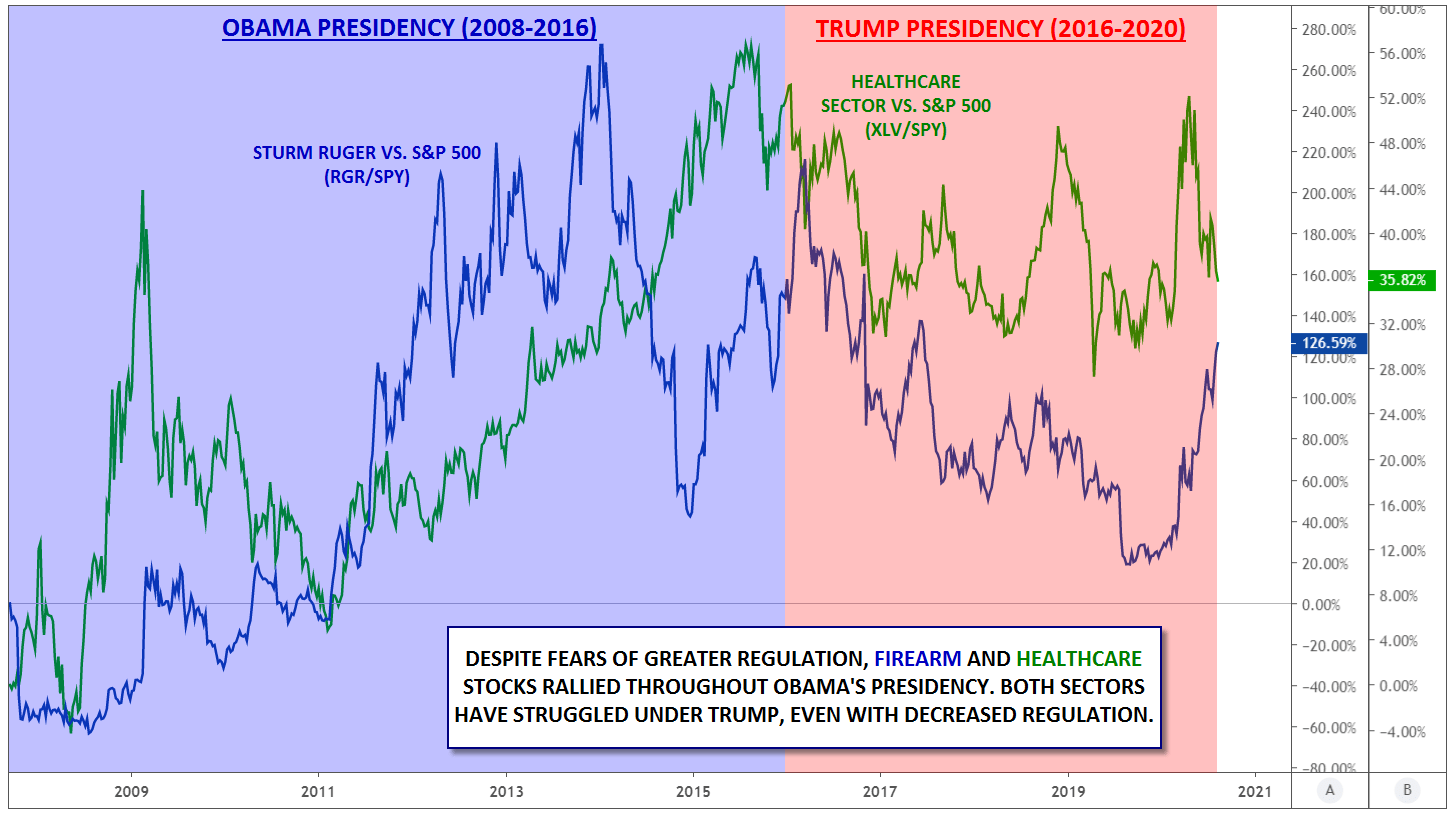
Experience tells us that it is a challenge to predict anything concrete about the impact of the upcoming election on specific stocks, and the specific stocks that thrive or struggle are often counterintuitive. For example, traders feared that the Obama Administration’s focus on gun control would hurt firearm stocks or that President Trump’s more “status quo” plan for healthcare would benefit medical stocks, at least relative to Hillary Clinton’s more dramatic proposal to overhaul the nation’s entire healthcare system. In both of those cases, the “logical” outcome was wrong: firearm manufacturers crushed the broader stock market throughout Obama’s presidency, whereas the healthcare sector is essentially performing in-line with the broader market since Election Day 2016:
Source: TradingView, GAIN Capital
Generally speaking, volatility in the S&P 500 is typically higher in election years compared to non-election years as traders weigh the ever-fluctuating polls and try to predict the political impact on their portfolios. According to JP Morgan, markets tend to react well to the election of a Republican president in the immediate aftermath of election day. Why is this the case? Generally speaking, Republican party policies are broadly thought to be more market friendly, though that reaction isn’t guaranteed; we don’t have to look back too far to see the stock market’s short-lived overnight dive as traders came to terms with President Trump’s surprise election night victory in 2016.
When it comes to this year’s election, economic volatility from policies will be most dramatic at a sector and industry level, rather than for the broad economy. Heading into Election Night 2020, there are several sectors that may see dramatic moves based on the results:
1) Healthcare: With presumptive Democratic nominee Joe Biden incorporating elements of former rival Bernie Sanders’ more substantial health care reform proposal (though crucially, not endorsing a full “Medicare for All” style overhaul) , the healthcare sector is poised for large policy-related moves. Despite his bluster to the contrary, President Trump has done little to further regulate big pharma firms in particular, so stocks like Johnson and Johnson (JNJ), Roche (ROG), Novartis (NVS), Merck (MRK), Abott Laboratories (ABT) and Amgen (AMGN) could benefit from a potential reelection of Donald Trump.
2) Energy: Democrats remain largely unified around the risks posed by climate change, and are therefore more likely to enact regulations on the fossil fuel industry and policies that promote clean energy adoption. As with Big Pharma names, another Trump victory could boost traditional energy conglomerates like Exxon Mobil (XOM), Royal Dutch Shell (RDS), Chevron (CVX), Total (TOT) and BP (BP).
3) Technology: Politicians on both sides of the aisle are growing increasingly antagonistic to the mega-cap technology firms that continue gobble up market share and embed themselves more deeply into every aspect of modern society. It’s difficult to handicap which party would be more likely to pursue aggressive antitrust actions against companies like Apple (AAPL), Amazon (AMZN), Facebook (FB), Alphabet (GOOG), or Netflix (NFLX), but either way, traders of all stripes will be watching this space closely. For what it’s worth, AAPL, AMZN, and NFLX are all up by more than 300% since the 2016 election, so bulls will definitely be hoping for more of the same in the coming four years!
4) Media: In another example of a counterintuitive outcome, media stocks have thrived despite (most) being labeled “fake news” by the current President. Stocks like AT&T (T), Twenty-First Century Fox (FOX), CBS (CBS) and Comcast (CMCSA) have all benefited from the population focusing more on current developments. These types of companies may struggle if Joe Biden wins and we see a “quieter” Commander-in-Chief over the next four years.
5) Marijuana: Relative to some of the more liberal Democratic candidates, Biden is seemingly lukewarm toward recreational marijuana, but the prospects of full legalization are nonetheless better under Biden than Trump, especially if the House of Representatives and/or Senate is also under Democratic control. In that case, stocks like Canopy Growth (CGC), GW Pharmaceuticals (GWPH), Curaleaf (CURL), Cronos Group (CRON), and Aurora Cannabis (ACB) could catch a bid, though the risk of a “buy the rumor, sell the news” event on either the election or potential signing of a federal legalization bill is possible.
As we noted, none of these situations are guaranteed to play out as expected, but policy risks are clearly elevated in both directions for the stocks highlighted above. While the drama of a presidential election is almost tailor-made for market volatility and trader overreactions, readers should ultimately watch how specific policies will impact certain sectors and companies to identify the strongest trading opportunities.
As you prepare to weather the coming storm, feel secure knowing City Index has a proven record of strength, security, and stability. Contact us today for more information on how to trade through the election and beyond with professional support.
As we approach the 2020 election, you must be wondering: how will the elected candidate impact the stock market and certain key stocks in particular?
Experience tells us that it is a challenge to predict anything concrete about the impact of the upcoming election on specific stocks, and the specific stocks that thrive or struggle are often counterintuitive. For example, traders feared that the Obama Administration’s focus on gun control would hurt firearm stocks or that President Trump’s more “status quo” plan for healthcare would benefit medical stocks, at least relative to Hillary Clinton’s more dramatic proposal to overhaul the nation’s entire healthcare system. In both of those cases, the “logical” outcome was wrong: firearm manufacturers crushed the broader stock market throughout Obama’s presidency, whereas the healthcare sector is essentially performing in-line with the broader market since Election Day 2016:
Source: TradingView, GAIN Capital
Generally speaking, volatility in the S&P 500 is typically higher in election years compared to non-election years as traders weigh the ever-fluctuating polls and try to predict the political impact on their portfolios. According to JP Morgan, markets tend to react well to the election of a Republican president in the immediate aftermath of election day. Why is this the case? Generally speaking, Republican party policies are broadly thought to be more market friendly, though that reaction isn’t guaranteed; we don’t have to look back too far to see the stock market’s short-lived overnight dive as traders came to terms with President Trump’s surprise election night victory in 2016.
When it comes to this year’s election, economic volatility from policies will be most dramatic at a sector and industry level, rather than for the broad economy. Heading into Election Night 2020, there are several sectors that may see dramatic moves based on the results:
1) Healthcare: With presumptive Democratic nominee Joe Biden incorporating elements of former rival Bernie Sanders’ more substantial health care reform proposal (though crucially, not endorsing a full “Medicare for All” style overhaul) , the healthcare sector is poised for large policy-related moves. Despite his bluster to the contrary, President Trump has done little to further regulate big pharma firms in particular, so stocks like Johnson and Johnson (JNJ), Roche (ROG), Novartis (NVS), Merck (MRK), Abott Laboratories (ABT) and Amgen (AMGN) could benefit from a potential reelection of Donald Trump.
2) Energy: Democrats remain largely unified around the risks posed by climate change, and are therefore more likely to enact regulations on the fossil fuel industry and policies that promote clean energy adoption. As with Big Pharma names, another Trump victory could boost traditional energy conglomerates like Exxon Mobil (XOM), Royal Dutch Shell (RDS), Chevron (CVX), Total (TOT) and BP (BP).
3) Technology: Politicians on both sides of the aisle are growing increasingly antagonistic to the mega-cap technology firms that continue gobble up market share and embed themselves more deeply into every aspect of modern society. It’s difficult to handicap which party would be more likely to pursue aggressive antitrust actions against companies like Apple (AAPL), Amazon (AMZN), Facebook (FB), Alphabet (GOOG), or Netflix (NFLX), but either way, traders of all stripes will be watching this space closely. For what it’s worth, AAPL, AMZN, and NFLX are all up by more than 300% since the 2016 election, so bulls will definitely be hoping for more of the same in the coming four years!
4) Media: In another example of a counterintuitive outcome, media stocks have thrived despite (most) being labeled “fake news” by the current President. Stocks like AT&T (T), Twenty-First Century Fox (FOX), CBS (CBS) and Comcast (CMCSA) have all benefited from the population focusing more on current developments. These types of companies may struggle if Joe Biden wins and we see a “quieter” Commander-in-Chief over the next four years.
5) Marijuana: Relative to some of the more liberal Democratic candidates, Biden is seemingly lukewarm toward recreational marijuana, but the prospects of full legalization are nonetheless better under Biden than Trump, especially if the House of Representatives and/or Senate is also under Democratic control. In that case, stocks like Canopy Growth (CGC), GW Pharmaceuticals (GWPH), Curaleaf (CURL), Cronos Group (CRON), and Aurora Cannabis (ACB) could catch a bid, though the risk of a “buy the rumor, sell the news” event on either the election or potential signing of a federal legalization bill is possible.
As we noted, none of these situations are guaranteed to play out as expected, but policy risks are clearly elevated in both directions for the stocks highlighted above. While the drama of a presidential election is almost tailor-made for market volatility and trader overreactions, readers should ultimately watch how specific policies will impact certain sectors and companies to identify the strongest trading opportunities.
As you prepare to weather the coming storm, feel secure knowing Forex.com has a proven record of strength, security, and stability. Contact us today for more information on how to trade through the election and beyond with professional support.



Open an account in minutes
Experience award-winning platforms with fast and secure execution, and enjoy tight spreads from 0.5 pts on FX and 0.3 pts on indices.
Economic calendar
Web Trader platform
Our sophisticated web-based platform is packed with features.
Related articles

S&P 500, Nasdaq, Dow Forecast: Rising Yields Test Rally Ahead of Nvidia, Fed 8 22 2026
S&P 500, Nasdaq and Dow test key technical levels as momentum fades, raising the risk of a deeper correction heading into a pivotal week.


Magnificent Seven Earnings Preview: Can Big Tech Reclaim AI Leadership?
The Magnificent Seven enter earnings with far more divided performance than in previous years, as investors increasingly distinguish between companies supplying the AI buildout and those funding it - what does that mean heading into earnings season?
USD/JPY unwind accelerates as GPIF headlines spark yen buying
Japanese assets are rallying after the government floated the prospect of the GPIF investing more heavily at home. While the proposal could have significant implications for global capital flows, it does not yet change the broader forces driving Japanese bond yields and USD/JPY.
This report is intended for general circulation only. It should not be construed as a recommendation, or an offer (or solicitation of an offer) to buy or sell any financial products. The information provided does not take into account your specific investment objectives, financial situation or particular needs. Before you act on any recommendation that may be contained in this report, independent advice ought to be sought from a financial adviser regarding the suitability of the investment product, taking into account your specific investment objectives, financial situation or particular needs.
StoneX Financial Pte. Ltd., may distribute reports produced by its respective foreign entities or affiliates within the StoneX group of companies or third parties pursuant to an arrangement under Regulation 32C of the Financial Advisers Regulations. Where the report is distributed to a person in Singapore who is not an accredited investor, expert investor or an institutional investor (as defined in the Securities Futures Act), StoneX Financial Pte. Ltd. accepts legal responsibility to such persons for the contents of the report only to the extent required by law. Singapore recipients should contact StoneX Financial Pte. Ltd. at 6826 9988 for matters arising from, or in connection with the report.
In the case of all other recipients of this report, to the extent permitted by applicable laws and regulations neither StoneX Financial Pte. Ltd. nor its associated companies will be responsible or liable for any loss or damage incurred arising out of, or in connection with, any use of the information contained in this report and all such liability is hereby expressly disclaimed. No representation or warranty is made, express or implied, that the content of this report is complete or accurate.
StoneX Financial Pte. Ltd. is not under any obligation to update this report.
Trading CFDs carries a high level of risk that may not be suitable for some investors. Consider your investment objectives, level of experience, financial resources, risk appetite and other relevant circumstances carefully. The possibility exists that you could lose some or all of your investments, including your initial deposits. If in doubt, please seek independent expert advice. Visit www.forex.com/en-sg/terms-and-policies for the complete Risk Disclosure Statement.