




FOMC Preview One or Two and Done
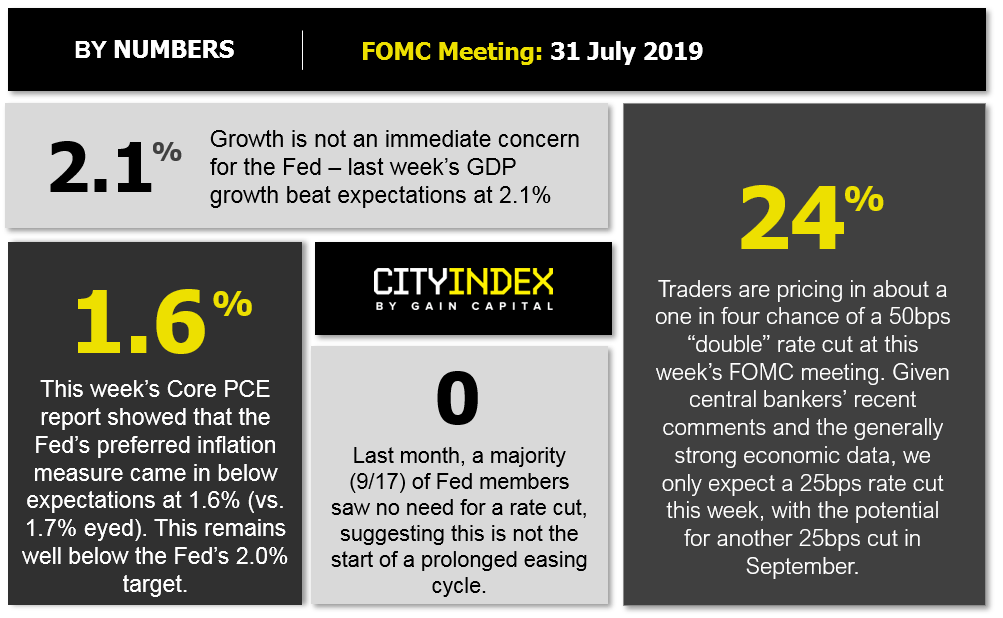
In order to support inflation, we expect the central bank to cut interest rates by just 25bps this week and leave the door open to another small cut in September. Beyond correcting the over-ambitious last rate hike or two from late last year, the Fed will likely prefer to remain on sidelines unless the economy takes a sharp turn lower.
Share this:

The Federal Reserve has been within its pre-meeting “blackout period” for more than a week now, but that restriction doesn’t apply to President Trump. Yesterday, the President tweeted that “quantitative tightening was a big mistake” and that the “Fed has made all of the wrong moves. A small rate cut is not enough…”
Of course, there’s a long history of political leaders trying to intervene into central bank policy. By contrast, less biased, more informed sources have recently argued for a more measured approach. Yesterday, former Fed Chairwoman Yellen endorsed a 25bps rate cut, but stated that she “wouldn’t see [it] as the beginning… of a major easing cycle.” Similarly, former New York Fed President Dudley wrote this morning that he thinks “there’s a good chance the Fed won’t be cutting further anytime soon” (after today). In other words, arguably the two people on the planet that are most well-connected to current Fed governors (and are legally allowed to speak about it) have both suggested that the Fed is likely to be conservative and is unlikely to embark on a prolonged easing cycle this week.
Meanwhile, the US economy continues to chug along at a steady, if unimpressive rate. Last week’s GDP report printed better than anticipated, showing 2.1% annualized growth in Q2, and more recent PMI figures remain among the strongest in the world, despite a small dip of late. The only sore spot for the Fed is inflation, which remains stubbornly below the central bank’s 2.0% target, with this morning’s Core PCE report printing at just 1.6% y/y.
Source: TradingView, City Index
In order to support inflation, we expect the central bank to cut interest rates by just 25bps this week and leave the door open to another small cut in September. Beyond correcting the over-ambitious last rate hike or two from late last year, the Fed will likely prefer to remain on sidelines unless the economy takes a sharp turn lower. Essentially, the central bank may opt for one or two “insurance cuts,” but the market should not view this as the start of a prolonged easing cycle yet.
Market Impact
A small rate cut will have only a limited impact on the US economy, which is balancing solid domestic growth against headwinds from global trade and geopolitical uncertainty.
By this point, the interest rate decision itself (assuming it’s for a 25bps cut) has already been discounted by the market, so the forward-looking outlook and the tone of Chairman Powell’s press conference will be the major driver for markets. As it stands, the market is expecting 3-4 interest rate reductions by this time next year; if the Fed is able to communicate a “one-(or two-)and-done” approach to rate cuts, the US dollar would likely rally, while US stocks may fall.
The Federal Reserve has been within its pre-meeting “blackout period” for more than a week now, but that restriction doesn’t apply to President Trump. Yesterday, the President tweeted that “quantitative tightening was a big mistake” and that the “Fed has made all of the wrong moves. A small rate cut is not enough…”
Of course, there’s a long history of political leaders trying to intervene into central bank policy. By contrast, less biased, more informed sources have recently argued for a more measured approach. Yesterday, former Fed Chairwoman Yellen endorsed a 25bps rate cut, but stated that she “wouldn’t see [it] as the beginning… of a major easing cycle.” Similarly, former New York Fed President Dudley wrote this morning that he thinks “there’s a good chance the Fed won’t be cutting further anytime soon” (after today). In other words, arguably the two people on the planet that are most well-connected to current Fed governors (and are legally allowed to speak about it) have both suggested that the Fed is likely to be conservative and is unlikely to embark on a prolonged easing cycle this week.
Meanwhile, the US economy continues to chug along at a steady, if unimpressive rate. Last week’s GDP report printed better than anticipated, showing 2.1% annualized growth in Q2, and more recent PMI figures remain among the strongest in the world, despite a small dip of late. The only sore spot for the Fed is inflation, which remains stubbornly below the central bank’s 2.0% target, with this morning’s Core PCE report printing at just 1.6% y/y.
Source: TradingView, FOREX.com
In order to support inflation, we expect the central bank to cut interest rates by just 25bps this week and leave the door open to another small cut in September. Beyond correcting the over-ambitious last rate hike or two from late last year, the Fed will likely prefer to remain on sidelines unless the economy takes a sharp turn lower. Essentially, the central bank may opt for one or two “insurance cuts,” but the market should not view this as the start of a prolonged easing cycle yet.
Market Impact
A small rate cut will have only a limited impact on the US economy, which is balancing solid domestic growth against headwinds from global trade and geopolitical uncertainty.
By this point, the interest rate decision itself (assuming it’s for a 25bps cut) has already been discounted by the market, so the forward-looking outlook and the tone of Chairman Powell’s press conference will be the major driver for markets. As it stands, the market is expecting 3-4 interest rate reductions by this time next year; if the Fed is able to communicate a “one-(or two-)and-done” approach to rate cuts, the US dollar would likely rally, while US stocks may fall.
Latest market news




Open an account in minutes
Experience award-winning platforms with fast and secure execution.
Economic calendar
Web Trader platform
Our sophisticated web-based platform is packed with features.
Related articles

AUD/USD Outlook: Historic yield squeeze leaves Aussie bears in control
Australian bond yields have fallen below their US equivalents as the Fed's hawkish repricing gathers momentum. With the Aussie weakening broadly, technical signals suggest sellers remain in control.


GBP/USD approaches breaking point as US yields surge
A historic repricing of US interest rate expectations has propelled the dollar higher, leaving GBP/USD testing a crucial support level ahead of UK GDP.

EUR/USD, DXY, Silver Price Outlook: Bullish Rebounds on Hold?
EUR/USD, DXY, Silver Price Outlook: Bullish rebounds across currency markets, precious metals, and risk assets are facing renewed pressure as U.S. CPI comes in above expectations and oil-tanker attacks persist in the Strait of Hormuz.

StoneX Financial Ltd (trading as "FOREX.com") is an execution-only service provider. This material, whether or not it states any opinions, is for general information purposes only and it does not take into account your personal circumstances or objectives. This material has been prepared using the thoughts and opinions of the author and these may change. However, FOREX.com does not plan to provide further updates to any material once published and it is not under any obligation to keep this material up to date.
This material is short term in nature and may only relate to facts and circumstances existing at a specific time or day. Nothing in this material is (or should be considered to be) financial, investment, legal, tax or other advice and no reliance should be placed on it. No opinion given in this material constitutes a recommendation by FOREX.com or the author that any particular investment, security, transaction or investment strategy is suitable for any specific person.
The material has not been prepared in accordance with legal requirements designed to promote the independence of investment research. Although FOREX.com is not specifically prevented from dealing before providing this material, FOREX.com does not seek to take advantage of the material prior to its dissemination. This material is not intended for distribution to, or use by, any person in any country or jurisdiction where such distribution or use would be contrary to local law or regulation. For further details see our full non-independent research disclaimer and quarterly summary.