






Is it Time for an Emergency Fed Rate Cut Traders Think So
Traders believe the central bank will be cutting interest rates dramatically and rapidly, perhaps as soon as today or later this week.
Share this:

After all the turmoil in markets last week, traders are seemingly taking a pause in early trade this morning. Equity indices across Asia, Europe, and the US are either trading higher or pointing to a higher open, the “safe haven” Japanese yen is the weakest major currency so far today, and oil is rallying by 3%.
While the two-day weekend break from trading certainly helped to “cool off” emotions, the biggest factor stabilizing markets is the belief that central bankers will ride to the rescue once again. At the Asian open, the Bank of Japan issued a brief statement acknowledging that, “Global financial and capital markets have been unstable recently with growing uncertainties about the outlook for economic activity due to the spread of the novel coronavirus” and vowing to “closely monitor future developments, and… strive to provide ample liquidity and ensure stability in financial markets through appropriate market operations and asset purchases.” The central bank subsequently injected ¥500B in two-week funds to support markets.
Looking ahead, the proverbial elephant in the room will be the Federal Reserve. In an unscheduled statement of his own on Friday, Fed Chairman Jerome Powell said that the Fed would “act as appropriate” to support the economy in the face of risks posed by the epidemic. Following last week’s massive selloff in risk assets, traders believe Powell was hinting at an imminent interest rate cut, perhaps even before the Fed’s scheduled meeting in two weeks’ time.
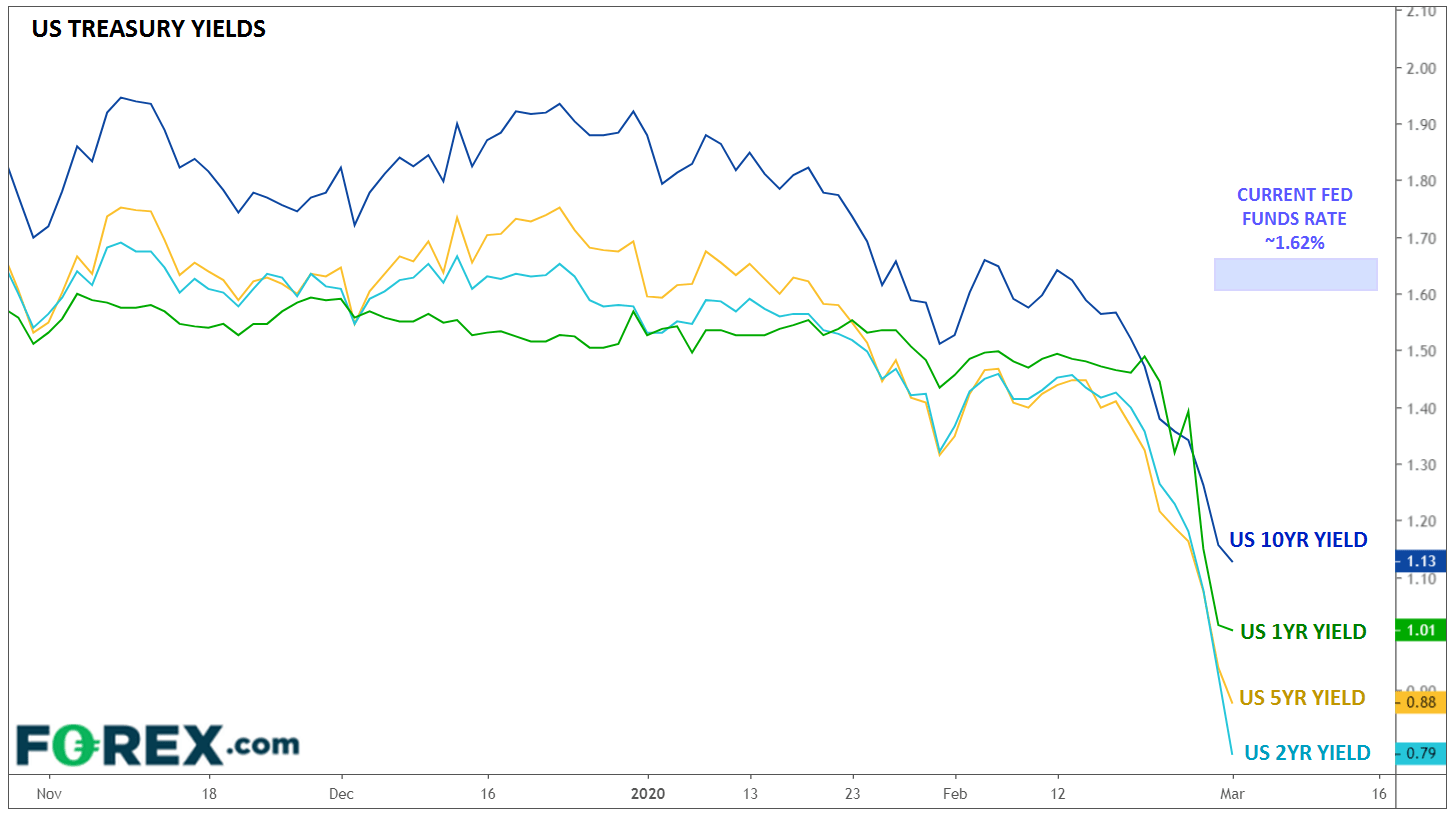
As the chart below shows, US interest rates have fallen off a cliff in recent days, with the 1-year, 2-year, 5-year, and 10-year tenors all shedding at least 40bps over the last two weeks alone.
Source: TradingView, GAIN Capital
For reference, the last time the Fed Funds rate was higher than the entire US yield curve (as we saw briefly last night) was in 2008, in the midst of the Great Financial Crisis. At the moment, the March Fed Funds rate is trading at 1.25%, nearly 40 bps below the current Fed funds rate of 1.62%, signaling that traders believe the central bank will be cutting interest rates dramatically and rapidly, perhaps as soon as today or later this week.
Make no mistake: situations like this are exactly why the Federal Reserve raised interest rates off 0% over the last few years, and the central bank will not be afraid to use the (limited) ammo it has at its disposal. Indeed, the Fed could very well take interest rates below 1.00% this summer in an effort to cushion the blow of coronavirus-related economic disruptions.
For the FX market, this means that the US dollar’s relative yield advantage over its G10 rivals could soon evaporate, and traders have been consistently selling the greenback as a result. After probing 100.00 less than two weeks ago, the US Dollar Index has fallen six of the past seven days to trade back at its 200-day EMA near 97.75.
If the Fed does follow through with a 50bps interest rate cut, either this week or at its regularly-scheduled meeting in two weeks’ time, the dollar could finally bounce in a “sell-the-rumor-buy-the-news” reaction. That said, the near-term momentum has clearly shifted in favor of the bears, and if the dollar index breaks below its 200-day EMA near 97.70, a move toward the bottom of the 1-year range near 96.00 could be next.
Source: GAIN Capital, TradingView
Related tags:




Open an account in minutes
Experience award-winning platforms with fast and secure execution.
Economic calendar
Web Trader platform
Our sophisticated web-based platform is packed with features.
Related articles

EUR/USD Forecast: Euro Under Pressure After Strong NFP Data
As the trading week comes to an end, the euro has once again struggled to sustain a meaningful recovery against the U.S. dollar, highlighting renewed weakness within EUR/USD price action. During the final trading session of the week, the pair declined nearly 0.7%, reflecting that confidence around the European currency remains limited in the short term.


Dollar forecast: NFP provides dollar, already supported amid tech sell-off, additional boost
The US dollar has found some mild amid the tech rout in recent days, most visibly against risk sensitive and commodity dollars. Today, we have so far seen a bit of a recovery in global indices from their overnight lows. Investors will be watching the markets to see whether fresh losses will be on the again once Wall Street gets going. Ahead of that, we have just seen the release of the October US non-farm payrolls report – and it was much stronger at 165K than expected.

EUR/USD Analysis: Euro Confidence Remains Limited After the ECB
The trading week is approaching its end and, for now, a neutral tone continues to dominate the euro's short-term price action. EUR/USD has recorded a move of only around -0.15% during the week, highlighting the pair's inability to establish a clear direction in favor of either the euro or the U.S. dollar.
StoneX Financial Ltd (trading as "FOREX.com") is an execution-only service provider. This material, whether or not it states any opinions, is for general information purposes only and it does not take into account your personal circumstances or objectives. This material has been prepared using the thoughts and opinions of the author and these may change. However, FOREX.com does not plan to provide further updates to any material once published and it is not under any obligation to keep this material up to date.
This material is short term in nature and may only relate to facts and circumstances existing at a specific time or day. Nothing in this material is (or should be considered to be) financial, investment, legal, tax or other advice and no reliance should be placed on it. No opinion given in this material constitutes a recommendation by FOREX.com or the author that any particular investment, security, transaction or investment strategy is suitable for any specific person.
The material has not been prepared in accordance with legal requirements designed to promote the independence of investment research. Although FOREX.com is not specifically prevented from dealing before providing this material, FOREX.com does not seek to take advantage of the material prior to its dissemination. This material is not intended for distribution to, or use by, any person in any country or jurisdiction where such distribution or use would be contrary to local law or regulation. For further details see our full non-independent research disclaimer and quarterly summary.