



AUD/USD Outlook: Inflation shifts RBA bets, but tech earnings drive the Aussie
Australia’s CPI report was strong on the surface, softer underneath. Traders cut RBA hike odds, but AUD/USD stayed elevated as risk sentiment and tech earnings dominate.
Share this:

- Headline CPI jumps 1.1% in March, annual pace accelerates to 4.6%
- Quarterly trimmed mean at 0.8% undershot RBA forecasts
- Three RBA hikes still favoured this year despite softer May pricing
- Risk appetite may matter more than rates for AUD/USD
Summary
Australian inflation accelerated sharply in March as the early impact of the Iran war flowed through via higher energy prices, but the overall result was not as severe as feared and underlying measures did not materially worsen. That helped trim expectations for the scale of further RBA tightening, although markets still see a high chance of a hike next week with another two moves largely priced by year-end.
For AUD/USD, the inflation report triggered only a brief dip, suggesting rate expectations are not the main driver right now. Instead, the Aussie appears more tied to broader risk sentiment, leaving the near-term focus on US tech earnings, the FOMC decision and whether the pair can hold above former resistance near .7158.
Hot headline, calmer underneath… for now
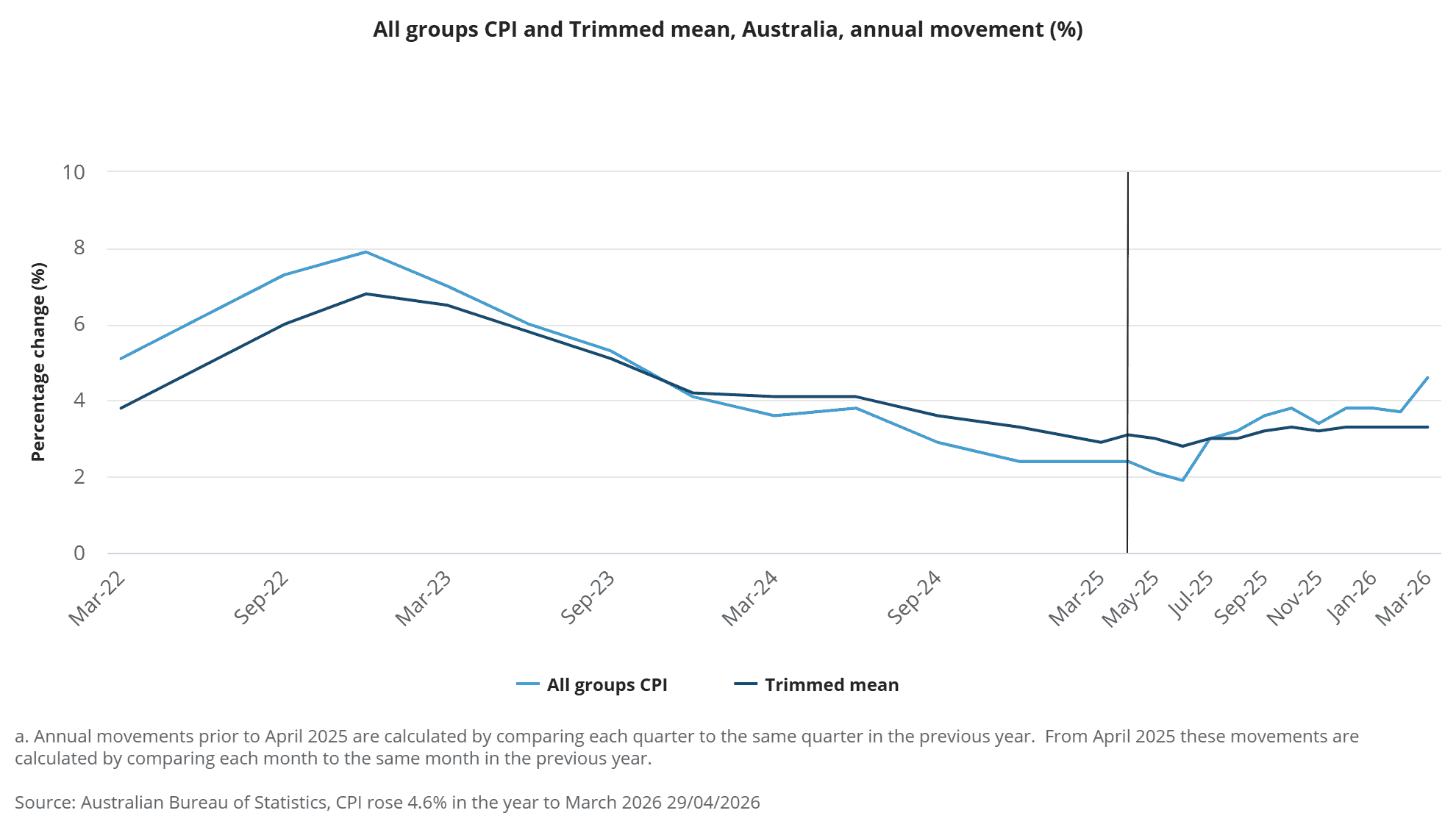
Headline inflation jumped 1.1% in March, leaving the increase from a year earlier at 4.6%, two tenths beneath the median economist forecast of 4.8%. The monthly gain was driven primarily by a 32.8% surge in automotive fuel prices, the largest increase since the series began in 2017, reflecting the earlier spike in global energy prices tied to the Iran conflict. Housing also remained a major contributor, with electricity prices elevated following the expiry of government rebates.
Source: ABS
Of more importance to markets and the RBA, underlying price pressures remained relatively contained, albeit at uncomfortably high levels. Trimmed mean inflation, which measures the average price increase across the ABS basket once the top and bottom 15% of weighted price moves are removed, rose 0.3% over the month, up from 0.2% in February but in line with market expectations. From a year earlier, it remained at 3.3%.
With the monthly inflation series only relatively new in Australia, the RBA continues to place heavy weight on quarterly trimmed mean outcomes, the measure it relied on before the monthly series was introduced late last year. While still running at levels inconsistent with the Bank achieving its 2.5% inflation target, the good news was the 0.8% quarterly outcome was a tenth below both the RBA and median economist forecast, slowing slightly from the 0.9% pace seen in the final quarter of last year. From a year earlier, this key inflation measure ticked up to 3.5%, in line with forecasts and a tenth above the prior quarter.
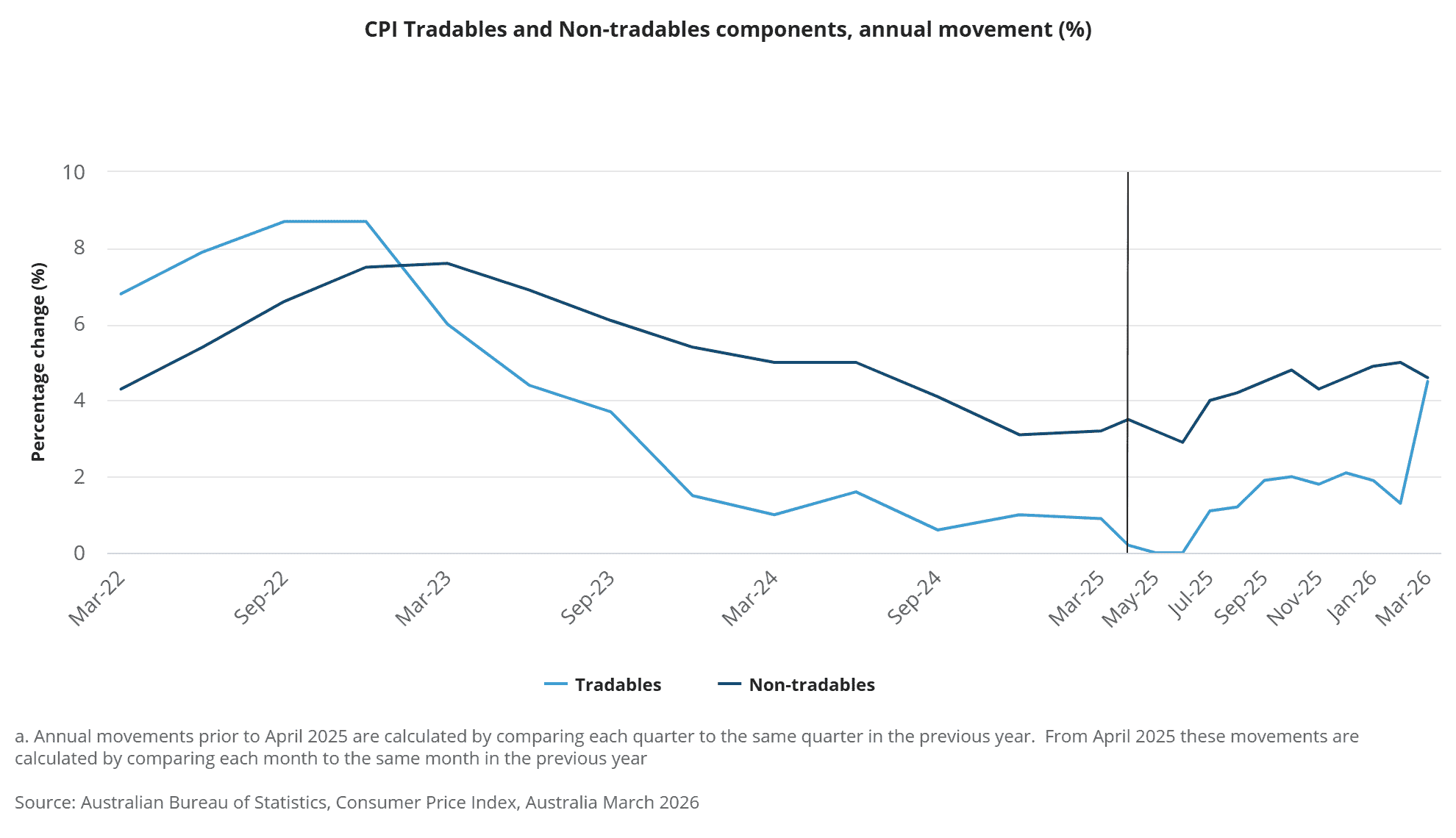
There was clear evidence of an early Iran war pass through in the trade-exposed parts of the basket. Annual tradables inflation, covering items more exposed to global pricing forces such as fuel, food, clothing and footwear, jumped to 4.5% in March from 1.3% in February.
By contrast, annual non-tradables inflation, covering areas driven more by domestic factors such as housing and education, eased to 4.6% from 5.0%. Electricity, new dwellings and rents remained the key contributors, suggesting home-grown price pressures are still elevated even if the pace is cooling gradually.
Source: ABS
The same split was visible in goods and services. Annual goods inflation accelerated sharply to 5.5% from 3.5%, while annual services inflation slowed to 3.6% from 3.9%, with rents and medical and hospital services the main contributors. Services inflation looked to have topped out prior to the Iran war, but the key question now is how quickly higher energy prices begin to spill into broader domestic pricing pressures.
That is the main caveat with this report. It captures only the early impact of the Iran war on prices, which naturally hits tradable goods first. What matters now is how long higher energy prices remain in place. The longer they persist without causing an immediate hit to demand and activity, the greater the risk the inflation pulse from tradable goods spreads elsewhere through higher inflation expectations, stronger wage demands and broader second round effects.
Softer core tempers RBA May pricing

Source: TradingView
On the back of the data, implied probability of an RBA rate hike in May fell marginally, according to interbank futures markets, easing from above 90% to 83%. Traders know Australia had an inflation problem before the war started, the question now is how much worse it will become in the June and September quarters. As such, beyond the high probability of a hike next week, another two are nearly fully priced by the end of the year, an outcome that would leave the cash rate at 4.85% if realised.
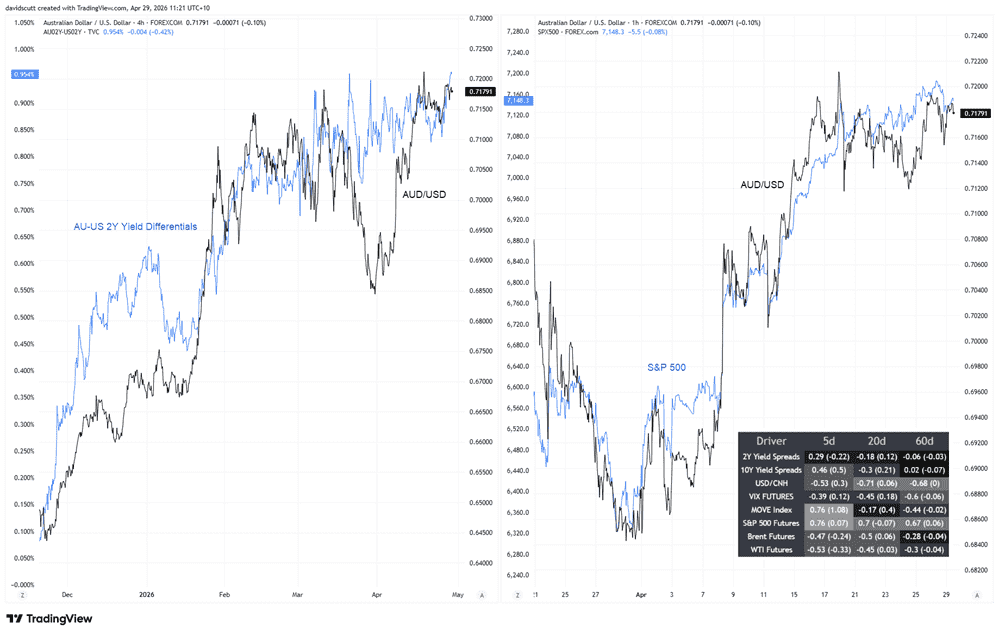
Mirroring the pullback in rate hike probabilities for May, AUD/USD dipped following the release of the inflation report, although it is notable the weakness was not acute by any means. That is probably because the Aussie has been more sensitive to risk appetite recently rather than rate differentials.
Risk appetite over rates
Source: TradingView
As seen in the correlation matrix insert on the chart above, multiple drivers appear to be competing for influence over Aussie dollar direction right now, with AUD/USD demonstrating a modest correlation with yield differentials and risk appetite, along with a reasonable negative relationship with energy prices and USD/CNH over the past week.
However, while the correlation with the yuan has softened a touch, the link with risk appetite, as proxied by S&P 500 futures, has strengthened, suggesting it is currently the primary driver of the pair’s performance. That places just as much emphasis on earnings updates from Alphabet, Amazon, Microsoft and Meta over the next 24 hours as on the FOMC monetary policy decision.
AUD/USD nears support zone
Source: TradingView
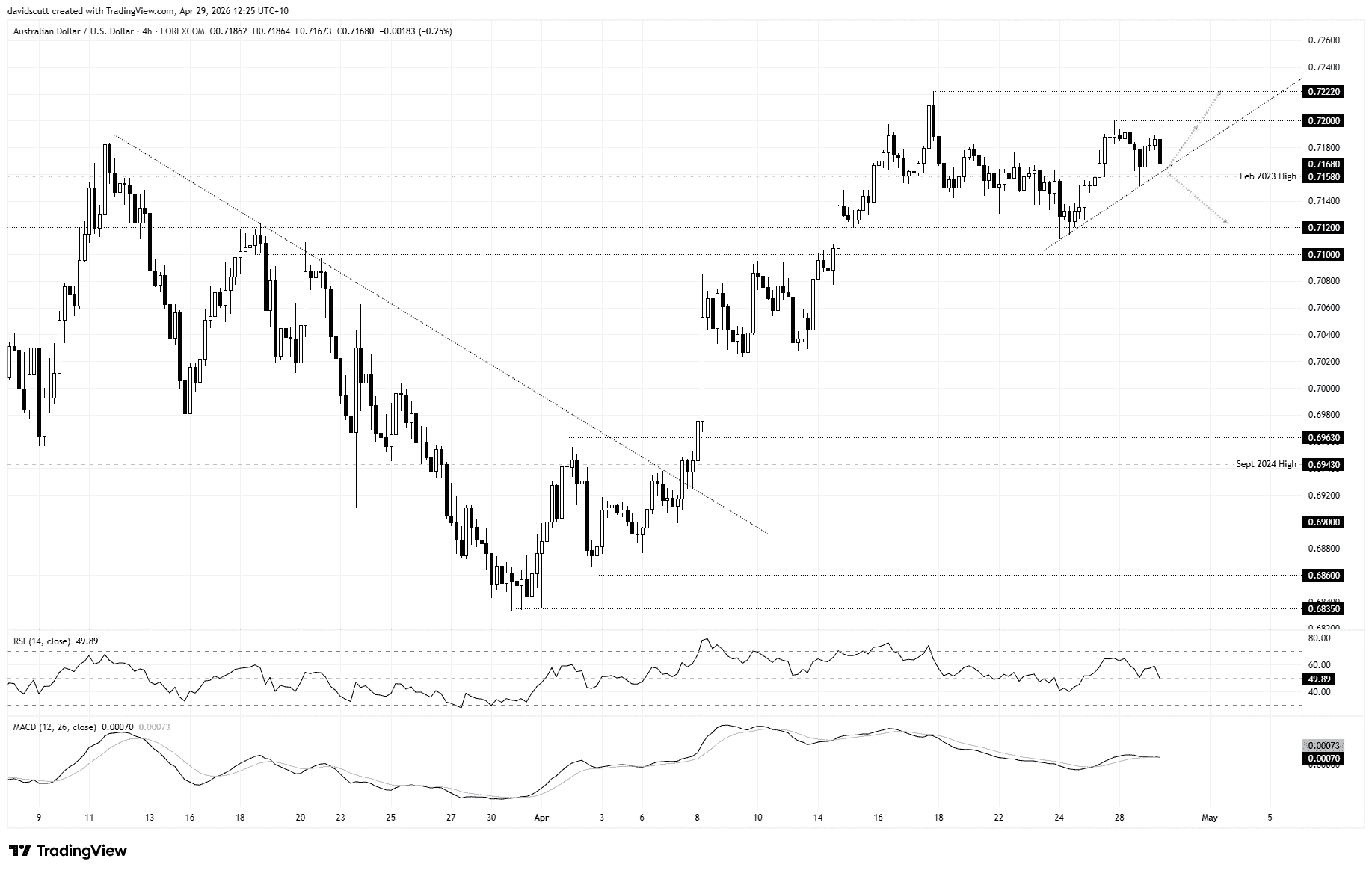
Despite the latest pullback, AUD/USD continues to grind higher on the H4 chart, remaining just beneath the multi-year high of .7222 set earlier this month. It now sits just above the February 2023 swing high of .7158, a level it has spent ample time around over the past fortnight.
With the oscillators pointing to waning upside strength while remaining in neutral territory, the preference remains to keep an open mind on both long and short setups, placing greater emphasis on the price action to guide direction.
On the downside, the intersection of the February 2023 high with minor uptrend support established earlier this month makes for a decent level to build setups around should the price return there. A test and bounce would allow for longs to be set with a tight stop below, targeting .7200 initially and the March high of .7222 after that.
But if the price were to break beneath the intersection and hold there, shorts could be set with a tight stop above, targeting .7120 or .7100, with .7150 a reference point located in between.


Open an account in minutes
Experience award-winning platforms with fast and secure execution.
Economic calendar
Web Trader platform
Our sophisticated web-based platform is packed with features.
Related articles
Gold weekly outlook: XAU/USD finally finds support but overhead resistance looms
The gold outlook remains uncertain following year-long selling. While the recent rebound is a welcome sign, this could just turn out to be an oversold bounce.

Nasdaq 100 forecast: Stocks rebound, but have markets found a floor?
US equities have recovered sharply after last week’s bruising sell-off, as confidence in Nvidia draws investors back into technology stocks. But a busy economic calendar, led by the November jobs report, will test whether the rebound has legs.

US dollar outlook: Fed hike priced | FOREX Friday
A December Fed rate hike looks fully priced in, as the dollar stays below this week's highs despite strong US data, while gold, silver and the EUR/USD rebound. Fawad Razaqzada explains why next week's jobs report is the main event, and the Dollar Index levels to watch.
StoneX Financial Ltd (trading as "FOREX.com") is an execution-only service provider. This material, whether or not it states any opinions, is for general information purposes only and it does not take into account your personal circumstances or objectives. This material has been prepared using the thoughts and opinions of the author and these may change. However, FOREX.com does not plan to provide further updates to any material once published and it is not under any obligation to keep this material up to date.
This material is short term in nature and may only relate to facts and circumstances existing at a specific time or day. Nothing in this material is (or should be considered to be) financial, investment, legal, tax or other advice and no reliance should be placed on it. No opinion given in this material constitutes a recommendation by FOREX.com or the author that any particular investment, security, transaction or investment strategy is suitable for any specific person.
The material has not been prepared in accordance with legal requirements designed to promote the independence of investment research. Although FOREX.com is not specifically prevented from dealing before providing this material, FOREX.com does not seek to take advantage of the material prior to its dissemination. This material is not intended for distribution to, or use by, any person in any country or jurisdiction where such distribution or use would be contrary to local law or regulation. For further details see our full non-independent research disclaimer and quarterly summary.