



Eight Markets to Watch if the Coronavirus Outbreak Worsens
We highlight eight markets that are already moving in response to the coronavirus epidemic
Share this:

Earlier today we outlined the one big reason that traders may still be underestimating the risks from coronavirus, noting that, “at its current growth clip, coronavirus could exceed the SARS infection figures by Wednesday and more than double them by Friday.” While time will tell if and when authorities are ultimately able to contain the outbreak, traders are already starting to position for an adverse scenario.
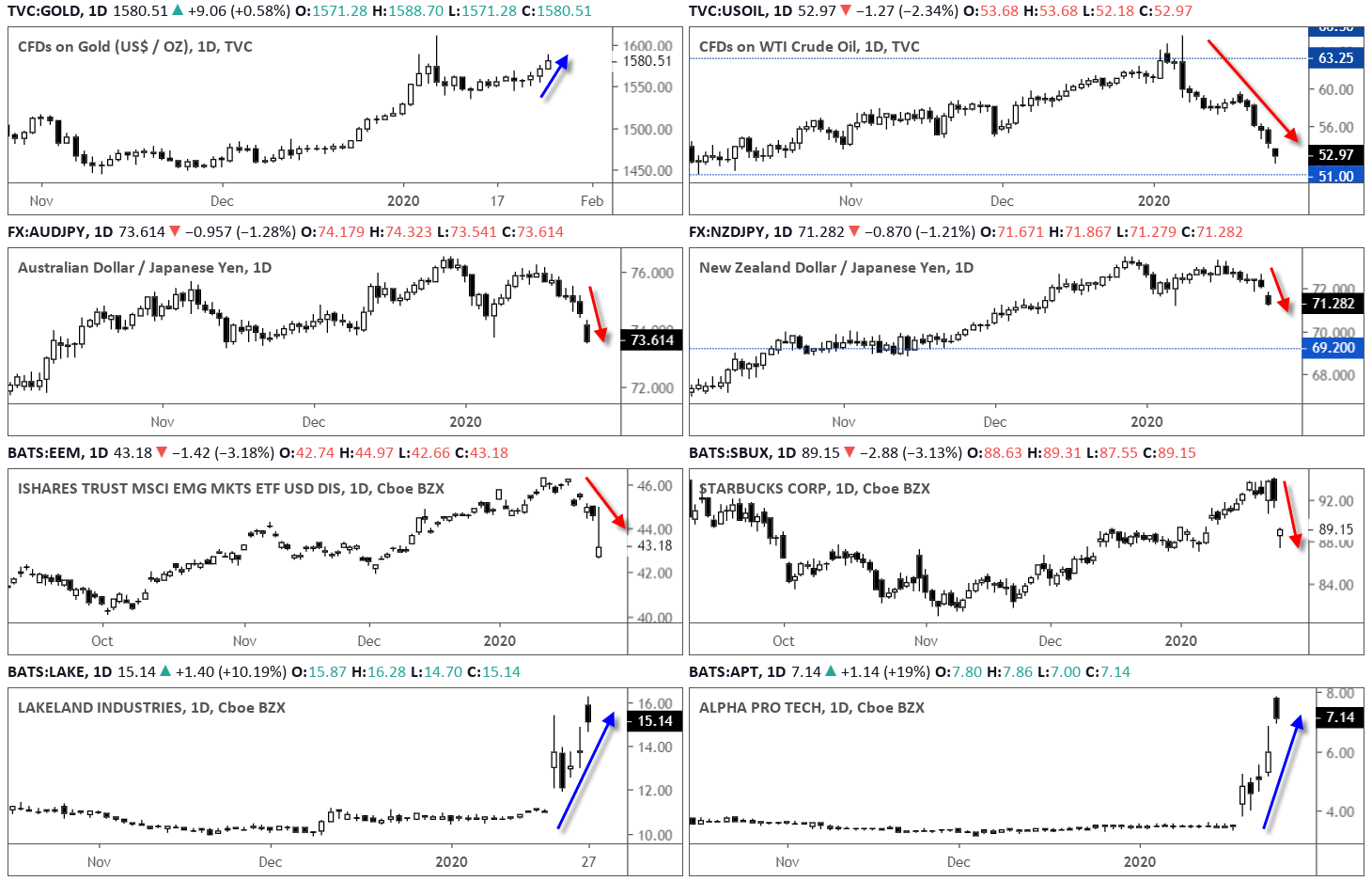
Below, we highlight eight markets that are already moving in response to the coronavirus epidemic:
1) Gold
The world’s ultimate safe haven asset is fulfilling its normal role during times of uncertainty, with the yellow metal trading about 0.5% higher as of writing and on track for its highest close since 2013.
2) Oil
Both major oil contracts are falling by about -2% on the day to hit their lowest levels in nearly 3 months. Obviously, any contraction in economic activity could decrease demand for petroleum, which is also plagued by oversupply issues despite production cuts from OPEC.
3) Safe Haven and Risk-Sensitive Currencies
As my colleague Joe Perry noted earlier today, the risk-off move is driving traders out of growth-sensitive major currencies such as the Australian and New Zealand dollars and into perceived “safe haven” currencies including the Japanese yen and Swiss franc. As such, crosses like AUD/JPY and NZD/JPY may be particularly vulnerable among the G10 currencies, with emerging Asian currencies like the Singapore Dollar, Indian Rupee, Thai Bhat, and Russian Ruble potentially seeing spillover volatility.
4) Emerging Markets
In addition to China, many emerging market funds have heavy exposure to other fast-growing countries in Southeast Asia that could be hit disproportionately hard by further limitations to travel and commerce. To take just one prominent example, the $31B iShares Emerging Markets ETF (EEM) is trading off by -3% on the day.
5) Consumer Companies with Substantial Business in China
Analysts have noted that the untimely closure of Shanghai Disneyland and many theatres across the country could impact Walt Disney Company (DIS, -2%). Similarly, Starbucks (SBUX, -3%) has closed all of its stores in the Wuhan and Hubei provinces. In more traditional consumer goods, Nike (NKE, -2%) derives more than $6B in revenue from Greater China and could be particularly vulnerable following last year’s tensions surrounding the NBA.
6) Airline Stocks
Fearing the potential negative impact on travel and tourism, traders are selling airline stocks aggressively. Among the three major US airlines, each of Delta (DAL, -3%) American (AAL, -5%), and United Airlines (UAL, -5%) are shedding more than 3% on the day. Chinese-based airlines like China Eastern (CEA) and China Southern Airlines (ZNH) have sold off by -7% as of writing
7) Other Travel-Related Stocks
Beyond the airlines, traders fear that a continued outbreak could hurt other travel-related companies. Hotel operators like Marriott International (MAR, -1%), Hyatt Hotels (H, -0.5%), Hilton Worldwide (HLT, -3%) are all falling, as are cruise lines like Carnival Corporation (CCL, -4%) Royal Caribbean (RCL, -7%) and Norwegian Cruise Lines (NCLH, -3%).
8) Medical Safety Equipment Stocks
Of course, the outbreak will also create a number of short-term winners, primarily among firms producing safety equipment for medical workers and other citizens. Names in that space include Alpha Pro Tech (APT, +19%), a mask manufacturer, and Lakeland Industries (LAKE, +10%), which creates protective clothes for high-risk workers.
Source: TradingView, GAIN Capital. Please note that these instruments may not be available in all regions.
Latest market news




Open an account in minutes
Experience award-winning platforms with fast and secure execution.
Economic calendar
Web Trader platform
Our sophisticated web-based platform is packed with features.
Related articles
Silver Update: XAG/USD Falls Below $40 as Selling Pressure Accelerates
Trading conditions continue to be particularly challenging for the silver market in the short term. This can be clearly seen in recent XAG/USD price action, with the metal losing more than 10% of its value over the last two trading sessions alone.

Gold Forecast: Gold Loses $3500 as Tariff Fears and Inflation Revive Rate Concerns
Gold is extending its decline today, falling below $3500 as traders digest fresh tariff threats, a technology-led stock selloff, and another firm U.S. inflation reading - what are the next levels to watch?

Nasdaq 100 Forecast: Nasdaq plunges as Nvidia selloff continues
U.S. stocks are falling sharply as the sell-off in AI stocks continues, amid concerns around fresh U.S. tariff proposals and after hotter-than-expected U.S. inflation data.

StoneX Financial Ltd (trading as "FOREX.com") is an execution-only service provider. This material, whether or not it states any opinions, is for general information purposes only and it does not take into account your personal circumstances or objectives. This material has been prepared using the thoughts and opinions of the author and these may change. However, FOREX.com does not plan to provide further updates to any material once published and it is not under any obligation to keep this material up to date.
This material is short term in nature and may only relate to facts and circumstances existing at a specific time or day. Nothing in this material is (or should be considered to be) financial, investment, legal, tax or other advice and no reliance should be placed on it. No opinion given in this material constitutes a recommendation by FOREX.com or the author that any particular investment, security, transaction or investment strategy is suitable for any specific person.
The material has not been prepared in accordance with legal requirements designed to promote the independence of investment research. Although FOREX.com is not specifically prevented from dealing before providing this material, FOREX.com does not seek to take advantage of the material prior to its dissemination. This material is not intended for distribution to, or use by, any person in any country or jurisdiction where such distribution or use would be contrary to local law or regulation. For further details see our full non-independent research disclaimer and quarterly summary.